

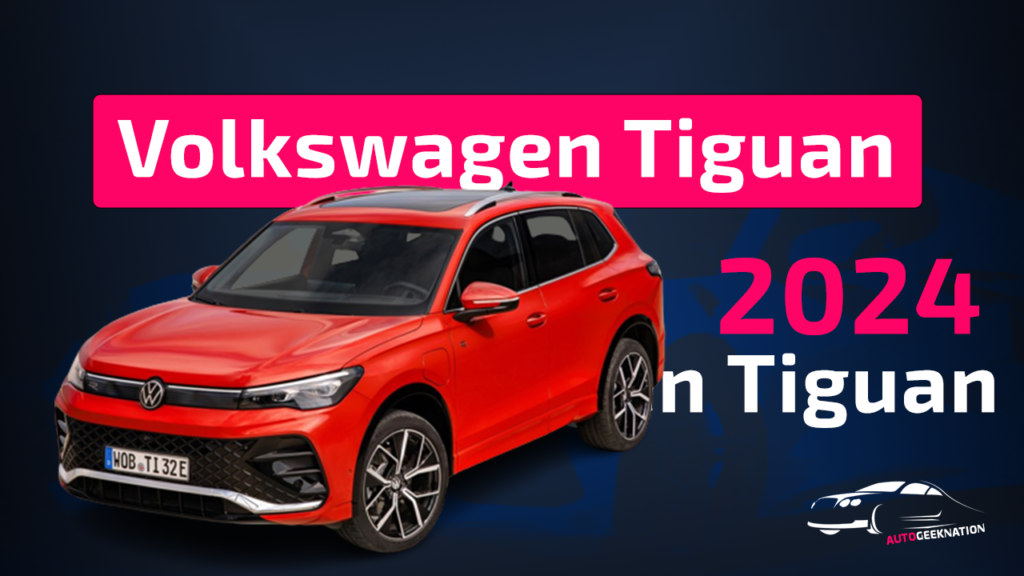
The Volkswagen Tiguan has entered its third generation with a major redesign, updated technology and a broader range of powertrains. First unveiled in 2023, the latest Tiguan went on sale in Europe in 2024 and is now an established production model rather than an upcoming SUV.
Volkswagen says more than 7.6 million Tiguan vehicles had been sold worldwide since the model’s introduction in 2007, making it one of the company’s most successful SUVs.
The new generation keeps the Tiguan’s familiar compact-SUV concept but adds a more sophisticated interior, improved aerodynamics, new plug-in hybrid technology, updated driver assistance systems and optional chassis technology aimed at improving both comfort and handling.
Volkswagen Tiguan – official Volkswagen information
A New Tiguan Based on MQB evo
The third-generation Tiguan is built on the latest evolution of Volkswagen’s MQB modular platform, known as MQB evo.
This architecture allows Volkswagen to use several types of propulsion in the same vehicle family, including petrol, diesel, mild-hybrid and plug-in-hybrid systems.
That flexibility is one of the defining characteristics of the new Tiguan. Instead of forcing buyers into one type of powertrain, Volkswagen continues to offer different solutions depending on market and customer requirements.
The result is a Tiguan that can be configured as an efficient mild hybrid for everyday driving, a diesel for long-distance use, or a plug-in hybrid for drivers who can regularly charge at home or at work.
Tiguan eHybrid: Plug-In Hybrid With Around 100 km of Electric Range
One of the most important changes is the latest Tiguan eHybrid.
Volkswagen developed two plug-in hybrid versions for the third-generation Tiguan, using a 1.5-litre turbocharged petrol engine combined with an electric motor and a larger battery than the previous generation.
Depending on equipment and configuration, Volkswagen announced an all-electric range of around 100 km, a substantial increase over the previous generation.
The eHybrid system is designed to cover many daily journeys using electric power while retaining the petrol engine for longer trips.
This makes the system fundamentally different from a conventional mild hybrid. A mild-hybrid Tiguan cannot normally cover an extended commute using electricity alone, whereas the eHybrid is specifically designed for meaningful electric-only driving.
DC Fast Charging Comes to the Tiguan eHybrid
Another significant improvement is charging.
Volkswagen introduced DC fast charging as standard for the new eHybrid versions, something that was not available on the previous generation in the same way. AC charging was also improved.
For owners who regularly use public charging stations, this can make the plug-in hybrid considerably more convenient.
However, the benefit depends heavily on how the vehicle is used. An eHybrid makes the most sense when the driver has regular access to charging. Without frequent charging, the additional complexity and weight of a plug-in hybrid system provide less practical benefit.
Petrol, Diesel and Mild-Hybrid Options
The third-generation Tiguan isn’t an electric-only or plug-in-only SUV.
Volkswagen continues to offer several propulsion technologies, depending on the market:
- TSI turbocharged petrol engines
- eTSI 48-volt mild-hybrid petrol engines
- TDI turbocharged diesel engines
- eHybrid plug-in hybrid systems
At the European launch, the eTSI versions were offered with 130 PS and 150 PS, while a 150-PS TDI was also available.
Current Volkswagen UK specifications, for example, list a 1.5-litre petrol range, a 2.0-litre diesel and plug-in-hybrid versions producing 204 PS or 272 PS, depending on configuration.
The exact engine lineup varies by country, so buyers should not assume that every Tiguan market receives the same powertrains or trims.
How Big Is the New Tiguan?
The new Tiguan became slightly longer, but Volkswagen deliberately kept its basic proportions close to the previous model.
The third generation is approximately three centimetres longer, while its width, height and wheelbase remain broadly similar to its predecessor.
This is important because Volkswagen increased interior practicality without turning the Tiguan into a much larger SUV.
The luggage compartment is one of the clearest examples.
652-Litre Boot
Volkswagen increased the Tiguan’s luggage capacity by 37 litres, bringing the official capacity to 652 litres when measured up to the height of the rear seat backrests.
Current Volkswagen UK technical information also lists a 652-litre boot volume for several petrol and diesel versions.
For families, this is arguably more important than a small increase in exterior dimensions. The additional luggage capacity makes the Tiguan better suited to everyday family use, airport trips and longer journeys.
Interior: A More Digital Tiguan
The cabin is one of the biggest visual changes.
The third-generation Tiguan introduces a redesigned cockpit featuring a Digital Cockpit, a central infotainment display and an optional head-up display.
Volkswagen also redesigned the user interface around the fourth-generation MIB4 infotainment system, with access to navigation, digital services and applications. The IDA voice assistant allows occupants to control certain vehicle and infotainment functions using natural-language commands.
The system is intended to reduce the need to navigate through complicated menus while driving.
As with other modern Volkswagen models, however, equipment and screen sizes depend on the selected trim and market.
Driving Experience Switch
Another distinctive feature is the multifunction driving experience switch.
The rotary controller incorporates an OLED display and allows the driver to adjust vehicle settings and driving modes.
The system is particularly useful on versions equipped with the optional adaptive chassis system because it can change the vehicle’s driving characteristics without requiring the driver to navigate through several touchscreen menus.
DCC Pro: More Sophisticated Adaptive Suspension
The new Tiguan also introduced DCC Pro, Volkswagen’s more advanced adaptive chassis control system.
Unlike a conventional single-valve adaptive damper, DCC Pro uses two-valve dampers, allowing Volkswagen to control compression and rebound characteristics more precisely.
The system is designed to provide a wider range between comfort and dynamic driving.
In a softer setting, the suspension can prioritize ride comfort. In more dynamic modes, the dampers can provide greater body control.
Volkswagen also introduced a Vehicle Dynamics Manager as part of the MQB evo chassis technology. The system coordinates functions such as electronic differential-lock intervention and, where fitted, the controlled dampers.
IQ.LIGHT HD Matrix Headlights
The new Tiguan can also be equipped with IQ.LIGHT HD matrix headlights, technology Volkswagen positioned as a major lighting upgrade.
The system uses individually controllable light elements to adapt the illumination pattern to driving conditions while helping maintain visibility without unnecessarily dazzling other road users.
Volkswagen presented the system as technology derived from the premium Touareg and adapted for the new Tiguan.
This is one of the features that demonstrates how equipment previously associated with more expensive Volkswagen models has gradually moved into the brand’s compact and mid-size vehicles.
More Comfortable Seats
The Tiguan’s optional ergoActive front seats are another major comfort feature.
They can include:
- Pneumatic lumbar adjustment
- A 10-chamber pneumatic massage function
- Seat heating
- Seat ventilation
- Additional adjustment functions
Volkswagen specifically highlighted the 10-chamber massage system as a premium-oriented feature introduced to improve long-distance comfort.
For a family SUV that may spend several hours on motorways, these features are arguably more useful than purely cosmetic equipment.
Driver Assistance and Parking Technology
The third-generation Tiguan comes with a broad range of assistance systems.
Depending on specification and market, these include:
- Front Assist
- Lane Assist
- Side Assist
- Rear View camera
- Dynamic Road Sign Display
- Exit Warning
- Adaptive cruise-related assistance
- Park Assist
- Trailer Assist
Volkswagen also offers Park Assist Pro, which can support automated parking and, in compatible configurations, allow the driver to control certain parking manoeuvres remotely using a smartphone.
The availability of these systems varies by trim and market, so they should not all be considered standard equipment on every Tiguan.
Five-Star Euro NCAP Safety Rating
The new Tiguan received a five-star Euro NCAP safety rating in 2024.
Volkswagen reported particularly strong results for child occupant protection and highlighted the SUV’s accident-prevention and assistance technologies. The latest Tiguan also includes rear side airbags as standard in the tested European configuration.
A five-star rating is useful information for family buyers, although the exact safety equipment of an individual vehicle can still vary according to market and specification.
Aerodynamics: From 0.33 to 0.28
Volkswagen also paid considerable attention to the Tiguan’s aerodynamics.
The drag coefficient was reduced from approximately 0.33 to 0.28.
The redesigned front end includes flatter LED headlights, a horizontal visual element and air curtains intended to improve airflow around the front wheels.
At the rear, a horizontal LED light signature gives the SUV a wider visual appearance.
These aerodynamic changes are not simply cosmetic. Reducing aerodynamic drag can help improve efficiency, particularly at higher road speeds, although actual fuel consumption or electric range will still depend on the powertrain, wheels, weather and driving conditions.
Is the New Tiguan Electric?
No — and this distinction is important.
The third-generation Tiguan is not a fully electric SUV.
Volkswagen offers several electrified versions, including 48V mild-hybrid eTSI engines and plug-in hybrid eHybrid models, but these remain different from Volkswagen’s dedicated battery-electric ID models.
The eHybrid can drive on electric power for a substantial distance, but it still has a petrol engine and a fuel tank for longer journeys.
Tiguan vs Fully Electric Volkswagen SUVs
For buyers considering an electric Volkswagen, the Tiguan occupies a different position from models in the ID family.
The Tiguan’s advantage is flexibility. A plug-in hybrid can cover many short journeys electrically while retaining the ability to travel long distances without depending entirely on public charging infrastructure.
A fully electric Volkswagen, by contrast, eliminates the combustion engine altogether but requires access to suitable charging infrastructure for longer journeys.
The better choice therefore depends less on the badge and more on how the vehicle will actually be used.
What Makes the Third-Generation Tiguan Different?
The latest Tiguan is not a revolutionary change in terms of its basic purpose. It remains a practical Volkswagen compact SUV.
The significant changes are underneath and inside:
- New MQB evo architecture
- Petrol, diesel, mild-hybrid and plug-in-hybrid powertrains
- Around 100 km of electric range for eHybrid versions under the relevant official test configuration
- DC fast charging for the eHybrid
- 652-litre luggage capacity
- New MIB4 infotainment system
- Digital Cockpit
- Optional head-up display
- DCC Pro adaptive suspension
- IQ.LIGHT HD matrix headlights
- Advanced driver-assistance systems
- Optional ergoActive massage seats
- Five-star Euro NCAP safety rating
Together, these changes make the third-generation Tiguan a considerably more technologically advanced SUV than the model it replaces.
Is the Volkswagen Tiguan Still a Good Family SUV?
The answer depends on what you need from an SUV, but the third-generation Tiguan has a strong practical argument.
Its relatively compact exterior dimensions are combined with a 652-litre luggage compartment, five-seat layout and multiple powertrain options. The availability of a plug-in hybrid is particularly interesting for drivers who can charge regularly but still need the flexibility of a petrol engine for longer journeys.
The eTSI versions may make more sense for drivers who don’t have access to charging, while the TDI remains relevant in markets where diesel is still popular for high-mileage driving.
The important point is that Volkswagen hasn’t tried to make every Tiguan buyer follow the same electrification path.
Final Verdict
The third-generation Volkswagen Tiguan represents an evolution of a successful formula rather than a complete departure from it.
Its biggest improvements are practical and technological: more luggage space, a significantly redesigned cabin, modern infotainment, improved driver assistance, more sophisticated suspension and a new generation of plug-in hybrid powertrains.
The eHybrid is arguably the most interesting version for drivers who want meaningful electric-only driving without giving up the convenience of a combustion engine for longer trips.
Meanwhile, petrol, mild-hybrid and diesel versions keep the Tiguan relevant for buyers with different driving patterns.
The result is a compact SUV that remains recognizably a Tiguan while offering substantially more technology and powertrain choice than previous generations.
FAQ
When did the third-generation Volkswagen Tiguan arrive?
Volkswagen unveiled the third-generation Tiguan in September 2023, with the model reaching European markets in the first quarter of 2024. It is now an established production model.
How many people can the Volkswagen Tiguan seat?
The standard Tiguan is a five-seat SUV. The third generation focuses on improving space and luggage capacity rather than adding a third row.
How big is the Tiguan’s boot?
The third-generation Tiguan has an official luggage capacity of 652 litres when measured to the height of the rear seat backrests.
Is the Tiguan available as a plug-in hybrid?
Yes. The Tiguan eHybrid combines a turbocharged petrol engine with an electric motor and battery. Volkswagen developed the new system to provide around 100 km of electric range, depending on configuration and equipment.
Can the Tiguan eHybrid use DC fast charging?
Yes. One of the major changes for the third generation is the introduction of DC fast charging for the eHybrid, alongside faster AC charging.
Does the Volkswagen Tiguan have diesel engines?
Yes, diesel remains available in selected markets. For example, Volkswagen UK currently lists a 2.0-litre diesel producing 150 PS.
What is DCC Pro on the Tiguan?
DCC Pro is Volkswagen’s optional adaptive suspension system using two-valve dampers. It is designed to provide more precise control over suspension characteristics between comfort and dynamic driving modes.
Does the Tiguan have matrix LED headlights?
Yes. The third generation can be equipped with IQ.LIGHT HD matrix headlights, depending on market and trim.
Is the new Volkswagen Tiguan fully electric?
No. The Tiguan is available with combustion, mild-hybrid and plug-in-hybrid powertrains. Volkswagen’s fully electric SUVs are part of the separate ID family.
Is the new Tiguan safe?
The third-generation Tiguan received a five-star Euro NCAP safety rating in 2024.
Sources
- Volkswagen Newsroom – World Premiere of the Third-Generation Tiguan
- Volkswagen Newsroom – Tiguan European Market Launch
- Volkswagen Newsroom – Tiguan DCC Pro and eHybrid Technology
- Volkswagen UK – Tiguan Technical Data
- Volkswagen Newsroom – Tiguan Five-Star Euro NCAP Rating