

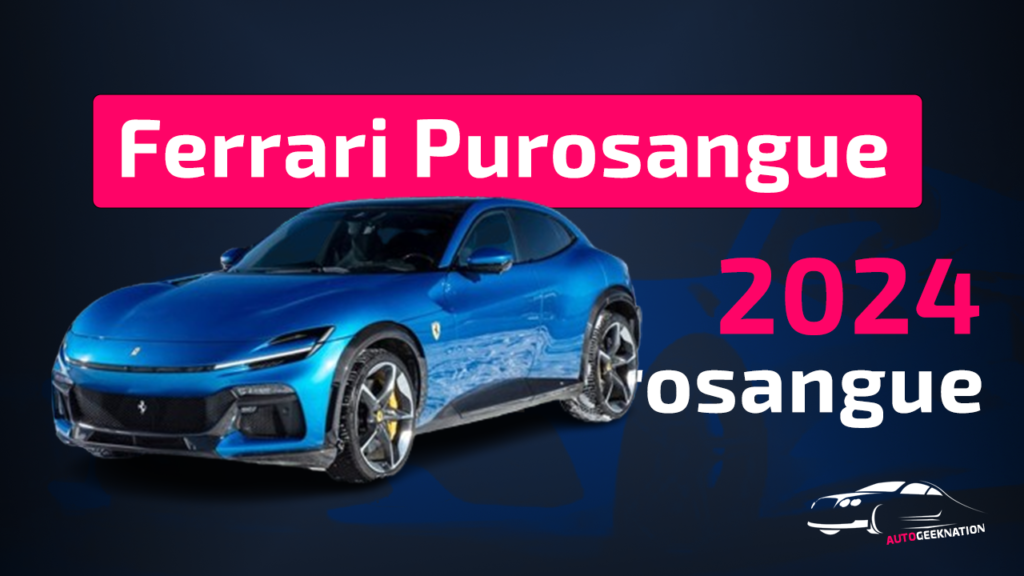
The Ferrari Purosangue changed the conversation around Ferrari when it arrived. For the first time, Maranello produced a four-door, four-seat car with the practicality of a higher-riding body while retaining a naturally aspirated V12 and the driving technology expected from a Ferrari.
Calling it simply Ferrari’s “first SUV” misses some of what makes the Purosangue unusual. Ferrari itself describes it as its first four-door, four-seat model, and its engineering philosophy is very different from that of a conventional luxury SUV.
The result is a car aimed at buyers who want space for four adults and more everyday usability without giving up the character of a high-performance Ferrari.
A Ferrari with four doors and four seats
The Purosangue is one of the biggest departures from Ferrari’s traditional sports-car formula.
Instead of the usual two-seat or 2+2 configuration, it provides four individual seats. Ferrari designed the car around easier access to the rear compartment, using rear-hinged rear doors that open in the opposite direction to the front doors.
These so-called “welcome doors” allow rear passengers to enter more easily without requiring the body to become excessively large.
The arrangement also makes the Purosangue fundamentally different from many performance SUVs. It is not simply a conventional SUV body fitted with a powerful Ferrari engine.
The seating position, low-slung proportions and chassis development were designed to preserve a strong connection between driver and car.
The naturally aspirated V12 remains the headline
At the heart of the Purosangue is a 6.5-litre naturally aspirated V12.
The engine produces:
- 725 cv
- 716 Nm of torque
- Maximum engine speed of 8,250 rpm
- 8-speed F1 dual-clutch transmission
- Naturally aspirated combustion with no turbocharger
Ferrari quotes 725 cv at 7,750 rpm and 716 Nm at 6,250 rpm. The engine uses a dry-sump lubrication system and technology derived from Ferrari’s V12 development programme.
That engine is one of the main reasons the Purosangue feels so different from the growing number of high-performance turbocharged and electrified luxury SUVs.
There is no small-displacement turbocharged V8 here. Ferrari chose to preserve the high-revving V12 character that has defined some of its most celebrated road cars.
Performance that rivals sports cars
Despite its size and four-seat layout, the Purosangue delivers serious performance.
Ferrari’s official specifications list:
- 0–100 km/h: 3.3 seconds
- 0–200 km/h: 10.6 seconds
- Top speed: over 310 km/h
- 100–0 km/h: 32.8 metres
The figures are remarkable considering that the Purosangue is a large four-seat car rather than a lightweight two-seat sports car.
Ferrari’s technical documentation lists a dry weight of approximately 2,033 kg with optional lightweight content, while the car has a 49:51 front-to-rear weight distribution.
That weight distribution is particularly important to the car’s dynamic character.
Ferrari did not simply concentrate on producing huge power. The engineering team also had to make the Purosangue behave like a Ferrari through corners and under braking.
Ferrari’s unusual active suspension
One of the most technically interesting aspects of the Purosangue is its suspension.
Ferrari introduced a completely new active suspension system using Multimatic’s True Active Spool Valve (TASV) technology.
Each corner uses a 48-volt electric motor integrated with a high-precision hydraulic damper. The system can actively control body and wheel movements rather than relying solely on conventional passive springs and dampers.
The suspension continuously monitors the car through accelerometers and position sensors.
It can then respond to:
- Body roll
- Pitch during acceleration and braking
- Wheel movement
- Road-surface irregularities
- Changes in cornering loads
Ferrari says the system can vary roll stiffness continuously and actively lower the roll centre by up to 10 mm, helping optimise the car’s behaviour in corners.
This is one of the technologies that separates the Purosangue from a conventional performance SUV.
Why Ferrari avoided conventional anti-roll-bar thinking
A conventional performance vehicle generally uses anti-roll bars as part of its strategy for controlling body roll.
The Purosangue instead uses its active suspension system to generate the required control electronically.
That gives Ferrari greater freedom to balance ride comfort and cornering behaviour.
The system can react at high frequency, controlling both body movement and wheel movement. This allows the Purosangue to absorb road imperfections while maintaining much tighter control during aggressive driving.
The technology was significant enough that Ferrari later adapted its active suspension concept for the much more extreme F80 supercar.
Four-wheel-drive technology
The Purosangue also uses Ferrari’s 4RM-S evo four-wheel-drive system as part of its electronic vehicle-dynamics package.
It works alongside Ferrari’s Side Slip Control 8.0, F1-Trac and ABS Evo systems to manage traction and stability.
The result is not intended to turn the Purosangue into an off-road vehicle. Instead, the four-wheel-drive system is part of Ferrari’s strategy for delivering traction and predictable handling while exploiting the V12’s considerable output.
That distinction is important: the Purosangue is engineered for high-performance road driving, not for competing with traditional off-road SUVs.
A carbon-fibre roof helps control weight
The Purosangue uses a carbon-fibre roof as standard.
This serves two purposes.
First, carbon fibre helps reduce weight compared with a conventional roof structure. Second, keeping weight higher up in the vehicle to a minimum helps lower the centre of gravity.
Ferrari also offers different roof configurations depending on customer preference and specification, including an electrochromic glass roof option.
For a vehicle of this size, controlling the mass of the body is particularly important because excessive weight can compromise both braking and handling.
The design is unmistakably Ferrari
Although the Purosangue introduces a new body concept for Ferrari, the styling avoids simply copying conventional SUV proportions.
The car measures approximately:
- 4,973 mm long
- 2,028 mm wide
- 1,589 mm high
- 3,018 mm wheelbase
Its relatively low height compared with many large performance SUVs contributes to its distinctive proportions.
The long bonnet, sharply sculpted body sides and short-looking roof profile give the Purosangue more of a high-performance GT character than a conventional tall SUV.
The rear-hinged doors further emphasise its unusual architecture.
A cabin designed for four adults
The interior is another major departure from Ferrari tradition.
There are four individual electrically adjustable seats, with the rear passengers receiving their own dedicated seating area rather than a small occasional rear bench.
Ferrari also provides heated seats front and rear, while a premium Burmester audio system is part of the car’s standard comfort equipment.
The dashboard retains Ferrari’s driver-focused philosophy while giving the front passenger a more substantial role in the cabin.
Rather than simply placing a huge central touchscreen in the middle of the dashboard, Ferrari uses a cockpit arrangement that separates the driver’s information from the passenger’s entertainment and information functions.
The rear seats are more than an emergency solution
Many performance cars with rear seats compromise heavily on rear passenger comfort.
The Purosangue takes a different approach.
Ferrari designed the vehicle from the beginning around four adults, and the rear seats are individual, electrically adjustable and heated.
The rear seats can also fold, expanding the available luggage area when passengers do not need all four seats.
This makes the Purosangue considerably more practical for long-distance travel than a conventional two-seat Ferrari.
Ferrari’s largest boot
The Purosangue also offers the largest luggage compartment of any Ferrari at the time of its introduction.
Ferrari lists a 473-litre boot capacity.
That figure is useful because it demonstrates what the Purosangue’s four-door layout is intended to achieve.
It is not just about carrying two extra passengers. The car was developed to offer enough practicality for longer journeys and everyday use while maintaining Ferrari’s performance priorities.
A Ferrari that is not built around fuel economy
There is no escaping the fact that the Purosangue’s naturally aspirated V12 consumes significant amounts of fuel.
Ferrari’s technical documentation lists combined fuel consumption of approximately 17.3 l/100 km under the WLTC test cycle, together with CO₂ emissions of around 393 g/km in the cited specification.
This is not a car designed around low running costs.
The Purosangue instead represents a different interpretation of performance: a large, naturally aspirated V12 delivering high power, a high engine speed and a distinctive mechanical character.
For buyers considering this type of vehicle, fuel consumption is simply one of the compromises that comes with the powertrain.
Is the Purosangue really an SUV?
This is one of the most interesting questions surrounding the car.
Ferrari has historically avoided treating the Purosangue as simply another SUV.
Its relatively low body, four-seat layout, sports-car-style driving position, active suspension and performance-focused chassis all make it substantially different from conventional luxury SUVs.
It is better understood as a high-performance four-door Ferrari with increased practicality and ride height than as a traditional off-road-oriented SUV.
That distinction also explains why Ferrari’s approach is different from vehicles such as the Lamborghini Urus or Bentley Bentayga.
Ferrari wanted the Purosangue to preserve the core characteristics of its sports cars rather than simply entering the luxury SUV category with a familiar formula.
Everyday practicality without abandoning Ferrari’s character
The Purosangue’s most convincing argument is arguably its versatility.
A traditional Ferrari sports car may provide extraordinary performance but offers limited passenger and luggage capacity.
The Purosangue changes that equation.
Four adults can travel together, the rear seats can fold, the boot is substantially larger than those of most Ferrari sports cars, and the rear doors make access much easier.
At the same time, the V12, 8-speed dual-clutch transmission, four-wheel-drive system and active suspension maintain a distinctly Ferrari-focused mechanical package.
The Purosangue is about more than horsepower
It would be easy to reduce the Purosangue to its 725 cv headline figure.
But its significance is broader.
The car demonstrates how Ferrari approached a difficult engineering problem: how to increase practicality without turning a Ferrari into a conventional luxury SUV.
The answer includes a naturally aspirated V12, an unusual four-seat cabin, rear-hinged doors, a carbon-fibre roof, active suspension and sophisticated electronic vehicle-dynamics systems.
The active suspension is particularly important because it allows Ferrari to address one of the fundamental challenges of a larger, heavier car: controlling body movement without making the ride unnecessarily harsh.
Ferrari Purosangue: a different kind of performance car
The Purosangue is not Ferrari abandoning its identity.
In many ways, it is Ferrari applying that identity to a completely different type of car.
The naturally aspirated V12 remains at the centre of the experience. The 725-cv output and 310-km/h-plus top speed put its performance firmly in supercar territory, while the active suspension demonstrates the extent to which Ferrari was prepared to rethink chassis engineering for a four-door model.
Meanwhile, four proper seats, rear-hinged doors and a 473-litre boot make it substantially more usable than a conventional Ferrari sports car.
That combination is what makes the Purosangue significant.
It is Ferrari’s answer to the demand for greater practicality, but it is an answer built around Ferrari’s own priorities rather than a conventional SUV formula.
Frequently Asked Questions
Is the Ferrari Purosangue an SUV?
Ferrari officially describes the Purosangue as its first four-door, four-seat car rather than simply presenting it as a conventional SUV. Its low-slung proportions, sports-car-oriented chassis and performance focus distinguish it from traditional SUVs.
How powerful is the Ferrari Purosangue?
The naturally aspirated 6.5-litre V12 produces 725 cv and 716 Nm. The engine revs to 8,250 rpm.
How fast is the Ferrari Purosangue?
Ferrari quotes 0–100 km/h in 3.3 seconds, 0–200 km/h in 10.6 seconds and a top speed of more than 310 km/h.
Does the Purosangue have four-wheel drive?
Yes. Ferrari’s 4RM-S evo four-wheel-drive system works with the car’s electronic vehicle-dynamics systems to manage traction and handling.
Does the Ferrari Purosangue have four seats?
Yes. The Purosangue has four individual seats, with two front seats and two separate rear seats. Ferrari designed the car specifically around four-adult accommodation.
What is special about the Purosangue’s rear doors?
The rear doors are hinged at the rear and open in the opposite direction from conventional front-hinged doors. Ferrari calls them “welcome doors.” The design improves rear-seat access while helping maintain the car’s compact proportions.
Does the Purosangue use active suspension?
Yes. Its active suspension uses 48-volt electric motors and Multimatic TASV technology to actively control suspension forces at each corner. Ferrari says the system can continuously vary roll stiffness and reduce the roll centre by up to 10 mm.
How large is the Purosangue’s boot?
Ferrari lists 473 litres of luggage capacity. The rear seats can also fold to provide additional space.
Is the Ferrari Purosangue electric or hybrid?
No. The Purosangue uses a naturally aspirated 6.5-litre V12 and does not use a plug-in hybrid powertrain. Its 48-volt electrical system is used as part of the active suspension technology and other vehicle systems, not as a propulsion hybrid system.
Sources
- Ferrari – Purosangue technical specifications
- Ferrari – Meet the Purosangue
- Ferrari – Purosangue active suspension technology
- Ferrari – Purosangue engineering and design information
- Ferrari – Purosangue V12 technical information