

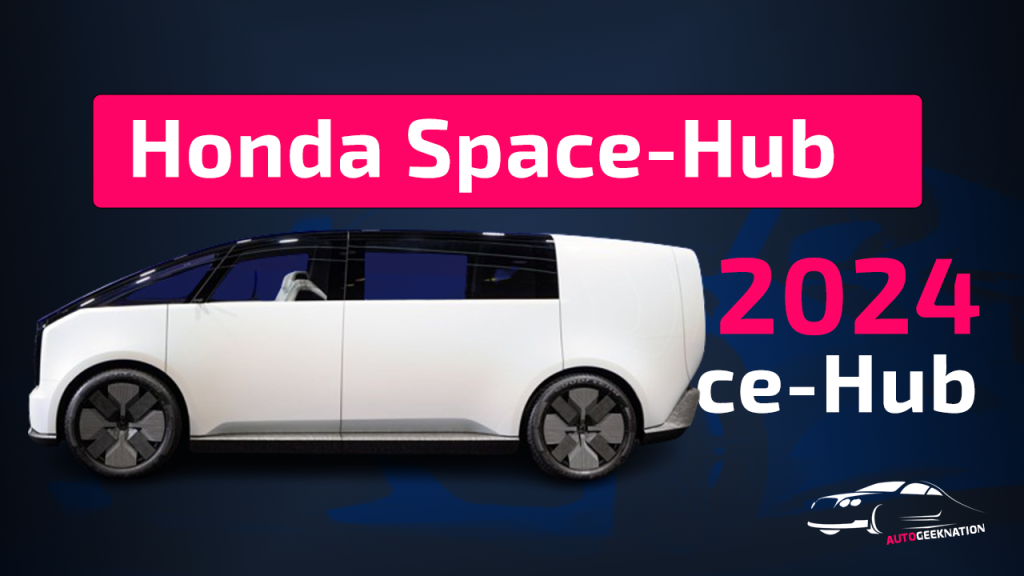
When Honda unveiled the Saloon and Space-Hub concepts at CES 2024, the company presented them as symbols of a major transformation in its approach to electric vehicles.
The message was clear: Honda wanted to build a new generation of EVs around three principles — “Thin, Light, and Wise.” The concepts introduced a dedicated EV architecture, unusual packaging, steer-by-wire technology, advanced driver assistance and a software-driven ownership experience.
At the time, Honda said the production version of the Saloon would arrive in North America in 2026, followed by other global markets.
But the story has changed.
In March 2026, Honda announced that it had cancelled development and the planned North American launch of the Honda 0 Saloon and Honda 0 SUV, alongside the Acura RSX, as part of a broader reassessment of its automobile electrification strategy. Honda cited changes in the EV market and the declining growth of EV demand in the United States as major factors.
That makes the Saloon and Space-Hub interesting for a different reason today. They are no longer simply previews of imminent Honda production cars. They represent an ambitious EV strategy that Honda subsequently changed.
The Honda 0 Series started with two concepts
Honda introduced the Honda 0 Series at CES 2024 with two concept vehicles:
- Honda Saloon
- Honda Space-Hub
The Saloon was presented as the flagship of the new EV family, while the Space-Hub explored a different interpretation of electric mobility, focusing on interior space and interaction between passengers.
Honda described the development philosophy as Thin, Light, and Wise.
The idea was to move away from the increasingly common EV formula of simply fitting a large battery into a heavy vehicle.
Instead, Honda wanted to reduce the thickness and weight of major components, create more useful interior space and use software and advanced electronics to make the vehicle more intelligent.
What did “Thin, Light, and Wise” mean?
Honda’s three-word philosophy was more than a marketing slogan.
Thin
Honda wanted to create a low-profile EV architecture with a thin floor and compact electric drive components.
The company said its new dedicated EV platform would use a compact e-axle and an ultra-thin battery pack to reduce the space occupied by the powertrain. This would give designers greater freedom to create a low vehicle while maintaining interior room.
Light
Honda also wanted to avoid the weight escalation that can accompany large EV batteries.
The objective was to develop lighter vehicles through improved packaging, more compact components and a different approach to EV engineering.
That philosophy was particularly important for the Saloon, whose low body and relatively unusual proportions were intended to provide both aerodynamic benefits and interior space.
Wise
The third element focused on software, connectivity, driver assistance and vehicle intelligence.
Honda envisioned the 0 Series as a type of software-defined vehicle, where software could continue to evolve after the vehicle was purchased.
That idea eventually became closely associated with Honda’s ASIMO OS.
The Saloon was the flagship
The original Saloon concept was arguably the most striking of the two.
Its body was extremely low and wide for an EV, giving it a profile that looked closer to a futuristic grand tourer than a conventional electric sedan.
Honda said the dedicated EV platform would allow the Saloon to achieve a low height while maintaining a surprisingly spacious cabin.
The concept also featured a steering yoke and an unusual interior layout designed around the driver.
The production prototype shown at CES 2025 retained the concept’s basic exterior design, according to Honda. At that point, the company was still planning to launch the Saloon in North America in 2026.
That plan would ultimately be cancelled.
Steer-by-wire was one of the major technical ideas
One of the most interesting technologies associated with the Saloon was steer-by-wire.
Traditional vehicles use a mechanical connection between the steering wheel and front wheels, even when electric assistance is used.
Honda’s 0 Series approach was designed to separate steering-wheel input from the mechanical steering system through electronic control.
Combined with Honda’s motion-management technology, this was intended to give engineers much greater freedom in tuning steering response and vehicle behaviour.
Honda also linked the system to its robotics research, particularly technologies related to sensing, posture control and motion management.
The goal was not simply to make the steering futuristic. Honda wanted the car to respond more naturally to the driver’s inputs while improving stability and control.
The Space-Hub concept explored a different idea
The Space-Hub was less about sports-car styling and more about how an EV could become a flexible space for its occupants.
Honda presented it as a van-like concept with a large glass area and an interior designed to encourage interaction between passengers.
The idea was to use the freedom created by an electric platform to rethink the relationship between the occupants and the vehicle.
The Space-Hub itself did not receive a production launch.
Instead, its core packaging philosophy influenced the Honda 0 SUV prototype presented at CES 2025. Honda explicitly described the 0 SUV as being based on the Space-Hub concept and focused on creating a spacious cabin with a clear field of view and flexible interior.
From Space-Hub to Honda 0 SUV
The evolution from Space-Hub to 0 SUV shows how Honda converted some of the original concept ideas into a more conventional production-oriented vehicle.
The 0 SUV was designed as a mid-size electric SUV and became the first model Honda said would enter production within the 0 Series.
Honda planned to launch it in North America in the first half of 2026 and then expand to other markets.
The SUV also adopted the Thin, Light, and Wise philosophy, while incorporating ASIMO OS and advanced vehicle-control technology.
But this model was also cancelled in Honda’s March 2026 strategy revision.
ASIMO OS was supposed to make the car smarter over time
The technology story did not stop with the hardware.
At CES 2025, Honda introduced ASIMO OS, an original vehicle operating system developed for the 0 Series.
The name comes from Honda’s famous ASIMO humanoid robot.
Honda intended the system to integrate vehicle functions including infotainment, advanced driver assistance and other electronic control systems.
The company also planned continuous over-the-air software updates, allowing functions and services to evolve after the customer purchased the vehicle.
This was one of the more ambitious parts of the 0 Series programme.
Instead of treating the vehicle’s software as something largely fixed at the factory, Honda wanted the car to become increasingly personalised through continued software development.
What was “ultra-personal optimization”?
Honda used the term “ultra-personal optimization” to describe its vision for adapting the vehicle to individual users.
The company planned for ASIMO OS to learn preferences and usage patterns and use that information to customise aspects of the driving and digital experience.
Honda described this as a way to create a vehicle that becomes more personalised the more it is used.
That concept is increasingly common across the software-defined vehicle industry, but Honda’s approach was notable because it connected the idea with its robotics research and human-machine interaction philosophy.
Advanced driver assistance was another pillar
Honda also planned to use the 0 Series as a platform for more advanced automated-driving technology.
At CES 2025, Honda said the 0 Series would use technology backed by its experience with Level 3 automated driving.
Honda had previously introduced Level 3 technology commercially through its Legend Hybrid EX in Japan, making it one of the earliest manufacturers to put a certified eyes-off driving system into limited production.
The 0 Series was intended to take that technology further and eventually expand the availability of more sophisticated automated-driving functions.
However, planned capabilities should not be confused with what consumers can currently buy from Honda. The cancellation of the North American 0 Saloon and 0 SUV means those specific production plans no longer represent Honda’s current vehicle lineup.
Honda also developed a new H logo
The 0 Series was accompanied by a redesigned Honda H mark.
Originally introduced specifically for the company’s next-generation EVs, the refreshed emblem was intended to represent a new stage in Honda’s development.
Interestingly, Honda later expanded the use of the new H mark beyond EVs.
In January 2026, the company announced that the refreshed H mark would become the new symbol for its automobile business, including dealerships and motorsports activities.
That means the logo concept introduced alongside the 0 Series ultimately survived the change in EV strategy.
The battery strategy was designed around efficiency
Honda’s 0 Series programme also involved a new approach to batteries.
The company discussed high-energy-density batteries, improved packaging and efforts to reduce degradation over time.
Honda’s broader EV technology programme aimed to make the battery pack thinner while improving energy efficiency and charging performance.
The original 2024 concept article mentioned a target of maintaining battery degradation at 10% or less after ten years.
That figure should be treated carefully, however. It was a Honda development target associated with the planned technology, not an independently verified long-term result from a production 0 Series vehicle.
Because the Saloon and 0 SUV were subsequently cancelled, it would be misleading to present the original target as a proven production-car specification.
Honda’s EV strategy changed before the 0 Series reached customers
This is the most important update to the original article.
In 2024, Honda was preparing for a major global expansion of the 0 Series.
In 2025, the company was still presenting production prototypes and discussing their planned 2026 launches.
But in March 2026, Honda announced a major reassessment of its automobile electrification strategy.
The company cancelled the planned North American development and market launch of:
- Honda 0 Saloon
- Honda 0 SUV
- Acura RSX
Honda said the decision reflected changes in the business environment, including a significant slowdown in EV demand in the United States.
This was not simply a delay.
Honda explicitly announced the cancellation of development and market launch for those three models.
Honda is putting more emphasis on hybrids
Following the reassessment, Honda said it would strengthen its hybrid models and reallocate resources in response to the changing market.
The company stated that it would enhance its hybrid lineup and competitiveness while taking a more flexible approach to future EV investments.
That does not mean Honda has abandoned electric vehicles altogether.
Honda continues to describe EVs as an important part of its long-term carbon-neutrality strategy.
Instead, the company is adjusting the timing, scale and allocation of its EV investments based on market conditions.
What about the Honda 0 α?
There was another development before the 2026 strategy change.
At the Japan Mobility Show 2025, Honda unveiled the Honda 0 α (Alpha) prototype.
It was positioned as a more accessible SUV within the 0 Series and was described as a gateway model to the family.
Honda had planned to begin global sales, mainly in Japan and India, from 2027.
However, Honda’s March 2026 announcement specifically named the 0 Saloon, 0 SUV and Acura RSX among the cancelled North American projects. It did not describe the 0 α in that announcement in the same terms.
Therefore, it is better not to assume that every future 0 Series model has been cancelled or that every original timeline remains unchanged. Honda’s broader EV roadmap is being reassessed.
What happened to the original 2024 vision?
The Saloon and Space-Hub concepts were important because they showed what Honda believed an EV could become.
The Saloon explored:
- Low and aerodynamic proportions
- A dedicated EV platform
- Steer-by-wire
- Advanced motion control
- A driver-focused digital interface
- Lightweight engineering
- Software-defined vehicle technology
The Space-Hub explored:
- Flexible passenger space
- A large, open cabin
- Greater interaction between occupants
- EV-specific packaging
- A new interpretation of interior design
Some of those ideas progressed into later prototypes, especially the 0 SUV and ASIMO OS.
But the commercial programme behind them changed significantly.
Why the Honda 0 Series still matters
It would be easy to look at the cancelled Saloon and SUV programmes and conclude that the 0 Series was simply a failed EV project.
That would be too simplistic.
The programme produced technology and design research that could influence Honda’s future vehicles even if the original products do not reach customers.
The new H mark has already become part of Honda’s broader automobile identity.
ASIMO OS demonstrated Honda’s direction toward software-defined vehicles.
The Thin, Light, and Wise philosophy provided a different approach to EV packaging.
And the 0 Series programme forced Honda to develop new expertise in batteries, electronic architecture, software, automated driving and vehicle dynamics.
Honda’s EV strategy is now more cautious
The most important lesson from the 0 Series story is that automotive product plans can change quickly.
In January 2024, Honda announced an ambitious global EV family.
By January 2025, the company was showing production-oriented prototypes and preparing for 2026 launches.
By March 2026, Honda had cancelled two of the most prominent North American 0 Series projects and shifted greater attention toward hybrid vehicles.
For consumers, this means the Saloon and Space-Hub should now be viewed primarily as concepts that helped define Honda’s technology direction, rather than as upcoming models that can simply be ordered or expected at dealerships.
Honda 0 Series: the legacy of the Saloon and Space-Hub
The Honda 0 Series began with an ambitious promise: start again from zero and rethink what an electric Honda could be.
The Saloon represented the most radical expression of that idea, combining a low futuristic body with steer-by-wire, advanced motion control and a software-focused cabin.
The Space-Hub explored how an electric platform could turn the cabin into a more flexible passenger space.
Honda then pushed the technology further with the 0 SUV prototype and ASIMO OS.
But market conditions ultimately forced a change of direction.
The cancellation of the 0 Saloon and 0 SUV in North America means the original CES 2024 vision will not reach the market in the form Honda initially promised. At the same time, the technology developed through the programme may continue to influence Honda’s future products.
For that reason, the 0 Series is still worth watching — not necessarily as a single family of EVs, but as a glimpse into the engineering and software direction Honda explored before changing course.
Frequently Asked Questions
What happened to the Honda 0 Saloon?
Honda cancelled the development and planned North American market launch of the Honda 0 Saloon in March 2026 as part of a reassessment of its EV strategy.
Is the Honda 0 Saloon coming in 2026?
No. Honda had originally planned to launch the production Saloon in North America in 2026, but that plan was subsequently cancelled.
What happened to the Honda Space-Hub?
The Space-Hub remained a concept rather than becoming a production model. Its design and packaging philosophy influenced the Honda 0 SUV prototype that Honda presented at CES 2025.
Was the Honda 0 SUV cancelled?
Yes. Honda announced in March 2026 that it had cancelled development and the planned North American launch of the Honda 0 SUV.
What is Honda ASIMO OS?
ASIMO OS is Honda’s original vehicle operating system developed for the 0 Series. It was designed to integrate functions such as infotainment and AD/ADAS while supporting over-the-air software updates and personalised vehicle experiences.
What does “Thin, Light, and Wise” mean?
It is Honda’s development philosophy for the 0 Series. “Thin” refers to efficient EV packaging, “Light” to reducing vehicle weight, and “Wise” to software, connectivity, driver assistance and intelligent vehicle functions.
Is Honda abandoning electric vehicles?
No. Honda says EVs remain part of its long-term carbon-neutrality strategy, but it is reassessing the timing and scale of EV investment and strengthening its hybrid lineup in response to market conditions.
Will Honda still use the new H logo?
Yes. Honda expanded the refreshed H mark beyond the 0 Series. In January 2026, it announced that the new H mark would become the symbol of its automobile business, including dealerships and motorsports activities.
Sources
- Honda Global — Honda 0 Series and Saloon/Space-Hub concepts at CES 2024
- Honda Global — Honda 0 Saloon and 0 SUV prototypes at CES 2025
- Honda Global — Honda 0 Series next-generation technologies
- Honda Global — Honda 0 α prototype
- Honda Global — 2026 EV strategy reassessment and cancellation of 0 Saloon/0 SUV
- Honda Global — New H mark for Honda automobile business