

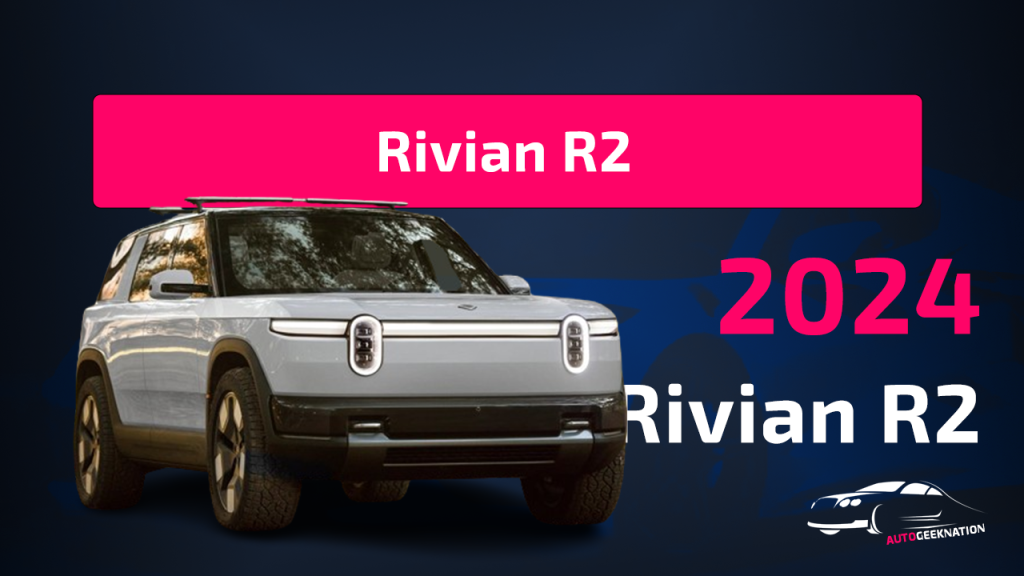
When Rivian introduced the R2, R3 and R3X in 2024, the three electric vehicles represented an ambitious expansion of the company’s lineup beyond the larger R1T pickup and R1S SUV.
Two years later, the situation looks very different.
The Rivian R2 has entered production and customer deliveries have begun, making it the first of the new-generation models to reach the market. The smaller R3 and performance-focused R3X, meanwhile, remain future products, with Rivian’s current plans pointing toward production later this decade.
That makes the R2, R3 and R3X an interesting look at how Rivian is trying to move from a relatively niche electric-vehicle manufacturer toward a much broader market.
Rivian R2: The First One to Reach Customers
The Rivian R2 is a five-seat electric SUV positioned below the company’s R1S in size and price.
Its importance to Rivian goes beyond simply adding another vehicle to the lineup. The R2 was engineered from the beginning with higher-volume production in mind, using a new midsize platform and manufacturing strategies intended to reduce complexity and cost.
Rivian officially began series production of the R2 at its Normal, Illinois, facility in April 2026. The first customer deliveries followed in June.
That means the R2 has now moved beyond the concept and reservation stage that defined the original 2024 story.
2026 Rivian R2 Pricing and Versions
The original R2 announcement suggested a starting price around $45,000, but that entry point is not the version Rivian launched first.
For 2026, Rivian’s lineup begins with the more powerful R2 Performance, while less expensive configurations are scheduled to follow.
The current U.S. lineup is:
| R2 version | Drive | Power | Rivian-estimated/EPA range | Starting price |
|---|---|---|---|---|
| R2 Performance | Dual-motor AWD | 656 hp | Up to 330 miles EPA-est. | $57,990 |
| R2 Premium | Dual-motor AWD | 450 hp | Up to 330 miles EPA-est. | $53,990 |
| R2 Standard | Single-motor RWD | 350 hp | Up to 345 miles | $44,990 |
The Performance version is available first. Premium is scheduled for late 2026, while the Standard version is scheduled for 2027. Rivian also says an additional Standard configuration around the $45,000 level will follow later.
This is an important correction to the original article: $45,000 is no longer the price of the first R2 available to customers. It represents a future lower-cost configuration.
R2 Performance: The Fastest Launch Version
The R2 Performance is currently the most powerful version of the vehicle.
It uses a dual-motor all-wheel-drive system producing 656 horsepower and 609 lb-ft of torque. Rivian quotes a 0–60 mph time of as little as 3.6 seconds.
Despite those performance figures, Rivian has not abandoned the adventure-oriented character that defined the company’s larger vehicles.
The R2 Performance is designed to combine everyday usability with off-road capability, while its structural battery pack contributes to a low center of gravity.
The Launch Package initially offered with the Performance model also adds equipment aimed at early customers, including the Tow Package, Autonomy+ and a dedicated Launch key fob.
R2 Premium Targets the Middle Ground
The R2 Premium is scheduled to arrive later in 2026.
It uses dual-motor all-wheel drive and produces 450 horsepower, with Rivian estimating up to 330 miles of EPA-rated range.
Its equipment is also more comfort-focused, including a premium interior with wood accents, heated and ventilated front seats, heated rear seats, premium audio and Rivian’s distinctive Torch flashlight.
For buyers who don’t need the maximum performance of the Performance model, this could become one of the more important versions of the R2 lineup.
The $45,000 R2 Is Still Coming
The entry-level R2 is one of the most important parts of Rivian’s long-term strategy.
The future Standard model starts at $44,990 and uses a single-motor rear-wheel-drive layout producing 350 horsepower. Rivian lists a starting estimated range of 275 miles, while longer-range configurations will also be offered.
The cheaper R2 matters because Rivian’s original goal with the vehicle was to reach customers far beyond the relatively expensive R1T and R1S.
In other words, the R2 is not simply a smaller Rivian. It is the company’s attempt to create a product that can operate at significantly greater volume.
A More Sustainable Approach to the R2
Rivian has also paid considerable attention to the materials used in the R2.
According to the company, approximately one-quarter of the vehicle by weight uses recycled or bio-based materials.
Rivian describes the R2 as its first vehicle specifically designed for high production volume and the mass market, making material efficiency and manufacturing processes particularly important.
That doesn’t mean the R2 is a completely sustainable vehicle—EV production still involves substantial environmental impacts—but it shows that Rivian is trying to address material use as part of the vehicle’s overall design.
Rivian R2 Technology: More Than Just an Electric Powertrain
Technology is another major part of the R2 strategy.
Rivian has introduced a new software foundation called Rivian OS 2.0, with a redesigned user interface and graphics architecture based partly around Unreal Engine 5.
The company also describes the R2 as moving toward what it calls an AI-defined vehicle, with hardware and software designed to evolve through over-the-air updates.
This is important because Rivian doesn’t treat the vehicle as a fixed product.
Software updates can modify functionality after the vehicle leaves the factory, potentially allowing improvements without traditional hardware changes.
The R3 Takes the Rivian Formula Further Down
If the R2 is designed to bring Rivian into the midsize SUV market, the R3 goes even smaller.
Rivian describes the R3 as a compact crossover with a distinctive hatchback-inspired shape. Its proportions are considerably different from both the R1S and R2.
The design was one of the biggest surprises of Rivian’s 2024 presentation. Rather than creating a conventional small SUV, the company gave the R3 a distinctive silhouette with short overhangs, upright glass and a rear hatch.
That allows Rivian to preserve its recognizable design language while entering a segment with considerably more mainstream appeal.
But there is one major difference between the R2 and R3 in 2026:
You cannot buy the R3 yet.
When Will the Rivian R3 Arrive?
Rivian has not launched the R3 as of September 2026.
Current reporting indicates that the R3 is expected to enter production later this decade at Rivian’s planned Georgia manufacturing facility. MotorTrend has reported a current target around 2028 production and 2029-model-year availability, although the timing could change.
That makes the R3 a considerably longer-term proposition than the R2.
Rivian’s Georgia factory is still under construction, with the company continuing its investment in the state. In August 2026, Rivian officially opened its new East Coast headquarters in Atlanta while continuing work on the manufacturing facility at Stanton Springs North.
Rivian R3X: The Performance Version
Alongside the standard R3, Rivian also revealed the R3X.
The R3X takes the basic R3 concept and turns up the performance and adventure elements. Rivian has described it as a high-performance crossover designed to combine on-road performance with off-road capability.
Unlike the current R2 Performance, however, the R3X is still a future vehicle.
Rivian CEO RJ Scaringe has indicated that the R3X is still a couple of years away, with production expected to follow the opening of the Georgia factory. Automotive reporting has described the planned R3X as using a tri-motor powertrain.
Rivian has not yet published a final production specification sheet or official U.S. price for the R3X.
That means performance numbers shown during the original concept presentation should not be treated as confirmed production specifications.
R2 vs. R3: What Is the Difference?
The simplest way to understand the two vehicles is to think of them as different steps in Rivian’s expansion strategy.
The R2 is the larger and more practical SUV, while the R3 is smaller and more crossover-like.
The R2 is already entering customer hands, while the R3 remains under development.
| Feature | Rivian R2 | Rivian R3 |
|---|---|---|
| Vehicle type | Midsize electric SUV | Compact electric crossover |
| Seating | 5 | 5 |
| Market status | In production and customer deliveries | Future model |
| Production location | Normal, Illinois | Planned Georgia production |
| Starting price | $44,990 future Standard | Not officially announced |
| Performance variants | R2 Performance | R3X |
| Main role | Higher-volume midsize Rivian | Smaller, more accessible Rivian |
The R3 could ultimately be the more important vehicle for Rivian’s volume ambitions because its smaller size and expected lower price would put it into a much broader segment.
What Happened to the Original $45,000 Promise?
This is one of the most important details for anyone reading older R2 articles.
When Rivian unveiled the R2 in March 2024, the company promoted a future starting price of approximately $45,000.
That figure hasn’t disappeared.
Instead, Rivian has moved the $45,000-class configuration further into the launch schedule. The first R2 available to customers is substantially more expensive, with the Performance model starting at $57,990.
This approach allows Rivian to launch with a higher-specification vehicle before introducing lower-cost versions.
For consumers, however, it means the R2’s original headline price should not be confused with the price of the vehicle currently available.
Can the R2 Really Replace the R1S?
Not exactly.
The R2 is smaller and positioned below the R1S. Rivian’s strategy is not to replace its flagship SUV but to create another category underneath it.
That distinction matters for buyers who need maximum passenger or cargo capacity.
The R2 is intended to offer Rivian’s adventure-oriented design and technology in a more compact package, while the R1S remains the company’s larger SUV.
The result is a broader range of choices rather than a direct replacement.
Why the R2 Matters So Much to Rivian
Rivian has built a strong reputation with the R1T and R1S, but both vehicles occupy relatively expensive segments.
The R2 changes that equation.
Its smaller platform was engineered specifically with manufacturing efficiency in mind, and Rivian has worked to simplify components and production while retaining the brand’s distinctive design and software architecture.
The company has also subjected the R2 to extensive durability testing, including extreme heat, cold, sand, water and towing conditions. Rivian says development vehicles accumulated tens of thousands of miles during validation.
That testing matters because the R2 has to work as more than a technology showcase.
It needs to become a high-volume vehicle.
The Bigger Challenge: Scaling Rivian
The R2’s success will ultimately depend on something that cannot be measured by horsepower or acceleration.
Production scale.
Rivian is attempting to move from building relatively low-volume premium EVs to producing a vehicle intended for a much larger customer base.
That requires competitive pricing, reliable manufacturing, efficient supply chains and enough production capacity to satisfy demand.
The R2 is therefore as important to Rivian’s business strategy as it is to its product lineup.
If the company can successfully scale the R2, the future R3 and R3X could give it an even broader portfolio.
What Comes Next for Rivian?
The immediate focus is the R2.
The Performance model is already available, the Premium version is scheduled for late 2026, and lower-cost R2 versions are scheduled for 2027.
The R3 and R3X come later.
Their eventual arrival will depend heavily on Rivian’s Georgia manufacturing program and the company’s ability to expand production capacity.
That makes the current Rivian roadmap relatively easy to understand:
R2 first. R3 later. R3X as the performance-focused extension of the smaller platform.
Final Verdict
The original R2/R3 story was about Rivian announcing an exciting new family of electric vehicles.
In 2026, the story is more interesting.
The Rivian R2 has become a real production vehicle, with customer deliveries underway and several versions planned. It combines the brand’s adventure-focused design with a smaller platform, new software architecture and a much broader price range than Rivian’s R1 models.
The R3 and R3X remain future products, and their specifications, pricing and exact launch timing should be treated cautiously until Rivian confirms production details.
For Rivian, however, these vehicles represent more than new models.
They are the company’s attempt to make the Rivian experience accessible to a much larger audience without abandoning the design, software and adventure-focused identity that made the brand distinctive in the first place.
The R2 is the beginning of that next chapter. The R3 could determine how far Rivian can take it.
Frequently Asked Questions
Is the Rivian R2 available in 2026?
Yes. Rivian began customer deliveries of the R2 in June 2026 after starting production at its Normal, Illinois, facility.
How much does the 2026 Rivian R2 cost?
The R2 Performance currently starts at $57,990 in the U.S. The Premium starts at $53,990 and is scheduled for late 2026, while the Standard version starts at $44,990 and is scheduled for 2027.
What is the range of the Rivian R2?
The R2 lineup offers different range figures depending on configuration. Rivian currently lists up to 330 miles EPA-estimated for the Performance and Premium versions, while the future Standard Long Range configuration is expected to reach up to 345 miles.
How powerful is the Rivian R2 Performance?
The R2 Performance produces 656 horsepower and 609 lb-ft of torque and can accelerate from 0–60 mph in as little as 3.6 seconds, according to Rivian.
Is the Rivian R3 available yet?
No. As of September 2026, the R3 has not entered production or customer deliveries. Current reporting points toward production later this decade, with 2028 often cited as the current target.
What is the Rivian R3X?
The R3X is the performance-oriented version of the smaller R3 crossover. Rivian has presented it as a more aggressive, performance-focused vehicle capable of combining road performance with adventure-oriented capability. Its final production specifications and pricing have not yet been officially announced.
Will the Rivian R3 be cheaper than the R2?
Rivian has not yet announced an official R3 starting price. Because the R3 is smaller and positioned below the R2, it is widely expected to be less expensive, but the final price should not be treated as confirmed until Rivian announces it.
Where will the Rivian R3 be built?
The R3 and R3X are expected to be produced at Rivian’s planned Georgia manufacturing facility. The factory is part of Rivian’s longer-term production expansion strategy.
Sources
- Rivian — R2 official product page
- Rivian — R2 pricing and lineup announcement
- Rivian — R2 Start of Production
- Rivian — R2 technology and Rivian OS 2.0
- Rivian — R2 sustainability and materials
- Car and Driver — R3X production timing
- MotorTrend — R2 vs. R3 comparison