

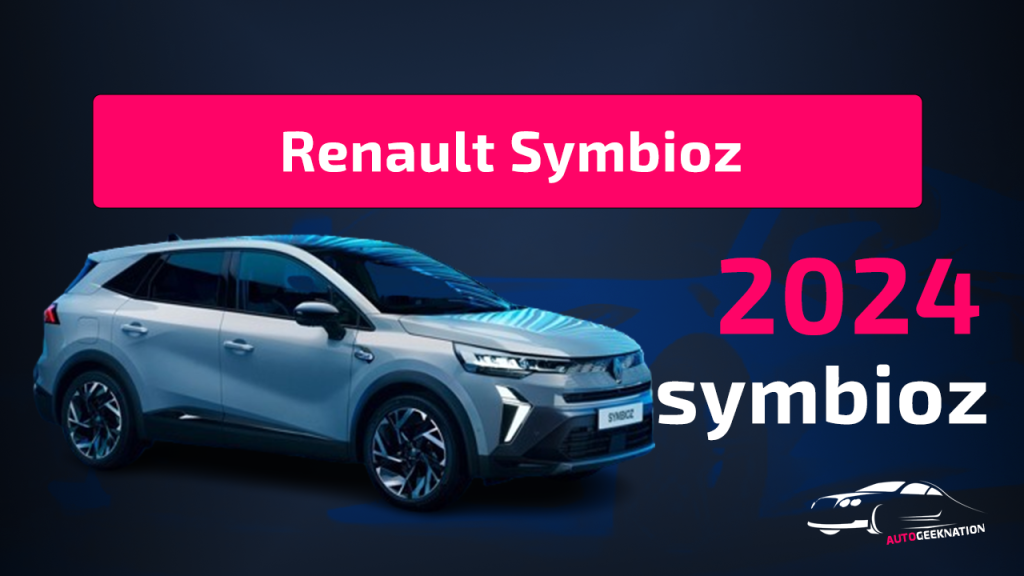
The Renault Symbioz was introduced as a compact family SUV designed to combine the practicality of a larger family car with dimensions that remain manageable in the city.
That positioning still defines the model in 2026, but the Symbioz has evolved since its original launch.
Renault now offers the model with two distinct electrified powertrain approaches in markets such as the UK: a 140 hp mild-hybrid petrol engine and the more sophisticated 160 hp E-Tech full hybrid. The latter replaced the original 145 hp full-hybrid specification as Renault’s more powerful hybrid option and brings lower official fuel consumption, stronger performance and a claimed driving range of up to 1,000 km.
The result is a family-oriented crossover that sits between the Renault Captur and Renault Austral, combining a relatively compact exterior with a surprisingly flexible interior.
What Is the Renault Symbioz?
The Symbioz is a five-seat compact SUV positioned at the lower end of Renault’s C-segment range.
At 4.41 metres long, it is larger than the Captur but shorter than the Austral. Renault designed it around a simple objective: provide enough interior and luggage space for family use without making the vehicle unnecessarily large for urban driving.
Its dimensions are approximately:
| Specification | Renault Symbioz |
|---|---|
| Length | 4.41 m |
| Width | 1.79 m |
| Wheelbase | 2.64 m |
| Seats | 5 |
| Boot capacity | 492–624 litres |
| Maximum luggage capacity | Around 1,580 litres |
| Rear bench travel | 16 cm |
The exact dimensions and luggage figures can vary slightly according to market and configuration.
This balance is central to the Symbioz’s identity. Renault isn’t trying to make it the largest SUV in its segment. Instead, the company has concentrated on making the available space flexible.
From Renault 16 to Symbioz: The “Voitures à Vivre” Philosophy
Renault describes Symbioz as part of its long-running “voitures à vivre”, or “cars for living,” philosophy.
The connection goes back decades.
The Renault 16, introduced in 1965, combined a practical hatchback body with a flexible interior at a time when family cars were often much less adaptable.
Renault later pushed the idea further with the Espace and Scénic, two vehicles that became closely associated with flexible family transportation.
Symbioz follows the same general philosophy, although the modern market has shifted heavily toward SUVs and crossovers.
Rather than simply offering more seats, Renault has concentrated on modularity, storage, connectivity and efficient electrification.
A Compact SUV With a Focus on Space
The Symbioz’s exterior proportions are deliberately restrained.
At 4.41 metres long and less than 1.8 metres wide, it remains relatively easy to place on narrow urban roads and in parking spaces.
But the interior is designed to make better use of those dimensions.
The rear bench can slide by 16 cm, allowing the owner to prioritize rear passenger legroom or luggage space depending on the situation. With the bench positioned for maximum luggage capacity, Renault quotes up to 624 litres of boot space. With the rear seats folded, the capacity rises to around 1,580 litres in Renault’s original specification.
That flexibility is arguably more useful for a family than simply adding a few extra centimetres to the vehicle’s exterior.
The Symbioz’s Design
The Symbioz adopts Renault’s contemporary design language, with a relatively upright body, sculpted sides and a distinctive front end.
The proportions are particularly important because the vehicle has to balance SUV styling with practical family-car requirements.
Depending on specification, the Symbioz can be equipped with larger alloy wheels and Renault’s more visually distinctive Esprit Alpine styling package.
Higher versions can also receive the Solarbay opacifying panoramic glass roof, which allows the cabin to be made brighter while giving occupants control over the amount of light entering the vehicle.
The design is therefore not purely cosmetic. Several of the exterior and roof options have a direct effect on the atmosphere inside the cabin.
The Interior: Designed as a Living Space
Renault’s “car for living” philosophy becomes more obvious once you move inside.
The cabin uses a relatively high seating position while retaining a dashboard layout centered around the driver.
The available 10.4-inch OpenR Link multimedia display forms the centerpiece of the infotainment system on current UK versions. The system includes Google built-in, while the instrument cluster uses a separate 10.25-inch digital display.
This setup provides access to navigation, media and connected functions without requiring the driver to rely entirely on a smartphone.
Higher specifications can also receive a Harman Kardon nine-speaker audio system, further separating the premium versions from entry-level models.
OpenR Link and Google Built-In
One of the Symbioz’s strongest technology features is Renault’s OpenR Link multimedia platform.
The system integrates Google services directly into the vehicle, providing navigation and connected functions through the central display.
The advantage is that the vehicle’s infotainment system is not simply a large screen for displaying a smartphone interface. It is integrated into the car’s software environment.
Renault has used the same general technology philosophy across several newer models, making Symbioz part of a broader move toward connected, software-focused cabins.
The Original E-Tech 145 Has Been Superseded
When Symbioz was originally introduced, its main electrified powertrain was Renault’s E-Tech full hybrid 145.
Renault quoted 145 hp, 4.7 L/100 km WLTP consumption and 105 g/km of CO₂ for that original version.
That specification is important historically, but it should not be presented as the current Symbioz powertrain across the entire range.
Renault has since introduced the E-Tech full hybrid 160, which uses a new 1.8-litre petrol engine and electric assistance.
That is the version that gives the current Symbioz its most significant powertrain upgrade.
E-Tech Full Hybrid 160: The Main 2026 Update
The E-Tech full hybrid 160 combines a petrol engine with electric motors and a relatively small battery.
Unlike a plug-in hybrid, it does not need to be connected to an external charger.
The battery is replenished through regenerative braking and the hybrid system’s operation. Renault’s system can use the electric motor alone in some situations, combine electric and combustion power when required, and manage energy automatically according to driving conditions.
The current E-Tech 160 produces 160 hp and uses an automatic multimode transmission.
Renault quotes:
- 160 hp
- Up to 1,000 km driving range
- Up to 4.3 L/100 km WLTP
- Around 98 g/km CO₂ WLTP
- 0–100 km/h in 9.1 seconds
- Automatic transmission
The 160 hp system also increases the Symbioz’s maximum towing capacity from 750 kg to 1,000 kg.
These figures represent a meaningful improvement over the original E-Tech 145.
How Does the Full Hybrid Work?
The E-Tech system is designed to make frequent use of electric propulsion without requiring the driver to manage charging.
When the car slows down, regenerative braking recovers energy and stores it in the hybrid battery.
At low speeds and during some acceleration phases, the electric motor can propel the vehicle.
When more power is required, the combustion engine and electric motor can work together.
The system continuously manages the energy flow automatically.
For a family buyer, this has an important practical advantage: there is no charging routine to plan around.
The driver fuels the car normally while the hybrid system manages the battery.
Mild Hybrid 140: A Different Approach
The current Symbioz range isn’t exclusively full hybrid.
Renault also offers a 1.3-litre mild-hybrid 140 in markets such as the UK.
This version produces 140 hp and 240 Nm, uses a six-speed manual gearbox and drives the front wheels. Renault lists 47.9 mpg combined and 134 g/mile CO₂ for the UK specification.
The mild-hybrid system is mechanically simpler than the E-Tech full hybrid.
For buyers who prefer a conventional manual driving experience and don’t specifically need full-hybrid capability, it provides another route to electrified assistance.
The trade-off is that the mild hybrid cannot drive the vehicle using electric power in the same way as the E-Tech full hybrid.
Which Symbioz Powertrain Makes More Sense?
It depends on how the car will be used.
The E-Tech 160 makes the strongest case for drivers who spend a lot of time in urban and mixed traffic, where regenerative braking and electric assistance can contribute significantly to efficiency.
The mild-hybrid 140 may appeal more to buyers who want a conventional manual transmission and a simpler powertrain.
For long-term fuel savings, the E-Tech full hybrid is the more technically sophisticated option.
For buyers who simply want a modern petrol crossover with some electrification, the mild hybrid may be sufficient.
Family Practicality Is the Symbioz’s Biggest Strength
The Symbioz’s strongest argument isn’t necessarily horsepower.
It is flexibility.
The sliding rear bench allows the owner to change the balance between passenger space and cargo capacity.
With the rear seats moved rearward, passengers gain additional legroom.
Move the bench forward and the boot grows.
Renault quotes a luggage capacity of 492 to 624 litres, depending on rear-seat position.
The power tailgate, hands-free opening and flat loading floor available on relevant specifications also make the cargo area easier to use.
For families, those details can matter more than an extra few tenths of a second in acceleration.
Safety and Driver Assistance
The Symbioz also includes a substantial collection of driver-assistance systems.
Depending on trim and market, the equipment can include:
- Adaptive cruise control
- Active Driver Assist
- Lane-keeping assistance
- Automatic emergency braking
- Traffic-sign recognition
- Blind-spot monitoring
- Parking assistance
- Around View Camera
- Rear automatic emergency braking
- Driver-monitoring functions
Renault describes Active Driver Assist as a Level 2 driving-assistance system.
That terminology is important.
Level 2 does not mean autonomous driving. The driver remains responsible for monitoring the road and the vehicle at all times.
Higher trim levels can include a particularly extensive suite of assistance systems; Renault originally stated that the Iconic version could have 29 next-generation driver-assistance features.
Solarbay: One of the Symbioz’s More Interesting Options
The Solarbay panoramic glass roof is one of the more distinctive available features.
Rather than using a conventional mechanical sunshade, the electrochromic glass can change its opacity.
This allows occupants to control how much sunlight enters the cabin.
It also reinforces Renault’s attempt to make the Symbioz feel more like a flexible living space rather than simply a compact SUV.
The feature is not standard on every version, however, and availability depends on market and trim. Renault UK’s current range lists Solarbay on the Iconic Esprit Alpine specification.
Current 2026 UK Range
The current UK range demonstrates how much the Symbioz lineup has evolved.
Renault currently lists three main trim levels:
- Techno
- Techno Esprit Alpine
- Iconic Esprit Alpine
The entry Techno can be ordered with the mild-hybrid 140, while the E-Tech 160 full hybrid is also available in the range.
Renault UK’s current listed prices start at £27,595 for the Symbioz Techno mild hybrid 140, while the E-Tech 160 is listed from £29,995 in the current pricing information.
Prices and specifications naturally vary between countries, so these figures should not be treated as global pricing.
How Does the Symbioz Fit Into Renault’s SUV Range?
The Symbioz occupies an interesting position.
The Captur is smaller and more urban-focused.
The Symbioz adds more rear-seat and luggage flexibility while remaining relatively compact.
The Austral sits above it with a larger footprint and a more substantial family-SUV proposition.
Renault itself describes Symbioz as positioned between Captur and Austral.
This makes the Symbioz particularly relevant to buyers who find the Captur too small but don’t want the size of a larger C-SUV.
Symbioz vs. Traditional Family Cars
The Symbioz also illustrates how the family-car market has changed.
Vehicles like the Renault 16 and Scénic were traditionally designed around family practicality using hatchback or MPV-style bodies.
Today, many customers want that practicality in an SUV-shaped vehicle.
Symbioz effectively combines the two approaches.
It has the higher seating position and exterior styling associated with an SUV, but its sliding rear bench and cargo flexibility are closer to the practical philosophy that historically defined Renault’s family cars.
What Are the Symbioz’s Main Strengths?
Strengths
- Compact 4.41-metre footprint.
- Flexible sliding rear bench.
- Up to 624 litres of boot space.
- Efficient E-Tech full-hybrid 160 powertrain.
- Mild-hybrid 140 alternative.
- No external charging required for the full hybrid.
- Google built-in through OpenR Link.
- Available Solarbay panoramic roof.
- Extensive driver-assistance technology.
- Comfortable family-oriented cabin.
- Relatively modest vehicle weight.
Weaknesses
- Not available as a full battery-electric vehicle.
- Rear-seat flexibility comes at the expense of fixed maximum passenger space.
- Higher trims can become considerably more expensive.
- Equipment varies significantly by market.
- The mild-hybrid version is less efficient than the full hybrid in official figures.
- It isn’t designed as a genuinely sporty crossover.
Is the Renault Symbioz a Good Family SUV?
The Symbioz makes a convincing argument for buyers who don’t necessarily need a large SUV.
Its dimensions remain manageable, but its interior can adapt to different family requirements.
The E-Tech 160 is particularly interesting because it gives the Symbioz a strong efficiency proposition without requiring the owner to install a home charger or change everyday driving habits.
The 140 mild hybrid provides an alternative for customers who prefer a manual gearbox and a more conventional driving experience.
The technology package is also competitive, particularly with OpenR Link, Google built-in and the optional Solarbay roof.
Final Verdict
The 2026 Renault Symbioz is best understood not as a revolutionary new type of family car, but as a modern interpretation of an idea Renault has been developing for decades.
The company’s historic “voitures à vivre” philosophy has evolved from hatchbacks and MPVs into the modern compact SUV.
Symbioz combines that philosophy with the practical advantages of a sliding rear bench, a large and flexible boot, connected technology and electrified powertrains.
The most important change since the model’s launch is the arrival of the E-Tech full hybrid 160. With up to 1,000 km of claimed range, 4.3 L/100 km WLTP consumption and 98 g/km CO₂, it gives Symbioz a stronger efficiency proposition than the original 145 hp hybrid.
At the same time, the availability of a mild-hybrid 140 gives customers more choice.
Ultimately, the Symbioz’s appeal isn’t about being the fastest or largest vehicle in Renault’s lineup.
It’s about finding a useful middle ground: SUV styling, family practicality, compact dimensions and hybrid efficiency in one package.
For buyers who want a family vehicle without moving into a large SUV, that balance may be exactly what makes the Symbioz worth considering.
Frequently Asked Questions
What is the Renault Symbioz?
The Renault Symbioz is a five-seat compact SUV positioned between the Captur and Austral in Renault’s European lineup. It measures approximately 4.41 metres long and emphasizes family practicality, modularity and electrified powertrains.
Is the Renault Symbioz a hybrid?
Yes. Current versions include a 140 hp mild hybrid and a 160 hp E-Tech full hybrid, depending on market and trim.
Does the Renault Symbioz need to be plugged in?
The E-Tech full-hybrid Symbioz does not require external charging. Its battery is recharged through regenerative braking and the hybrid system itself.
What is the Renault Symbioz E-Tech 160’s fuel consumption?
Renault currently quotes up to 4.3 L/100 km WLTP for the E-Tech 160, with CO₂ emissions of approximately 98 g/km. Actual consumption varies according to driving conditions, equipment and driving style.
How much luggage can the Renault Symbioz carry?
The sliding rear bench allows the boot to vary from approximately 492 to 624 litres. With the rear seats folded, Renault quotes around 1,580 litres in its original specification.
How big is the Renault Symbioz?
The Symbioz is approximately 4.41 metres long, 1.79 metres wide and 2.64 metres in wheelbase.
Does the Renault Symbioz have seven seats?
No. The Symbioz is a five-seat SUV. Its focus is on five-seat passenger comfort and flexible cargo space rather than three-row seating.
What is the difference between the Symbioz mild hybrid and E-Tech full hybrid?
The mild-hybrid 140 uses a 1.3-litre petrol engine, manual transmission and electrical assistance. The E-Tech 160 is a full hybrid with electric propulsion capability and an automatic multimode transmission.
How much does the Renault Symbioz cost?
Pricing depends on the market. In the UK, Renault currently lists the Symbioz from £27,595 for the Techno mild hybrid 140, while the E-Tech 160 starts from around £29,995 in current pricing information.
Sources
- Renault Global Media — Symbioz family and technical overview
- Renault Global Media — E-Tech 160 update
- Renault UK — Symbioz official model page
- Renault UK — Symbioz prices and versions
- Renault UK — Symbioz technical specifications
- Renault — Symbioz E-Tech full-hybrid technology