

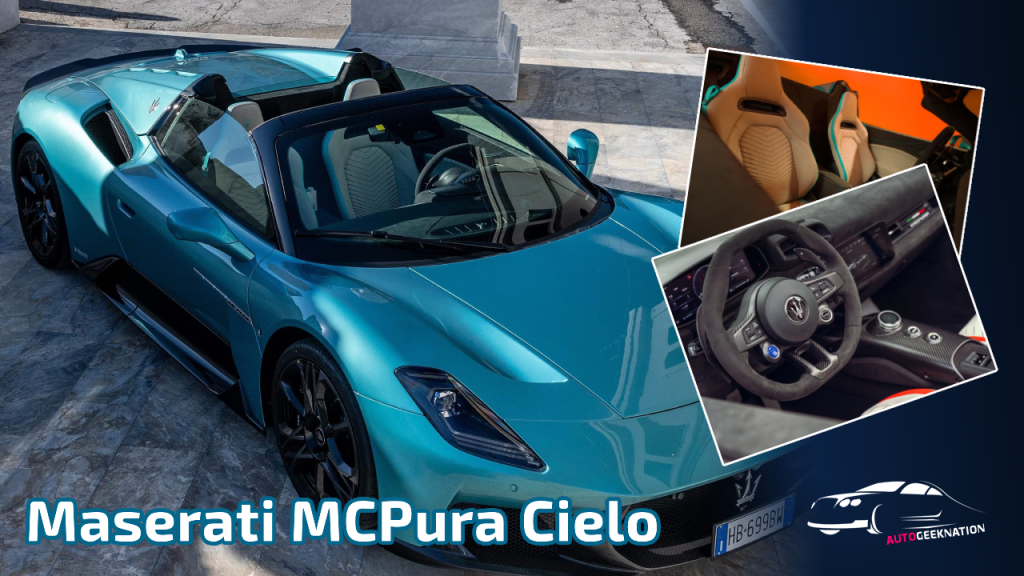
The 2027 Maserati MCPURA Cielo is the open-top expression of Maserati’s latest mid-engine supercar, combining a 630-horsepower twin-turbo V6 with rear-wheel drive, a carbon-fiber structure and one of the most distinctive roof systems in its class.
Based on the MC20 that introduced Maserati’s modern supercar era in 2020, the MCPURA takes that formula in a more expressive direction. The Cielo adds an electrically operated retractable glass roof while retaining the Nettuno V6, butterfly doors and carbon-fiber architecture that define the car.
This is not simply a faster convertible.
Maserati has designed the Cielo around the idea that a supercar should deliver different experiences depending on how it is configured. With the roof closed and the electrochromic glass opaque, the cabin has a more enclosed and focused atmosphere. Make the glass transparent and the sky becomes part of the cockpit. Retract the roof, and the car becomes a true open-air supercar.
For 2027, Maserati’s official configurator continues to list the MCPURA Cielo as a production model with 630 hp, rear-wheel drive, a 2.9-second 0–100 km/h time and a top speed above 320 km/h.
What Is the Maserati MCPURA Cielo?
The MCPURA is Maserati’s evolution of the MC20 supercar.
Maserati unveiled the MCPURA at the 2025 Goodwood Festival of Speed, describing it as an evolution of the MC20 rather than an entirely unrelated replacement. Both the coupe and Cielo convertible are built at Maserati’s historic Modena facility in Italy.
The Cielo is the open-top version.
Its name, which means “sky” in Italian, reflects the car’s central feature: a retractable roof incorporating electrochromic glass.
That gives the Cielo three distinct cabin experiences:
- Roof closed and glass opaque — a more enclosed supercar cockpit.
- Roof closed and glass transparent — an open-feeling cabin without exposing the occupants to the elements.
- Roof retracted — a genuine open-air driving experience.
It is a clever way of adding versatility without abandoning the structural and visual identity of the mid-engine MCPURA.
630-HP Nettuno V6
At the heart of the MCPURA Cielo is Maserati’s 3.0-liter twin-turbocharged Nettuno V6.
The official European specification lists:
- 630 hp
- 720 Nm of torque
- 3.0-liter V6
- Twin turbochargers
- Rear-wheel drive
- Mid-engine layout
The Nettuno is particularly important to Maserati because it was developed specifically for the company’s modern supercar program.
Its most unusual feature is its pre-chamber combustion system with twin spark plugs. Maserati says the technology is derived from Formula 1 solutions and is protected by international patents.
Rather than simply relying on larger turbochargers and more boost, the engine uses sophisticated combustion technology to improve how the air-fuel mixture is ignited.
The result is an engine that produces more than 200 horsepower per liter while retaining the character of a high-revving performance V6.
0–100 km/h in Less Than 2.9 Seconds
The MCPURA Cielo is firmly in supercar territory.
Maserati’s current specifications give the Cielo a 0–100 km/h acceleration time of less than 2.9 seconds and a maximum speed of more than 320 km/h.
The official Italian 2027 configurator similarly lists:
- 0–100 km/h: 2.9 seconds
- Top speed: over 320 km/h
- Power: 630 hp
- Drive: rear-wheel drive
The Cielo therefore sacrifices very little in straight-line performance compared with the coupe.
That is important because converting a mid-engine supercar into a convertible normally introduces additional structural requirements and weight.
Maserati has worked to keep that penalty relatively contained.
Rear-Wheel Drive Instead of All-Wheel Drive
The MCPURA Cielo sends its power exclusively to the rear wheels.
That is increasingly unusual in the modern supercar world, where all-wheel drive and hybrid assistance are often used to maximize acceleration.
Maserati has taken a different approach.
The combination of a mid-engine layout, carbon-fiber architecture and rear-wheel drive is intended to preserve a more traditional sports-car character, with the driver remaining closely connected to the power delivery.
This does not necessarily make the MCPURA the fastest car in every situation.
Instead, it gives Maserati room to emphasize steering feel, balance and the interaction between throttle input and rear-wheel traction.
That distinction is central to the MCPURA’s personality.
The Cielo’s Electrochromic Glass Roof
The roof is arguably the most visually impressive difference between the MCPURA and the Cielo.
Maserati uses a retractable PDLC electrochromic glass roof.
PDLC stands for polymer-dispersed liquid crystal technology. Rather than using a conventional mechanical sunshade to change the appearance of the glass, the system electronically changes the glass from transparent to opaque.
Maserati says the roof can switch between the two states in approximately one second.
This means the driver does not have to open the roof to change the atmosphere inside the cabin.
A button can transform the cabin from a darker, enclosed environment into a much brighter space with a view of the sky.
When the roof itself is retracted, the experience changes again, allowing occupants to enjoy the engine note, airflow and surroundings directly.
A Carbon-Fiber Supercar
The MCPURA Cielo’s performance is supported by a lightweight carbon-fiber architecture.
The car uses a carbon-fiber monocoque, an important structural element of the MC20/MCPURA family.
Maserati’s European technical catalogue lists a homologated weight of 1,560 kg for the Cielo, compared with 1,475 kg for the MCPURA coupe.
The additional weight is understandable because a convertible requires additional structural reinforcement and roof hardware.
Even so, 1,560 kg is relatively controlled for a 630-hp open-top supercar.
The result is a power-to-weight ratio that helps explain the Cielo’s extremely quick acceleration.
Butterfly Doors Remain Part of the Formula
The MCPURA Cielo retains one of the most recognizable features of the MC20 family: butterfly doors.
Instead of opening conventionally outward, the doors swing upward and outward, creating a dramatic entrance.
They also expose portions of the carbon-fiber structure around the passenger compartment, emphasizing the engineering beneath the bodywork.
The doors are not merely decorative.
Their design also helps make access easier in a car with a very low seating position and wide sills.
But, as with almost every butterfly-door supercar, they are also a major part of the visual experience.
Italian Supercar Design
The MCPURA Cielo has the proportions expected from a modern mid-engine exotic.
The nose is low, the cabin sits forward of the rear axle and the body has deep sculpted surfaces designed to manage airflow around the car.
Large air intakes feed the engine and cooling systems, while the rear section communicates the car’s mid-engine layout.
The design is deliberately cleaner than some of the more aggressive competitors in the segment.
Maserati’s goal is not simply to make the MCPURA look extreme.
It is to make it look unmistakably Italian.
The car’s proportions, butterfly doors, low roofline and sculpted bodywork give it a presence that is immediately recognizable without relying on excessive visual decoration.
The MCPURA Cielo Interior
Inside, the Cielo follows a more focused philosophy than many modern luxury cars.
The cabin combines premium materials with Alcantara, carbon-fiber elements and digital interfaces, while keeping the driver-oriented atmosphere expected from a mid-engine supercar.
The seating position is low and the cockpit is compact.
Rather than attempting to replicate the spaciousness of a luxury GT, the MCPURA emphasizes the feeling of sitting inside a purpose-built performance machine.
With the roof open, natural light and the surrounding environment become part of the cabin.
That is one of the reasons the Cielo feels fundamentally different from the coupe even though the underlying performance hardware remains closely related.
Technology Without Losing the Driver Focus
The MCPURA Cielo includes modern digital technology, but Maserati has not transformed the cabin into a giant screen environment.
The driver remains surrounded by performance-oriented controls and a relatively compact cockpit.
Digital instrumentation provides essential vehicle information, while the infotainment system handles navigation, connectivity and media functions.
The philosophy is relatively straightforward:
technology should support the driving experience rather than dominate it.
That approach helps the Cielo maintain a more traditional supercar atmosphere despite being a modern vehicle.
1,560 kg: The Weight of Open-Air Performance
Weight deserves particular attention because it is one of the few areas where the Cielo differs significantly from the coupe.
Maserati lists:
- MCPURA: 1,475 kg homologated
- MCPURA Cielo: 1,560 kg homologated
The Cielo therefore carries approximately 85 kg more than the coupe.
That difference comes largely from the additional structure and roof mechanism required to create a convertible without compromising rigidity.
Nevertheless, the 630-hp engine gives the Cielo an impressive power-to-weight ratio.
This is one reason the car can still achieve a sub-2.9-second 0–100 km/h figure.
How Practical Is a 630-HP Supercar?
Practicality is obviously not the MCPURA Cielo’s primary purpose.
But Maserati has provided more storage than the dramatic shape might suggest.
The official technical specifications list:
- 100 liters of rear luggage space
- 50 liters of front luggage space
- 150 liters total
That is enough for carefully planned weekend luggage, but it is obviously nowhere near the capacity of a family vehicle.
The important point is that Maserati has given owners two separate storage areas rather than relying exclusively on a tiny rear compartment.
For a supercar designed around performance and emotion, that is a useful compromise.
Dimensions of the MCPURA Cielo
The Cielo measures:
| Specification | MCPURA Cielo |
|---|---|
| Length | 4,667 mm |
| Width with mirrors | 2,178 mm |
| Height | 1,214 mm |
| Wheelbase | 2,700 mm |
| Rear luggage | 100 L |
| Front luggage | 50 L |
| Fuel tank | 60 L |
| Homologated weight | 1,560 kg |
These dimensions give the Cielo the compact proportions expected of a mid-engine supercar while still providing a substantial footprint for high-speed stability.
Made in Modena
The MCPURA’s Italian identity is not simply a marketing statement.
Maserati builds the MCPURA and MCPURA Cielo at its historic Viale Ciro Menotti facility in Modena, Italy.
The Nettuno engine is also produced in Modena, and Maserati’s Officine Fuoriserie facility provides extensive personalization possibilities.
That makes the MCPURA unusual in an era when many exotic cars rely on globally distributed production.
For Maserati, keeping the MCPURA’s development and production closely connected to Modena reinforces the relationship between the car and the region’s long history of performance-car manufacturing.
Fuoriserie: Making the Cielo Personal
For a car at this level, personalization is almost as important as the underlying mechanical specification.
Maserati offers its Fuoriserie personalization program for customers who want combinations of colors, materials, finishes and details beyond the standard range.
The program can transform an MCPURA Cielo from a relatively understated supercar into something much more individual.
Maserati demonstrated that approach with the MCPURA Cielo Frozen Magma, a one-off creation presented at St. Moritz in January 2026.
The car featured an exclusive Ai Aqua Rainbow exterior finish created through the Fuoriserie program.
This is important because the MCPURA is positioned as much around exclusivity and craftsmanship as outright performance.
MCPURA Cielo vs. Ferrari, Lamborghini and McLaren
The MCPURA Cielo competes in a segment where numbers alone do not tell the entire story.
Ferrari, Lamborghini and McLaren each approach the modern supercar differently.
Some emphasize hybrid assistance and extreme acceleration. Others focus on aerodynamic efficiency, track capability or increasingly sophisticated electronic systems.
Maserati takes a somewhat different route with the MCPURA Cielo.
Its formula combines:
- A 630-hp twin-turbo V6
- Rear-wheel drive
- Carbon-fiber architecture
- Butterfly doors
- A mid-engine layout
- An electrochromic glass roof
- Italian craftsmanship
- Extensive personalization
That combination gives the car a personality distinct from simply chasing the highest horsepower figure.
The Cielo is particularly interesting for buyers who want the drama of an Italian supercar while also valuing the open-air experience.
MCPURA Cielo vs. the MC20 Cielo
The MCPURA Cielo is best understood as an evolution of the MC20 Cielo rather than an entirely unrelated car.
| Feature | MC20 Cielo | MCPURA Cielo |
|---|---|---|
| Engine | 3.0L Nettuno V6 | 3.0L Nettuno V6 |
| Power | 630 hp | 630 hp |
| Drive | RWD | RWD |
| Body | Carbon-fiber architecture | Carbon-fiber architecture |
| Roof | Retractable glass | Retractable PDLC electrochromic glass |
| 0–100 km/h | ~3.0 sec | <2.9 sec |
| Top speed | ~320 km/h | >320 km/h |
| Positioning | MC20 open-top supercar | MCPURA open-top evolution |
The mechanical philosophy remains recognizable, but Maserati has refined the design, technology and presentation.
The MCPURA therefore represents an evolution of the MC20 concept rather than a complete departure from it.
2027 Maserati MCPURA Cielo: Key Specifications
| Specification | MCPURA Cielo |
|---|---|
| Engine | 3.0L twin-turbo V6 |
| Engine family | Nettuno |
| Power | 630 hp |
| Torque | 720 Nm |
| Drive | Rear-wheel drive |
| Layout | Mid-engine |
| 0–100 km/h | Less than 2.9 sec |
| Top speed | Over 320 km/h |
| Construction | Carbon-fiber monocoque |
| Roof | Retractable PDLC electrochromic glass |
| Glass transition | Approx. 1 second |
| Homologated weight | 1,560 kg |
| Rear luggage | 100 L |
| Front luggage | 50 L |
| Wheelbase | 2,700 mm |
| Length | 4,667 mm |
Specifications refer primarily to Maserati’s European technical data and can vary by market or homologation.
Is the Maserati MCPURA Cielo Worth the Attention?
The MCPURA Cielo is not trying to be the most practical car in its segment.
It is not trying to be an electric supercar.
And it does not rely on all-wheel drive or a hybrid powertrain to deliver its performance.
Instead, Maserati has built the Cielo around a relatively traditional supercar recipe and then added one of the most sophisticated convertible roof systems in the class.
The result is a fascinating combination.
You get a 630-hp twin-turbo V6, rear-wheel drive and carbon-fiber construction, but you can also choose how much of the outside world enters the cabin.
The roof can remain closed and opaque.
It can become transparent.
Or it can disappear completely.
That flexibility is what gives the Cielo its character.
The Real Appeal Is the Experience
On paper, a 630-hp rear-wheel-drive supercar with a 320+ km/h top speed is already impressive.
But the MCPURA Cielo’s real appeal is more difficult to quantify.
It is the sound of the Nettuno V6 with the roof down.
It is the view of the sky through the transparent glass roof.
It is the sensation of sitting low behind a mid-mounted engine.
It is the drama of butterfly doors opening upward.
And it is the knowledge that the car was built in Modena.
Those details are difficult to capture in a specification sheet, but they are precisely the things that can make one supercar feel more special than another.
Final Verdict
The 2027 Maserati MCPURA Cielo represents one of the more characterful approaches to the modern open-top supercar.
Its numbers are unquestionably serious: 630 hp, 720 Nm, less than 2.9 seconds from 0–100 km/h and more than 320 km/h of top speed.
But performance figures alone do not explain the appeal.
The Cielo combines a carbon-fiber structure with a rear-wheel-drive layout, Maserati’s technically sophisticated Nettuno V6, butterfly doors and an innovative PDLC glass roof.
It also remains closely connected to Maserati’s Italian identity, with production taking place at the historic Modena factory and personalization handled through the company’s Fuoriserie program.
That makes the MCPURA Cielo more than an MC20 with a new name.
It is Maserati’s interpretation of what a modern Italian supercar should feel like.
Fast, dramatic, technically sophisticated and unmistakably emotional.
For enthusiasts who believe that a supercar should offer more than acceleration numbers, the MCPURA Cielo has a compelling argument.
It does not simply give you the ability to drive very fast.
It gives you several different ways to experience the journey.
2027 Maserati MCPURA Cielo FAQs
Is the Maserati MCPURA Cielo a production car?
Yes. Maserati officially unveiled the MCPURA in July 2025, and the current 2027 Maserati configurator lists the MCPURA Cielo as a production model.
How much horsepower does the MCPURA Cielo have?
The MCPURA Cielo produces 630 hp from its 3.0-liter twin-turbo Nettuno V6. It also produces 720 Nm of torque.
How fast is the Maserati MCPURA Cielo?
Maserati lists 0–100 km/h acceleration in less than 2.9 seconds and a top speed of more than 320 km/h for the European specification.
Does the MCPURA Cielo have all-wheel drive?
No. The MCPURA Cielo uses rear-wheel drive.
What makes the MCPURA Cielo roof special?
The Cielo uses a retractable PDLC electrochromic glass roof. Maserati says the glass can change from transparent to opaque in approximately one second. The roof can also retract to provide a fully open-air driving experience.
How much does the MCPURA Cielo weigh?
Maserati’s European technical catalogue lists a 1,560-kg homologated weight for the MCPURA Cielo. The coupe is listed at 1,475 kg.
How much luggage space does the MCPURA Cielo have?
The Cielo has 100 liters of rear luggage space and 50 liters at the front, giving it 150 liters of combined luggage capacity.
Where is the Maserati MCPURA Cielo built?
The MCPURA Cielo is produced at Maserati’s historic Viale Ciro Menotti plant in Modena, Italy. The Nettuno engine is also produced in Modena.
Is the MCPURA Cielo faster than the MC20 Cielo?
Maserati’s current specifications give the MCPURA Cielo a sub-2.9-second 0–100 km/h time and a top speed above 320 km/h. It represents an evolution of the MC20 Cielo rather than an entirely new mechanical concept.
Sources & Links
- Maserati — MCPURA official world premiere
- Maserati — MCPURA Cielo official model page
- Maserati — Current vehicle configurator
- Maserati — MCPURA technical catalogue
- Maserati — MCPURA Cielo Frozen Magma