

Tesla Cybercab: From Concept to Real-World Robotaxi
The Tesla Cybercab has moved beyond the auto-show concept stage and into limited real-world passenger service. Tesla began deploying the purpose-built, two-seat autonomous vehicle in selected areas of Austin, Texas, in September 2026.
That makes the Cybercab more significant than simply another new Tesla model. It is a vehicle designed around the assumption that there will be no human driver inside. There is no steering wheel, accelerator pedal or brake pedal, and Tesla’s current rider documentation describes a cabin built specifically around passenger use.
The timing is also important. While Tesla is putting the Cybercab into service, U.S. regulators are examining how the vehicle was certified. On September 4, 2026, the National Highway Traffic Safety Administration (NHTSA) opened an audit query into Tesla’s self-certification of the Cybercab against applicable Federal Motor Vehicle Safety Standards.
So the Cybercab is now a real operating vehicle—but its wider rollout still involves significant technical, regulatory and operational questions.
What Is the Tesla Cybercab?
The Cybercab is Tesla’s purpose-built autonomous electric vehicle for its Robotaxi network. Unlike a Model Y being adapted for autonomous ride-hailing, the Cybercab was designed from the beginning around passenger transportation without conventional driver controls.
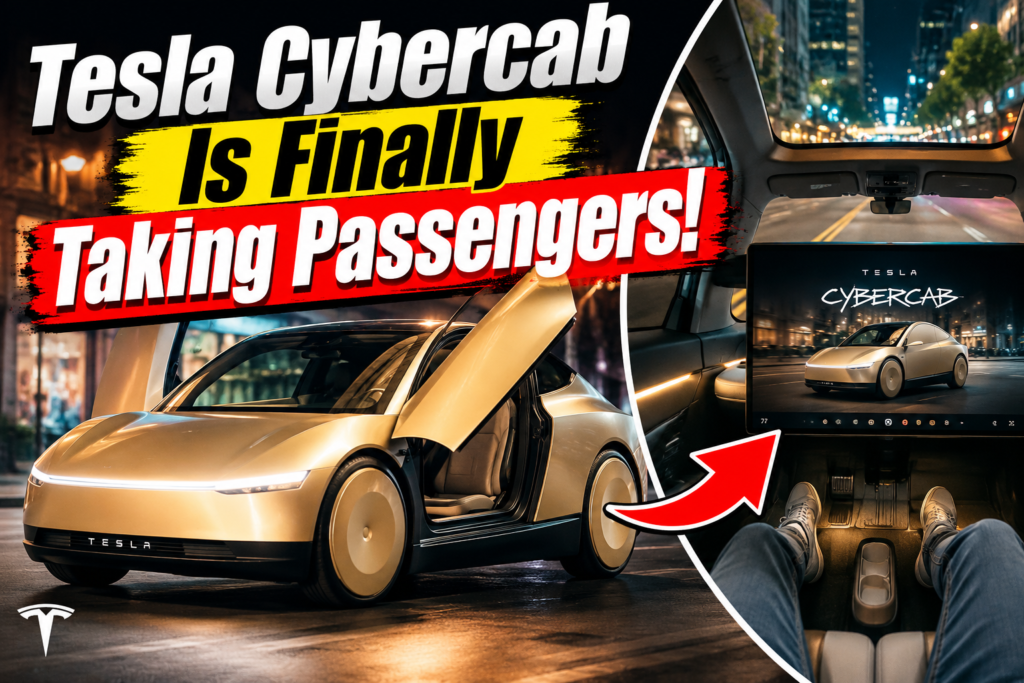
Tesla says the vehicle is designed for full autonomy without a steering wheel or pedals. It has two seats, a central touchscreen and a rear trunk intended to carry passenger luggage and other items.
Tesla had already described the Cybercab as a vehicle designed from the ground up for autonomy. In its 2024 reporting, the company said the vehicle would use its next-generation platform and a new powertrain. Tesla later confirmed that Cybercab production had started and that engineering test drives of production vehicles had begun on public roads.
The important distinction is that Cybercab is the vehicle, while Robotaxi is the service. Tesla’s Robotaxi network currently uses both Cybercab and Model Y vehicles.
A Design Built Around Passengers
The Cybercab’s exterior is deliberately different from a conventional sedan. Its low profile, compact proportions and upward-opening butterfly-style doors give it an unmistakable appearance.
The unusual doors are not merely a styling exercise. Tesla’s rider guide explains that the doors open outward and upward, with automatic opening available when the vehicle detects the ride requester’s phone. Passengers can also operate the doors manually when necessary.
The more important design decision, however, is what Tesla removed.
There is no steering wheel, accelerator pedal or brake pedal. Because there is no driver position to accommodate, the cabin can be organized entirely around the two passengers. Tesla’s current documentation also confirms that there is no front trunk, while the rear trunk provides the primary cargo space.
This changes the purpose of the vehicle. A conventional car is designed first around the person controlling it. The Cybercab is designed around the people being transported.
Inside the Cybercab
The Cybercab has two seats and a large central touchscreen that acts as a major interface between the passengers and the vehicle.
The screen is used for functions that would normally be distributed across physical controls and a conventional dashboard. Passengers can control the doors, adjust the seats and climate, access entertainment and interact with Robotaxi support through the touchscreen.
The two seats can be adjusted through the touchscreen or the Robotaxi mobile app. Tesla’s rider guide specifies 43.4 inches (1,103 mm) of interior legroom and 51.8 inches (1,317 mm) of shoulder room. Rear cargo capacity is listed at 20.2 cubic feet, or 572 liters.
That cargo capacity is particularly relevant because a two-seat robotaxi does not need to behave like a conventional four- or five-passenger vehicle. Tesla can dedicate much of the available space to the needs of a smaller number of passengers and their luggage.
The cabin also includes USB-C charging ports, climate controls, window switches and a cabin camera used for occupancy monitoring.
What Is It Like to Ride in a Cybercab?
The basic process is closer to ordering a ride than operating a car.
A passenger uses the Tesla Robotaxi app, enters a destination within the available service area and reviews the estimated fare and waiting time. After confirming the ride, the app provides information about the arriving vehicle.
Tesla’s rider instructions tell passengers to check that the license plate matches the vehicle shown in the app. Once inside, the passenger selects or adjusts the available settings, fastens the seat belt and starts the ride from the touchscreen.
During the journey, the touchscreen displays trip information and estimated arrival time. Passengers can also adjust the climate and access available entertainment features.
At the destination, the Cybercab moves into Park and passengers can open the doors using the touchscreen or the interior door lever.
That workflow illustrates the fundamental difference between a robotaxi and a normal car: the passenger is interacting with a transportation service rather than taking responsibility for operating the vehicle.
Autonomous Driving: What the Cybercab Actually Does
Tesla describes Robotaxi as a ride-hailing service using its Full Self-Driving technology to provide autonomous rides. The Cybercab is the purpose-built vehicle intended for this service.
It is important, however, not to confuse this with Tesla’s consumer FSD (Supervised) system.
Tesla itself distinguishes the two. FSD (Supervised) requires an attentive human driver who remains ready to take control, whereas Robotaxi vehicles are being deployed for driverless operation within supported service areas. Tesla’s 2026 investor materials describe the expansion of unsupervised Robotaxi operations in selected U.S. locations.
The Cybercab therefore represents a different operational model. Its design assumes that the passenger is not expected to intervene by steering, accelerating or braking.
That does not mean the technology can operate anywhere under any circumstances. Tesla’s current Robotaxi service remains geographically and operationally limited, and availability depends on the supported service area shown in the app.
Cybercab Availability in 2026
As of September 2026, Cybercab rides are available only in limited areas of Austin, Texas, according to Tesla’s current customer information.
Tesla’s wider Robotaxi service has a larger footprint. The company lists limited Robotaxi operations in Austin, Dallas and Houston in Texas, as well as Miami, Orlando and Tampa in Florida. However, those services can use Model Y vehicles as well as Cybercabs, so the broader Robotaxi footprint should not be confused with Cybercab availability.
This distinction matters when discussing Tesla’s autonomous rollout. The company has expanded driverless operations, but the Cybercab itself is still at an early deployment stage.
Tesla reported in July 2026 that it had started Cybercab production and had begun employee rides at its Gigafactory Texas campus. The company also said engineering test drives of production Cybercabs had begun on public roads.
Safety and the Regulatory Question
The lack of a steering wheel and pedals is one of the Cybercab’s defining characteristics—and one of the reasons its deployment has attracted regulatory attention.
On September 4, 2026, NHTSA announced an Audit Query examining Tesla’s self-certification that the Cybercab complies with applicable Federal Motor Vehicle Safety Standards. The agency specifically said it would examine the technical data and processes Tesla relied on when certifying a vehicle without traditional human controls.
This does not mean that NHTSA has determined the Cybercab is unsafe or illegal. It means the agency is reviewing the basis for Tesla’s certification.
That distinction is important. Autonomous vehicles create a regulatory problem that conventional cars do not: many existing vehicle standards were developed around the assumption that a human occupies the driver’s position and has direct control over the vehicle.
Tesla is therefore attempting to deploy a fundamentally different vehicle architecture while regulators are evaluating how existing rules apply to it.
Passenger Safety Features
Removing the driver’s controls does not mean the Cybercab has no conventional occupant-safety equipment.
Tesla’s rider documentation states that both seats have seat belts and that passengers must be buckled before a ride can begin. The belts can automatically tighten under certain driving or collision conditions.
Tesla also provides passengers with a dedicated emergency and support system. The Cybercab has a physical Stop button that can initiate a pull-over request, while passengers can contact Robotaxi Support through the touchscreen.
There is also a cabin camera designed to monitor occupancy. Tesla’s documentation explains that passengers should not obstruct it.
These details highlight an important part of autonomous transportation: the passenger still needs a clear way to communicate with the service and respond to emergencies even though they cannot manually drive the vehicle.
Cybercab Specifications
| Specification | Tesla Cybercab |
|---|---|
| Vehicle type | Purpose-built autonomous electric vehicle |
| Primary role | Robotaxi / autonomous ride-hailing |
| Seating | 2 passengers |
| Steering wheel | No |
| Accelerator pedal | No |
| Brake pedal | No |
| Powertrain | Electric |
| Main passenger interface | Central touchscreen |
| Overall width | 69 in / 1,754 mm |
| Overall height | 55.4 in / 1,408 mm |
| Ground clearance | 5.7 in / 144 mm |
| Interior legroom | 43.4 in / 1,103 mm |
| Interior shoulder room | 51.8 in / 1,317 mm |
| Rear cargo volume | 20.2 cu ft / 572 L |
| Current Cybercab service | Limited areas of Austin, Texas |
The dimensions and cargo figures above come from Tesla’s current Cybercab Rider Guide. Tesla notes that product information can change as the vehicle and software are updated.
What Makes the Cybercab Different From a Model Y Robotaxi?
The easiest comparison is between the Cybercab and the Model Y vehicles Tesla also uses in its Robotaxi fleet.
A Model Y is fundamentally a conventional passenger vehicle that Tesla is operating as an autonomous taxi. The Cybercab, by contrast, was designed specifically for the Robotaxi mission.
That difference explains its two-seat configuration and the absence of conventional driving controls.
Tesla says the Cybercab is intended to become a high-volume vehicle for its Robotaxi fleet. The company’s earlier investor communications also indicated that, once in production, Cybercab would eventually replace existing Model Y vehicles in the fleet and become the largest-volume vehicle in the network over time.
Whether that happens at the expected scale will depend on production, regulatory approval, autonomous-driving performance and the economics of operating the service.
What the Cybercab Could Change
The most interesting aspect of the Cybercab is not its butterfly doors or touchscreen. It is the possibility of treating a vehicle as part of a continuously operating transportation network.
A privately owned car can remain parked for most of the day. A robotaxi, at least in theory, can move from one passenger to another after completing a trip.
That creates a different economic model. Instead of designing a vehicle around a family that may use it for commuting, shopping, weekends and vacations, a two-seat robotaxi can be optimized around frequent short trips and high utilization.
The two-seat layout makes sense in that context. Many urban trips involve only one or two people, so Tesla is effectively trading passenger capacity for a smaller, purpose-built vehicle.
But the potential advantages should not be overstated. A robotaxi network needs enough vehicles, charging infrastructure, maintenance capacity, reliable autonomous operation and regulatory permission to work at scale.
The Cybercab therefore should be viewed as an early implementation of a transportation model—not proof that private car ownership is about to disappear.
What We Know vs. What Has Not Been Confirmed
Confirmed
- Tesla has started production of Cybercab vehicles.
- Cybercab has two seats.
- It does not have a steering wheel, accelerator pedal or brake pedal.
- Cybercab rides are currently available in limited areas of Austin, Texas.
- Tesla provides a dedicated Robotaxi app and rider procedures for Cybercab trips.
- Tesla publishes dimensions and cargo capacity for the current vehicle.
- NHTSA is auditing Tesla’s Cybercab self-certification.
Not Yet Established
The current sources do not establish a final global rollout schedule, a consumer retail price for privately owned Cybercabs, a definitive Robotaxi launch date for every major market, or the final long-term size of Tesla’s Cybercab fleet.
Tesla does provide a process for customers interested in purchasing Cybercab vehicles for commercial purposes, but that is different from announcing normal consumer retail availability.
These distinctions are important because early announcements about autonomous vehicles can easily be interpreted as promises of immediate widespread availability.
Pros and Cons
Potential advantages
- Purpose-built around autonomous passenger transportation.
- Two-seat configuration can suit many urban trips.
- No conventional driver controls, freeing cabin space for passengers.
- Central touchscreen provides a unified passenger interface.
- 572 liters of rear cargo capacity is substantial for a two-seat vehicle.
- Integration with Tesla’s existing Robotaxi service creates a clear operational model.
Current limitations
- Cybercab service remains geographically limited.
- The vehicle depends on Tesla’s autonomous-driving system and supporting infrastructure.
- Regulatory treatment remains under active scrutiny.
- Two seats make it unsuitable for larger groups.
- Tesla has not established normal consumer retail availability.
- The wider economic benefits of autonomous ride-hailing have yet to be demonstrated at large scale.
The Bottom Line
The Tesla Cybercab is now more than a futuristic prototype. Production has started, passengers are riding in the vehicle through limited Austin Robotaxi service, and Tesla has published detailed instructions for operating as a passenger.
Its most important feature is also its most consequential: the Cybercab has been designed without the traditional controls of a driver-operated car.
That creates a fundamentally different passenger experience and allows Tesla to design the vehicle around autonomous ride-hailing rather than private ownership. At the same time, the September 2026 NHTSA audit shows that putting such a vehicle on public roads involves more than demonstrating that autonomous driving can work. The vehicle also has to fit within a regulatory and safety framework originally built around human-controlled automobiles.
For now, the Cybercab should be seen as an early, limited deployment rather than evidence that driverless transportation has already become mainstream. Its next challenge is not simply proving that passengers will ride in it. Tesla must show that the vehicle, its autonomous system and the surrounding Robotaxi operation can scale safely, reliably and within the rules.
FAQ
Is the Tesla Cybercab fully autonomous?
Tesla designed the Cybercab for autonomous Robotaxi operation without a steering wheel, accelerator pedal or brake pedal. Its current Robotaxi service operates only within supported areas, so it should not be interpreted as a vehicle capable of unrestricted autonomous travel everywhere.
How many people can ride in a Cybercab?
The Cybercab has two passenger seats. Tesla’s current specifications and rider guide both identify it as a two-seat vehicle.
Where can I ride in a Tesla Cybercab?
Tesla currently lists Cybercab rides in limited areas of Austin, Texas. The broader Robotaxi service also operates Model Y vehicles in several Texas and Florida cities.
Does the Cybercab have a steering wheel or pedals?
No. Tesla’s current rider documentation states that the Cybercab does not have a steering wheel, accelerator pedal or brake pedal.
How do you order a Cybercab?
A passenger requests a ride through Tesla’s Robotaxi app, enters a destination within the available service area and confirms the estimated fare and wait time. The app then provides information about the arriving vehicle.
How much does the Tesla Cybercab cost?
Tesla has not announced a normal consumer purchase price for the Cybercab in the sources used for this article. Tesla currently provides a contact process for commercial fleet or individual commercial-interest inquiries, which is different from ordinary consumer retail availability.
Is Tesla’s Cybercab being investigated by NHTSA?
Yes. On September 4, 2026, NHTSA announced an Audit Query examining Tesla’s self-certification that the Cybercab meets applicable federal motor vehicle safety standards. The announcement does not itself conclude that the vehicle is unsafe or non-compliant.
Is the Cybercab the same as Tesla FSD?
No. Tesla’s FSD (Supervised) system is designed for vehicles with a human driver who must remain attentive and ready to take control. Cybercab is designed for Tesla’s driverless Robotaxi service.
Sources
- Tesla — Cybercab Rider Guide
- Tesla — Cybercab Overview
- Tesla — Ride with Cybercab
- Tesla — Cybercab Frequently Asked Questions
- Tesla — Dimensions and Specifications
- Tesla Investor Relations — Q2 2026 Update
- NHTSA — NHTSA Opens Investigation into Tesla Cybercab Self-Certification Following Austin Deployment
- Reuters — Tesla starts Cybercab rides in Austin, drawing US safety agency interest