

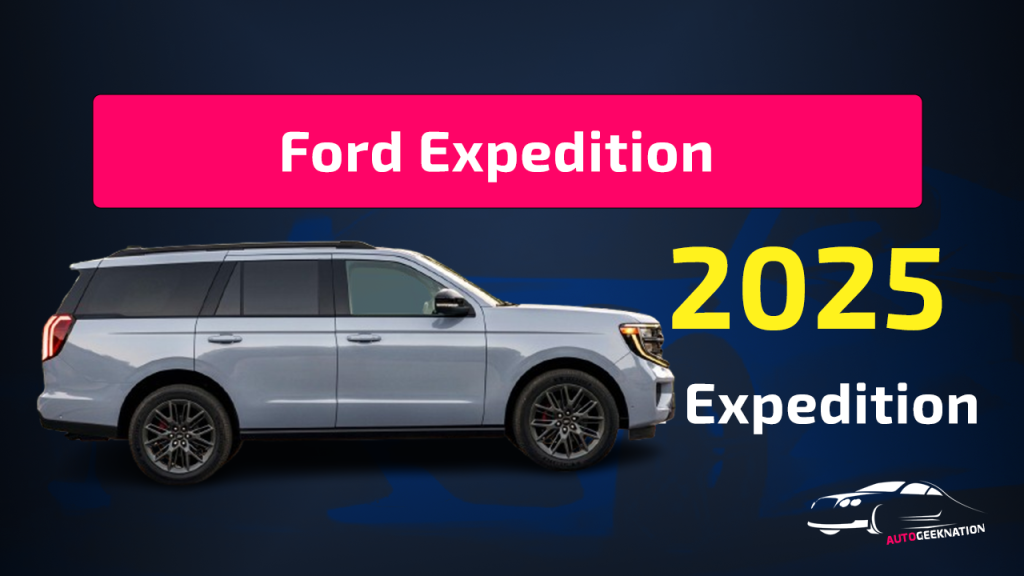
The 2026 Ford Expedition continues the fifth-generation formula introduced for the 2025 model year, combining three-row passenger space, powerful EcoBoost performance, serious towing capability and a technology-focused cabin.
Rather than introducing another major redesign for 2026, Ford carries forward the architecture and features introduced with the recent update. That includes the distinctive Split Gate, the large 24-inch dashboard display, the off-road-oriented Tremor model, flexible seating and available Ford BlueCruise.
Available in both standard-wheelbase and extended-length Expedition MAX forms, the Expedition is designed for buyers who need considerably more space and capability than a midsize SUV can provide.
The current U.S. lineup uses a twin-turbocharged 3.5-liter V6 paired with a 10-speed automatic transmission. Depending on configuration, the engine produces either 400 horsepower and 480 lb-ft of torque or 440 horsepower and 510 lb-ft in high-output form.
A Full-Size SUV Designed Around Family Life
The Expedition has always been positioned as one of Ford’s largest family vehicles, but the latest generation puts greater emphasis on how families actually use a three-row SUV.
The standard Expedition provides substantial passenger and cargo space while remaining shorter than the Expedition MAX. Buyers who regularly travel with large amounts of luggage, sports equipment or camping gear can choose the extended-wheelbase MAX.
The Expedition can seat up to eight passengers, depending on configuration, while second-row captain’s chairs are available for buyers who prefer a seven-seat layout.
The third row is also one of the Expedition’s important advantages. Unlike some three-row SUVs where the rearmost seats are best suited to children, the Expedition provides meaningful space for adults.
For families, that makes the vehicle useful not only for occasional third-row passengers but also for long road trips.
Expedition and Expedition MAX: Two Ways to Go Big
Ford offers two body lengths.
The standard Expedition is the more maneuverable choice, while the Expedition MAX adds significant length to increase cargo capacity.
The MAX measures approximately 221.7 inches long with a 131.5-inch wheelbase. Its additional body length creates considerably more usable room behind the third row. Car and Driver lists approximately 36 cubic feet of cargo space behind the third row in the MAX.
That difference becomes especially useful when all three rows are occupied.
A family of seven or eight can travel with luggage without necessarily having to sacrifice third-row seating.
The trade-off is obvious: the MAX is a very large vehicle. Its additional length can make parking garages, narrow streets and tight parking spaces more challenging.
400 or 440 Horsepower From the EcoBoost V6
The Expedition does not rely on a large-displacement V8.
Instead, Ford uses a 3.5-liter twin-turbocharged EcoBoost V6.
The standard version produces:
- 400 horsepower
- 480 lb-ft of torque
- 10-speed automatic transmission
A high-output version increases those numbers to:
- 440 horsepower
- 510 lb-ft of torque
Both versions provide substantial torque, which is particularly useful for towing and accelerating a heavily loaded SUV.
The 440-hp version is particularly interesting because the Expedition is capable of surprisingly strong acceleration despite its size.
Car and Driver tested an Expedition MAX equipped with the high-output engine and recorded 0–60 mph in 4.9 seconds. The tested vehicle weighed nearly 6,000 pounds, making that performance particularly notable for a full-size three-row SUV.
Of course, the Expedition isn’t intended to be a sports car. Its acceleration is better understood as useful reserve power for highway merging, passing and towing.
The Expedition Tremor Brings Off-Road Hardware
For buyers who want more than highway and towing capability, Ford continues to offer the Expedition Tremor.
The Tremor replaces the previous Timberline concept with a more explicitly off-road-focused configuration.
It uses the 440-hp high-output 3.5-liter EcoBoost V6 and four-wheel drive, along with hardware designed for rougher terrain.
The Tremor includes:
- 33-inch all-terrain tires
- off-road-tuned suspension
- increased ground clearance
- underbody protection
- electronic locking rear differential
- Rock Crawl mode
- Trail Control
- Trail Turn Assist
- front tow hooks
- dedicated off-road drive modes
Car and Driver notes that the Tremor uses a raised suspension, skid plates and 33-inch General Grabber all-terrain tires, along with Rock Crawl and Trail Turn Assist.
The result is still a very large SUV, but one that can be taken farther away from paved roads than a conventional Expedition.
That distinction is important.
The Tremor is not designed to turn the Expedition into a lightweight rock-crawling machine. Instead, it gives families the ability to reach campsites, trails and recreational destinations while retaining the passenger and cargo capacity expected from a full-size SUV.
Ford Split Gate Makes the Cargo Area More Useful
One of the most recognizable features introduced with the fifth-generation Expedition is the Ford Split Gate.
Instead of using a conventional single-piece liftgate, the system separates the rear opening into two sections.
The upper portion operates like a traditional liftgate, while the lower portion folds down.
This makes it easier to access the cargo area and can provide a convenient platform when the vehicle is parked.
Ford designed the system around activities such as tailgating, camping and outdoor events.
The lower section can support up to 500 pounds, giving owners another practical surface for loading, organizing equipment or sitting while preparing for an activity.
It’s a relatively simple idea, but one that fits the Expedition’s role as a family and recreation vehicle.
Flexible Seating for Passengers and Cargo
A three-row SUV has to solve a difficult problem: families often need maximum passenger capacity and maximum cargo capacity at different times.
The Expedition addresses this with flexible seating and power-folding rear seats.
The third row can be folded to increase cargo capacity, while the second row can also be configured depending on whether passengers or larger objects are being transported.
Car and Driver reports that both the second and third rows can fold flat, creating a more useful loading area. In its testing, the publication fitted seven carry-on suitcases behind the third row and 48 with the second and third rows folded.
This is where the Expedition’s size becomes an advantage rather than simply a disadvantage.
For families moving furniture, sports equipment, luggage or outdoor gear, the interior can function almost like a cargo van while retaining three-row seating when needed.
A 24-Inch Digital Dashboard
The redesigned Expedition also brought a major change to the cabin’s technology.
Every 2026 Expedition features a 24-inch dashboard display that integrates digital vehicle information with the broader infotainment experience.
The system uses Google software and supports features including:
- wireless Apple CarPlay
- wireless Android Auto
- Google Maps
- Google Play applications
- over-the-air updates
- onboard Wi-Fi
The large display gives the dashboard a distinctly more modern appearance than the previous-generation Expedition.
More importantly, the system is designed around a vehicle where passengers may spend several hours inside.
For families, connectivity can be just as important as horsepower.
Technology for Long Road Trips
Ford’s technology strategy for the Expedition goes beyond the driver’s seat.
The large cabin allows the SUV to function as a mobile environment for work, entertainment and travel.
Depending on configuration, occupants can benefit from multiple charging points, device-storage solutions and connectivity features designed to keep passengers occupied during long journeys.
The available Wi-Fi functionality can also allow passengers to connect their own devices without relying entirely on cellular data connections.
For families who regularly drive several hours to reach vacation destinations, these details can have a surprisingly large impact on the ownership experience.
Ford BlueCruise for Highway Driving
The Expedition is also available with Ford BlueCruise, Ford’s hands-free highway driving system.
On compatible roads and under appropriate conditions, BlueCruise can control steering, acceleration and braking while the driver remains responsible for monitoring the road and being prepared to take control.
The system is particularly relevant to the Expedition’s role as a long-distance family vehicle.
A large SUV that spends significant time on highways can benefit from technology that reduces some of the driver’s workload during extended journeys.
However, BlueCruise should not be confused with fully autonomous driving. The driver remains responsible for the vehicle at all times.
Towing: One of the Expedition’s Biggest Strengths
Towing is one of the areas where the Expedition separates itself from many three-row SUVs.
When properly equipped, the standard-wheelbase 2026 Ford Expedition can tow up to 9,600 pounds.
The longer Expedition MAX is rated up to 9,000 pounds.
That difference is important.
The MAX provides more cargo room, but the standard-wheelbase Expedition has the higher maximum towing rating.
Actual towing capacity depends on configuration, drivetrain, equipment, passengers, cargo and trailer setup, so the 9,600-pound figure should not be treated as the rating of every Expedition.
The SUV can also be equipped with technologies intended to make trailer operation easier, including:
- Pro Trailer Hitch Assist
- Pro Trailer Backup Assist
- trailer sway control
- integrated trailer brake controller
- dedicated towing equipment
For owners towing a boat, camper, utility trailer or recreational equipment, these systems can make the Expedition a genuine alternative to a pickup truck.
How Much Can the Expedition Really Tow?
The headline 9,600-pound maximum is impressive, but it is important to understand that not every configuration reaches it.
For example, Car and Driver lists a 2026 Expedition Active 4×2 with a maximum towing capacity of 6,100 pounds, while a 2026 Expedition MAX Platinum 4×4 is listed at 9,000 pounds.
This is why buyers should check the exact vehicle configuration rather than relying only on the model’s maximum advertised rating.
For a serious towing purchase, the trailer’s loaded weight, passengers, cargo, drivetrain and factory towing equipment should all be considered.
Fuel Economy Comes With a Full-Size SUV Trade-Off
The Expedition’s size and power inevitably affect fuel consumption.
According to Car and Driver’s current 2026 data, rear-wheel-drive versions can reach approximately 17 mpg city and 23 mpg highway, while four-wheel-drive models are rated at around 16 mpg city and up to 22 mpg highway, depending on configuration.
The 2026 U.S. Expedition lineup remains gasoline-powered rather than hybrid.
That means buyers choosing the Expedition are prioritizing space, towing, power and capability over maximum fuel efficiency.
For a vehicle of this size, however, the EcoBoost V6 provides a strong combination of torque and performance without requiring a traditional V8.
Driving the Expedition
The Expedition is built primarily for comfort and utility rather than sporty handling.
Its independent rear suspension helps provide a smoother ride, particularly on highways, while the turbocharged V6 delivers strong acceleration when needed.
But its sheer size remains impossible to hide.
Car and Driver describes the Expedition as comfortable and capable but notes that its large dimensions and relatively imprecise steering can make it feel less agile than some competitors.
That isn’t necessarily a weakness for the target customer.
Someone buying an Expedition is generally looking for space and capability rather than sports-car handling.
The priorities are different: comfortable highway cruising, stable towing, three-row room and the ability to carry a large family and its equipment.
Expedition MAX: The Choice for Maximum Cargo
The Expedition MAX is aimed at buyers for whom cargo capacity is more important than maneuverability.
Its extended body creates more room behind the third row, making it especially useful when all seats are occupied.
This is one of the most important differences between the two models.
If a family regularly travels with seven or eight people and luggage, the standard Expedition can eventually force compromises.
The MAX reduces those compromises.
The downside is that its roughly 222-inch overall length makes it a serious vehicle to maneuver in urban environments.
For frequent long-distance travel, however, that extra space can be extremely valuable.
2026 Ford Expedition Pricing
For the U.S. market, Car and Driver currently lists the 2026 Ford Expedition range from approximately $65,495 to $87,155, depending on body style, trim and equipment.
A specific 2026 Expedition Active 4×2 is listed at $65,495, while a 2026 Expedition MAX Platinum 4×4 is listed at approximately $80,045 before additional options and charges.
Actual transaction prices can vary depending on destination charges, options, dealer pricing and market conditions.
The higher trims can also move into luxury-SUV territory, particularly when expensive appearance, technology and comfort packages are added.
What Changed From the 2025 Model?
The biggest mistake would be to describe the 2026 Expedition as a completely redesigned vehicle.
That happened for 2025.
The fifth-generation Expedition introduced the new exterior, Split Gate, redesigned cabin, 24-inch display and Tremor model.
For 2026, Ford largely carries that package forward rather than introducing another major redesign. Car and Driver explicitly describes the 2026 Expedition as largely unchanged following the previous year’s update.
That actually makes the 2026 model easier to understand.
It is the second model year of a major redesign, giving buyers access to the new architecture and technology without waiting for another generation.
2026 Ford Expedition vs. Its Full-Size SUV Rivals
The Expedition competes in one of the most demanding SUV categories, alongside vehicles such as the Chevrolet Tahoe, GMC Yukon, Chevrolet Suburban, Toyota Sequoia and Jeep Grand Wagoneer.
Its strongest argument is the combination of:
- up to eight-passenger seating
- 400-hp standard EcoBoost V6
- 440-hp high-output option
- up to 9,600 pounds of towing
- Expedition MAX extended-wheelbase option
- available Tremor off-road model
- 24-inch digital dashboard
- available BlueCruise
- flexible three-row interior
Car and Driver currently rates the 2026 Expedition 8/10, describing it as a spacious, capable full-size SUV with strong performance and towing ability.
The competition can offer different strengths, particularly hybrid powertrains, diesel engines, luxury appointments or different approaches to off-road capability.
The Expedition’s identity is more straightforward: it is a large family hauler with serious towing ability and strong gasoline performance.
Is the 2026 Ford Expedition a Good Family SUV?
For families that actually need the dimensions of a full-size SUV, the Expedition makes a strong case.
Its biggest advantage is not one particular technology feature.
It is the combination of space and capability.
You can carry up to eight people, fold the rear seats for large cargo, tow a substantial trailer and choose the MAX when additional cargo room is more important.
The Tremor adds another dimension for families who spend weekends camping or exploring trails.
The 24-inch display and connectivity features then bring the cabin into the modern digital era.
The major downside is equally obvious: the Expedition is large, expensive and relatively fuel-hungry compared with smaller SUVs.
For a buyer who doesn’t need its towing or interior capacity, a smaller SUV will likely be easier and cheaper to live with.
But for someone who does need those capabilities, the Expedition’s size is precisely the reason to buy it.
Final Verdict
The 2026 Ford Expedition isn’t a revolution compared with the 2025 model.
It doesn’t need to be.
Ford’s fifth-generation redesign already addressed the major areas of the vehicle, introducing a more modern cabin, the Split Gate, a huge digital interface, flexible seating and the Tremor off-road model.
For 2026, those features continue to make the Expedition one of the most capable family-oriented full-size SUVs on the market.
Its 400-hp standard EcoBoost V6 provides substantial performance, while the available 440-hp high-output engine adds even more capability.
The headline towing capacity reaches 9,600 pounds for properly equipped standard-wheelbase models, while the Expedition MAX provides up to 9,000 pounds of towing along with additional cargo room.
The Tremor expands the vehicle’s abilities beyond pavement, while the Split Gate and flexible interior focus on the practical details that matter during family trips.
Ultimately, the 2026 Expedition succeeds because it doesn’t try to be everything to everyone.
It is a large, powerful and highly capable family SUV for buyers who genuinely need three rows, significant cargo space and serious towing ability.
For those buyers, the Expedition remains a compelling alternative to a full-size pickup truck—especially when passenger comfort and enclosed cargo space are just as important as towing.
Frequently Asked Questions
Is the 2026 Ford Expedition redesigned?
No. The major fifth-generation redesign arrived for the 2025 model year. The 2026 Expedition largely carries the redesigned vehicle forward.
How much horsepower does the 2026 Ford Expedition have?
The standard 3.5-liter twin-turbo V6 produces 400 horsepower and 480 lb-ft of torque. A high-output version produces 440 horsepower and 510 lb-ft.
How much can the 2026 Ford Expedition tow?
The standard-wheelbase Expedition can tow up to 9,600 pounds when properly equipped. The Expedition MAX is rated up to 9,000 pounds. Actual capacity depends on configuration and equipment.
Is the Expedition MAX bigger than the regular Expedition?
Yes. The Expedition MAX has a longer body and wheelbase, providing additional cargo space, particularly behind the third row. The MAX measures about 221.7 inches long.
What is the Ford Expedition Tremor?
The Tremor is the off-road-oriented Expedition. It combines the 440-hp high-output V6 with four-wheel drive, a raised suspension, 33-inch all-terrain tires, skid plates, a locking rear differential and dedicated off-road driving modes.
Does the 2026 Expedition have a hybrid engine?
No. The current U.S. 2026 Expedition lineup uses gasoline-powered 3.5-liter EcoBoost V6 engines.
How many people can the Ford Expedition seat?
Depending on configuration, the Expedition can seat up to eight passengers. Seven-seat configurations with second-row captain’s chairs are also available.
Does the 2026 Expedition have BlueCruise?
Yes. Ford offers BlueCruise hands-free highway driving on the Expedition, subject to system availability, compatible roads and operating conditions.
What is the Ford Expedition Split Gate?
The Split Gate is Ford’s two-part rear cargo-door design. The upper portion opens like a conventional liftgate while the lower section folds down, providing easier cargo access and a useful platform when parked.
How much does the 2026 Ford Expedition cost?
Current U.S. pricing starts around $65,495 according to Car and Driver, with higher trims and configurations reaching approximately $87,155 before applicable options and charges.
Sources
- Ford — 2026 Expedition Technical Specifications
Ford 2026 Expedition Technical Specifications - Ford — 2026 Expedition Towing Guide
Ford 2026 Expedition Towing Guide - Ford — 2026 Expedition Order Guide
Ford 2026 Expedition Order Guide - Car and Driver — 2026 Ford Expedition Review, Pricing and Specs
Car and Driver — 2026 Ford Expedition - Car and Driver — 2026 Ford Expedition Specifications
Car and Driver — 2026 Expedition Specifications - Car and Driver — 2026 Ford Expedition Active Specifications
Car and Driver — 2026 Expedition Active 4×2