

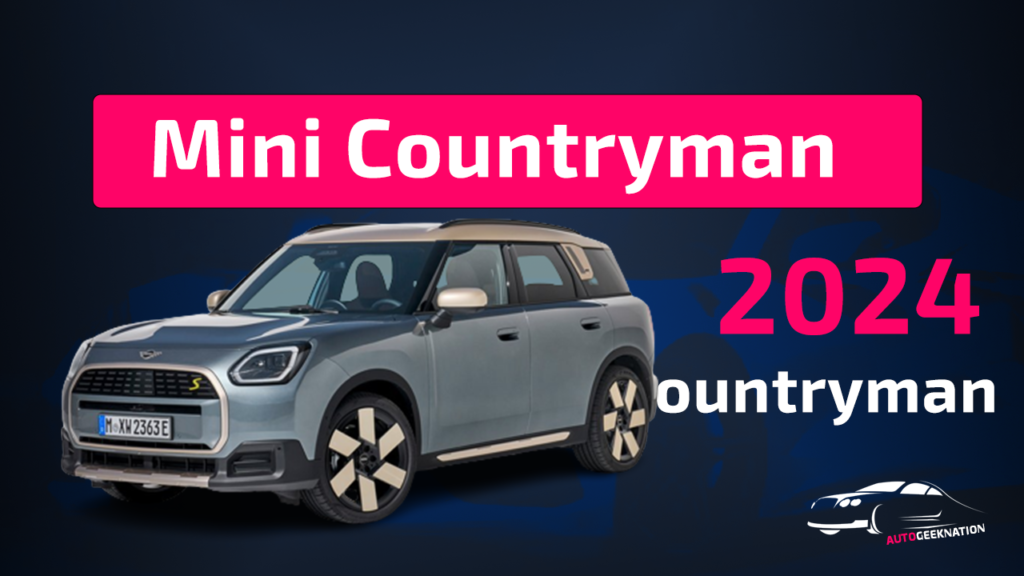
The MINI Countryman has changed significantly with its third generation. What was once the largest model in the MINI range has become a substantially more versatile SUV, with petrol and fully electric versions sharing the same generation.
Unlike the old Countryman, which offered a plug-in hybrid among its electrified options, the current generation introduced dedicated battery-electric versions: the MINI Countryman E and the more powerful MINI Countryman SE ALL4.
The electric Countryman entered production in 2024 at BMW Group Plant Leipzig in Germany, where MINI Countryman models are manufactured alongside several BMW models. The plant also produces the high-voltage batteries for the electric Countryman.
MINI Countryman – official MINI Australia page
A Much Larger Countryman
The third-generation Countryman is not simply a mild update of the previous SUV. MINI has moved the model further into the compact-SUV category, giving it more space and a more substantial road presence.
That change is important because the Countryman now has to serve a wider range of buyers than the smaller MINI Cooper. It is intended to combine MINI’s distinctive design and technology with the practicality expected from a family-oriented SUV.
The result is a Countryman that makes more sense as a daily vehicle for people who need additional passenger and cargo space without moving into a much larger SUV.
The Countryman E: The Entry Point to Electric Driving
The MINI Countryman E uses a front-wheel-drive electric powertrain.
At its original European launch, the E produced 150 kW (204 hp) and 250 Nm. BMW Group quoted a 0–100 km/h time of around 8.6 seconds and a top speed of 170 km/h.
Current market specifications can differ, however. For example, MINI Australia lists the electric Countryman range at 150–230 kW, reflecting the E and SE ALL4 versions available in that market.
This is worth highlighting because MINI specifications are not identical in every country. Equipment, performance figures and even published range can vary depending on market configuration.
Countryman SE ALL4: More Power and All-Wheel Drive
At the other end of the electric range is the MINI Countryman SE ALL4.
Its dual-motor setup provides 230 kW (313 hp) and 494 Nm, with electric power sent to all four wheels through MINI’s ALL4 all-wheel-drive system. BMW Group introduced it as the performance-oriented electric version of the Countryman.
The SE ALL4 was originally quoted with a 0–100 km/h time of 5.6 seconds and a top speed of 180 km/h.
Current Australian MINI documentation lists the SE ALL4 at 230 kW and 494 Nm, with a 0–100 km/h time of 5.8 seconds in its current specification.
That small difference demonstrates why readers should always check the specification sheet for the exact market and model year rather than assuming that every Countryman SE has identical figures worldwide.
Battery and Electric Range
One of the most important changes for the Countryman is the move to a dedicated battery-electric drivetrain.
The electric models use a battery with approximately 65 kWh usable capacity, with MINI Australia currently listing 64.8 kWh. The official Australian charging information gives the same battery capacity for both the Countryman E and SE ALL4.
Range depends on the version and market.
MINI Australia currently quotes a 467–501 km WLTP combined range across its electric Countryman versions, with the Countryman E reaching up to 501 km and the SE ALL4 up to 467 km.
Earlier European launch specifications quoted lower figures for some configurations, which explains why older articles may list approximately 464 km for the E and 433 km for the SE ALL4.
The important point is that WLTP range is an official laboratory figure, not a guarantee of real-world driving distance. Weather, speed, temperature, wheel choice, driving style and use of heating or air conditioning can all affect actual range.
Charging: 10–80 Percent in About 29 Minutes
The electric Countryman supports DC fast charging at up to 130 kW.
According to MINI Australia’s current charging information, both the Countryman E and SE ALL4 can charge from 10 to 80 percent in approximately 29 minutes using a suitable 130 kW DC charging station.
MINI also lists AC charging capability of up to 22 kW where the appropriate vehicle and charging equipment are available.
The company’s charging figures are based on controlled conditions, so charging time can be longer depending on battery temperature, state of charge, charger output and other conditions.
For everyday use, this means the Countryman Electric is better suited to road trips than an EV that requires significantly longer stops, although charging infrastructure remains an important consideration.
Practicality Is Still a Major Part of the Countryman’s Appeal
The electric drivetrain doesn’t turn the Countryman into a purely technology-focused vehicle. Practicality remains one of the model’s main reasons for existing.
The SUV offers five seats and a more useful interior footprint than smaller MINI models. The current electric Countryman also provides a large luggage area for a compact SUV, with MINI emphasizing its everyday usability and flexible interior.
That makes the Countryman Electric particularly interesting for buyers who like the design and character of MINI but need something capable of handling family duties.
Interior Technology
The third-generation Countryman also introduced MINI’s new interior design philosophy.
One of its most recognizable elements is the large circular central OLED display, which acts as the main interface for infotainment and vehicle functions.
Depending on specification and market, the Countryman can also be equipped with features such as:
- MINI Navigation
- smartphone connectivity
- advanced driver-assistance systems
- parking assistance
- head-up display
- MINI Experience Modes
- connected services through the MINI App
- wireless smartphone integration
- premium audio equipment
The MINI App can also be used to monitor charging status, locate charging stations and control selected vehicle functions remotely.
What Happened to the Petrol Countryman?
The arrival of the electric Countryman did not mean MINI immediately abandoned combustion engines.
The third-generation Countryman was developed with different propulsion options, including petrol and diesel engines in selected markets. BMW Group confirmed that combustion-powered and electric Countryman models could be produced on the same flexible production line at Leipzig.
However, the engine lineup is market-dependent and has changed over time.
For example, MINI Australia’s current range includes the Countryman C, Countryman S ALL4 and John Cooper Works Countryman ALL4, alongside the separate all-electric Countryman E and SE ALL4 range.
This is another reason why an old 2024 specification table should not automatically be treated as the specification of a Countryman sold today.
MINI Countryman Electric vs SE ALL4
The choice between the two electric versions is relatively straightforward.
| Specification | Countryman E | Countryman SE ALL4 |
|---|---|---|
| Drive | Front-wheel drive | All-wheel drive |
| Power | 150 kW / 204 hp | 230 kW / 313 hp |
| Torque | 250 Nm | 494 Nm |
| Battery | 64.8 kWh | 64.8 kWh |
| WLTP range* | Up to 501 km | Up to 467 km |
| DC charging | Up to 130 kW | Up to 130 kW |
| 10–80% DC | Approx. 29 min | Approx. 29 min |
*Current MINI Australia figures. Specifications can vary by market, equipment and model year.
The E makes more sense if maximum range and lower performance are the priority. The SE ALL4 sacrifices some range for substantially more power and all-wheel-drive traction.
Is the Countryman Electric Related to the BMW X1?
The Countryman and BMW X1 are closely connected within the BMW Group’s compact-vehicle architecture and production strategy.
The relationship is more meaningful than simply sharing a factory. Both belong to the BMW Group’s compact SUV family, while the Countryman is designed around MINI’s own styling, interior philosophy and driving character.
The Leipzig production line demonstrates how closely the group’s manufacturing strategy has become integrated: BMW and MINI models can be produced together using a flexible manufacturing system.
That helps explain why the latest Countryman is considerably larger and more technically sophisticated than earlier generations.
The Countryman Is Now Made in Germany
The third-generation Countryman is particularly significant for MINI because it became the first MINI model produced in Germany.
BMW Group began Countryman production at its Leipzig plant in 2023, followed by production of the fully electric versions in 2024. The facility manufactures both combustion-powered and electric Countryman models.
The Leipzig plant also manufactures high-voltage batteries for the electric Countryman, making it an important part of BMW Group’s European EV production network.
What Makes the Third-Generation Countryman Different?
The biggest change is not one particular specification. It is the role the Countryman now plays within MINI’s range.
It is:
- Larger than previous Countryman generations.
- Available with fully electric powertrains.
- Offered with front- or all-wheel drive depending on version.
- Built in Germany for global markets.
- More focused on digital technology.
- More practical as a family SUV.
- Available with both electric and combustion powertrains depending on market.
The electric versions also give MINI buyers a genuine choice between efficiency and performance rather than forcing everyone into the same setup.
Is the MINI Countryman Electric Worth Considering?
The Countryman Electric makes the most sense for someone who wants an EV but doesn’t want a conventional-looking compact SUV.
The Countryman E is the more efficiency-oriented choice, particularly if range matters more than acceleration. The SE ALL4 is the enthusiast option, adding substantially more power and all-wheel drive while accepting a reduction in official WLTP range.
Its biggest advantage is arguably the combination of compact-SUV practicality and MINI’s distinctive design and interior experience.
However, prospective buyers should pay close attention to local pricing, charging infrastructure and the exact equipment level. MINI’s specifications vary considerably between markets, and figures published for the 2024 launch should not automatically be applied to every current Countryman.
FAQ
Is the MINI Countryman available as an electric car?
Yes. The third-generation Countryman introduced fully electric versions, including the Countryman E and Countryman SE ALL4.
What is the range of the MINI Countryman Electric?
Current MINI Australia figures give a WLTP combined range of up to 501 km for the Countryman E and up to 467 km for the SE ALL4.
How powerful is the MINI Countryman SE ALL4?
The electric SE ALL4 produces 230 kW (313 hp) and 494 Nm in the specification listed by MINI Australia.
How fast can the Countryman SE ALL4 accelerate?
The original launch specification quoted 0–100 km/h in 5.6 seconds, while current Australian documentation lists 5.8 seconds. Always check the specification for the exact market and model year.
How long does the MINI Countryman Electric take to charge?
MINI Australia quotes approximately 29 minutes for 10–80% DC charging at up to 130 kW.
Does the electric Countryman have all-wheel drive?
Only the Countryman SE ALL4 has electric all-wheel drive. The Countryman E uses front-wheel drive.
Is there still a petrol MINI Countryman?
Yes. MINI continues to offer combustion-powered Countryman models in some markets, although the exact engine and trim lineup differs by country.
Where is the MINI Countryman made?
The third-generation Countryman is produced at BMW Group Plant Leipzig in Germany. The plant manufactures both electric and combustion-powered Countryman models.
Is the MINI Countryman Electric’s range the same in every country?
No. Official range figures can vary because of market-specific specifications, wheels, equipment and homologation. Range figures should always be identified by their test cycle, such as WLTP.
Sources
- MINI Australia – All-Electric MINI Countryman
- MINI Australia – Countryman Range and Charging
- MINI Australia – MINI Countryman
- BMW Group – Production launch of the MINI Countryman Electric
- BMW Group – Production launch of the MINI Countryman