

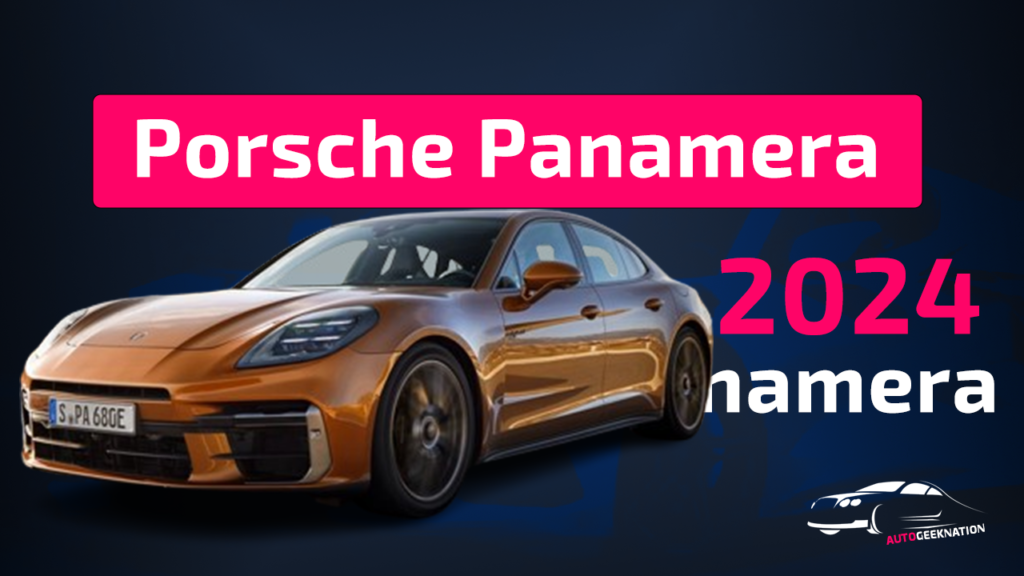
The Porsche Panamera has always occupied an unusual position in the Porsche range. It is a four-door luxury car designed to provide the practicality of a large sedan without abandoning the performance and driving character expected from the Stuttgart sports-car manufacturer.
The third-generation Panamera takes that formula further with a redesigned interior, more advanced suspension technology and a broader range of plug-in hybrid powertrains. The lineup now stretches from the rear-wheel-drive Panamera with a twin-turbo V6 to the 782-hp Panamera Turbo S E-Hybrid, giving buyers a much wider choice between traditional combustion power, efficiency and outright performance.
For 2026, the Panamera is no longer simply a new-generation luxury sedan. It has become one of Porsche’s most technically sophisticated road cars.
A third-generation Panamera with a familiar silhouette
Porsche has deliberately avoided turning the Panamera into something unrecognisable.
The third-generation car retains the model’s characteristic long, low proportions and five-door fastback-style body, but Porsche has refined the exterior with new lighting, redesigned air openings and stronger horizontal visual elements.
The changes are particularly noticeable around the front and rear ends, while the overall silhouette remains recognisably Panamera.
That approach makes sense for Porsche. The Panamera is not intended to be a radical departure from its predecessors; it is an evolution of the formula that combines sports-car performance with everyday usability.
The suspension is one of the Panamera’s biggest innovations
One of the most important changes is underneath the body.
The current Panamera comes standard with an adaptive two-chamber air suspension with two-valve dampers and Porsche Active Suspension Management (PASM). The two-valve system allows compression and rebound damping to be controlled separately, giving Porsche more freedom to balance ride comfort and body control.
The result is a chassis designed to behave differently depending on the driving situation.
On a rough road, the suspension can prioritise comfort and absorb imperfections. During faster driving, the system can provide stronger body control to reduce unwanted movement.
Porsche Active Ride
For the E-Hybrid versions, Porsche offers an even more sophisticated option: Porsche Active Ride.
Unlike a conventional adaptive suspension, Active Ride uses electrically driven hydraulic pumps connected to the individual dampers. The system can actively control the forces at each wheel and dramatically reduce body movement during braking, acceleration and cornering.
One of its most unusual capabilities is its ability to counteract body pitch and roll. In the appropriate setting, the Panamera can even lean into corners, creating a motorcycle-like visual effect.
When the car is stationary, the system can also raise the body to make entering and exiting easier.
This technology illustrates the basic philosophy of the new Panamera: it does not force owners to choose between a comfortable luxury sedan and a sporty Porsche. It attempts to provide both.
The Panamera E-Hybrid family has expanded
The original launch article focused heavily on the Panamera Turbo E-Hybrid. That is no longer the complete picture.
Porsche now offers several plug-in hybrid versions, including:
- Panamera 4 E-Hybrid
- Panamera 4S E-Hybrid
- Panamera Turbo E-Hybrid
- Panamera Turbo S E-Hybrid
All of these combine a petrol engine with an electric motor and all-wheel drive.
The basic technology is shared across the E-Hybrid family: a 25.9-kWh gross high-voltage battery, a 140-kW (190-PS) electric motor and an 11-kW onboard AC charger. Porsche says the new battery stores around 45% more energy than the previous generation while occupying a comparable amount of space.
The electric motor is integrated into the housing of the eight-speed PDK dual-clutch transmission rather than using a separate motor housing. Porsche says this approach saves around five kilograms and also helps with thermal management.
Panamera 4 E-Hybrid: the more accessible plug-in hybrid
The Panamera 4 E-Hybrid provides a lower entry point into the plug-in hybrid range.
Current Porsche Morocco specifications list:
- 470 hp combined output
- All-wheel drive
- 0–100 km/h in 4.1 seconds with Sport Chrono
- Top speed of 280 km/h
- Up to 96 km of combined electric range under the listed ECE measurement
- Starting price from MAD 1,486,000 in Morocco
That makes the 4 E-Hybrid particularly interesting for buyers who want Porsche performance but also expect to complete shorter daily journeys using electric power.
Panamera 4S E-Hybrid: a stronger middle ground
Above the 4 E-Hybrid sits the Panamera 4S E-Hybrid.
It combines the 2.9-litre twin-turbo V6 with the electric motor to produce 544 hp. Porsche quotes a 0–100 km/h time of 3.7 seconds with Sport Chrono and a top speed of 290 km/h.
This version is arguably the middle ground of the E-Hybrid family: significantly more powerful than the 4 E-Hybrid while avoiding the size and performance focus of the V8-powered Turbo models.
Panamera Turbo E-Hybrid: 680 hp from a V8 hybrid
The Panamera Turbo E-Hybrid remains one of the most impressive combinations of combustion and electric power in the range.
Its powertrain pairs a revised 4.0-litre twin-turbo V8 with the 190-PS electric motor.
Together they produce:
- 680 hp
- 930 Nm
- 0–100 km/h in 3.2 seconds
- Top speed of 315 km/h
- Up to around 92 km of electric range on Porsche Morocco’s current specification
- Starting price from MAD 2,324,000 in Morocco
The 25.9-kWh battery can be charged through the standard 11-kW AC onboard charger. Porsche quotes approximately 2 hours and 39 minutes for a full charge under suitable 11-kW conditions.
The Turbo E-Hybrid therefore isn’t simply a V8 with a small electric motor attached. The electric system plays a significant role in both performance and efficiency.
Panamera Turbo S E-Hybrid: 782 hp at the top
The current flagship is the Panamera Turbo S E-Hybrid.
Its combined output reaches 782 hp, making it substantially more powerful than the 680-hp Turbo E-Hybrid.
Porsche lists:
- 782 hp
- 0–100 km/h in 2.9 seconds
- Top speed of 325 km/h
- Up to 92 km combined electric range on the current Porsche Morocco specification
- All-wheel drive
- Starting price from MAD 2,664,000 in Morocco
That 2.9-second acceleration figure places the Panamera Turbo S E-Hybrid firmly in sports-car territory despite its four-door luxury-car mission.
Porsche also equips the Turbo S E-Hybrid with Porsche Ceramic Composite Brakes (PCCB) as standard, with yellow brake calipers.
Turbonite gives the Turbo models their own identity
Porsche uses Turbonite to visually distinguish the Turbo models.
The grey metallic colour appears on exterior details and is carried into the cabin, where it can be combined with contrasting trim and stitching. The Turbo S E-Hybrid also receives distinctive exterior elements and Dark Bronze tailpipes.
These aren’t merely cosmetic changes. Porsche uses the Turbonite treatment to establish a visual identity for the highest-performance versions of its model families.
A driver-focused interior
Inside, the Panamera follows Porsche’s newer cockpit philosophy.
The Porsche Driver Experience places important driving information directly in front of the driver while keeping frequently used controls within easy reach.
The cabin combines digital displays with physical controls rather than attempting to place every function behind a touchscreen.
Porsche has also redesigned the centre console and dashboard to create a more driver-focused environment.
The result is more modern than the previous-generation Panamera without completely abandoning the physical interaction that remains important when driving a performance car.
Passenger display and digital connectivity
The Panamera can also be equipped with a dedicated passenger display.
This allows the front passenger to interact with entertainment and other digital functions without forcing the driver to use the main central screen.
The car is also designed to integrate more closely with the owner’s digital ecosystem through Porsche Communication Management (PCM), Porsche ID and smartphone connectivity.
Apple CarPlay is integrated into the system, while Porsche has also expanded the functions available through its connected services and MyPorsche ecosystem.
More capable driver assistance
The third-generation Panamera also receives an expanded range of driver-assistance technology.
Depending on market and equipment, available systems include:
- Adaptive cruise and speed assistance
- Lane-related assistance
- Swerve assistance
- Intersection-related assistance
- Park Assist
- Surround-view camera technology
- Night vision assistance
- Matrix LED headlights
The precise equipment list varies according to model, market and optional packages.
Porsche has also made Matrix LED headlights standard on the current Panamera range in many markets, improving the car’s ability to manage the light distribution ahead without simply relying on conventional high-beam switching.
These systems are designed to assist the driver rather than replace the driver’s responsibility.
The Panamera still offers a conventional V6
Despite the focus on hybridisation, Porsche has not turned every Panamera into a plug-in hybrid.
The standard Panamera and Panamera 4 continue to use a 2.9-litre twin-turbo V6.
The current engine produces 353 PS and 500 Nm. Porsche lists the rear-wheel-drive Panamera at 5.3 seconds from 0–100 km/h, while the Panamera 4 reaches 100 km/h in 5.0 seconds.
This is important because the Panamera lineup is not simply a choice between “hybrid” and “performance.” Buyers can still choose a conventional petrol powertrain if that better suits their priorities.
The GTS keeps the V8 alive
For enthusiasts who prefer a more traditional performance-oriented Panamera, Porsche also offers the Panamera GTS.
The GTS uses a twin-turbo 4.0-litre V8 producing 500 hp.
With the Sport Chrono Package, Porsche quotes:
- 0–100 km/h in 3.8 seconds
- Top speed of 302 km/h
- All-wheel drive
In Morocco, the current GTS starts from MAD 1,928,000.
Unlike the E-Hybrid models, the GTS does not use a plug-in hybrid system. It represents the more traditional Porsche approach to high-performance Panamera driving.
How the Panamera lineup compares
| Model | Power | 0–100 km/h* | Drive |
|---|---|---|---|
| Panamera | 353 hp | 5.3 s | RWD |
| Panamera 4 | 353 hp | 5.0 s | AWD |
| Panamera 4 E-Hybrid | 470 hp | 4.1 s | AWD |
| Panamera 4S E-Hybrid | 544 hp | 3.7 s | AWD |
| Panamera GTS | 500 hp | 3.8 s | AWD |
| Panamera Turbo E-Hybrid | 680 hp | 3.2 s | AWD |
| Panamera Turbo S E-Hybrid | 782 hp | 2.9 s | AWD |
*Figures shown with Sport Chrono where Porsche specifies it. Equipment and technical specifications can vary by market.
This lineup illustrates how broad the Panamera family has become. A buyer can choose a relatively traditional rear-wheel-drive V6 model or move all the way to a 782-hp plug-in hybrid flagship.
What makes the Panamera different from a typical luxury sedan?
The Panamera’s defining characteristic is the way Porsche combines apparently conflicting objectives.
It needs to be comfortable enough for long-distance travel, practical enough for daily use and luxurious enough to compete with premium executive cars.
At the same time, it is engineered to behave like a Porsche.
The suspension technology is therefore particularly important. The standard adaptive air suspension provides a broad comfort-to-sport range, while Porsche Active Ride takes that concept significantly further on E-Hybrid models.
The hybrid versions also demonstrate how electrification can be used for performance rather than simply fuel economy.
Instant electric torque can improve throttle response, while the combustion engine provides sustained performance and long-distance capability.
Is the Panamera now an electric car?
No.
This distinction is important.
The Panamera is still available with conventional petrol engines, and its E-Hybrid versions are plug-in hybrids, not fully electric vehicles.
The E-Hybrid models can drive using electric power for shorter distances, but they retain petrol engines for longer journeys and high-performance driving.
Porsche’s current lineup therefore gives buyers several different approaches to electrification without abandoning the combustion engine entirely.
2026 Porsche Panamera prices in Morocco
Porsche Morocco currently lists the following starting prices for the main Panamera versions:
- Panamera: from MAD 1,327,000
- Panamera 4: from MAD 1,375,000
- Panamera 4 E-Hybrid: from MAD 1,486,000
- Panamera 4S E-Hybrid: from MAD 1,643,000
- Panamera GTS: from MAD 1,928,000
- Panamera Turbo E-Hybrid: from MAD 2,324,000
- Panamera Turbo S E-Hybrid: from MAD 2,664,000
These are Porsche Morocco’s listed recommended customer prices and can change with equipment, options, taxes or model-year updates.
The Panamera’s evolution is about more than power
The third-generation Panamera is easy to describe through its headline numbers: 782 hp, 325 km/h and 2.9 seconds to 100 km/h.
But those numbers only tell part of the story.
The more significant development is the way Porsche has integrated electrification, suspension technology and digital systems without changing the basic purpose of the Panamera.
The E-Hybrid versions can operate electrically for shorter journeys, recharge through an 11-kW AC charger and use the electric motor to improve response. The standard adaptive air suspension gives the car a broad comfort-to-performance range, while Porsche Active Ride pushes chassis control to another level.
At the same time, the conventional Panamera and GTS ensure that buyers who prefer a petrol-powered Porsche still have strong options.
That combination is what makes the current Panamera unusual: it is simultaneously a luxury sedan, a long-distance car and, in its most powerful versions, a genuine high-performance machine.
Frequently Asked Questions
Is the Porsche Panamera a hybrid?
Not all versions. Porsche offers both conventional petrol Panamera models and plug-in hybrid E-Hybrid versions. The E-Hybrid range includes the 4 E-Hybrid, 4S E-Hybrid, Turbo E-Hybrid and Turbo S E-Hybrid.
How powerful is the Porsche Panamera Turbo S E-Hybrid?
The Panamera Turbo S E-Hybrid produces 782 hp of combined system power and accelerates from 0–100 km/h in 2.9 seconds with the Sport Chrono Package. Its top speed is 325 km/h.
How much electric range does the Panamera E-Hybrid have?
Electric range depends on the version and measurement standard. Porsche Morocco currently lists up to 96 km of combined electric range for the Panamera 4 E-Hybrid and up to 92 km for the Turbo E-Hybrid and Turbo S E-Hybrid.
How long does it take to charge a Panamera E-Hybrid?
The E-Hybrid models use an 11-kW onboard AC charger. Porsche quotes approximately 2 hours and 39 minutes for a full charge under suitable 11-kW charging conditions.
What is Porsche Active Ride?
Porsche Active Ride is an advanced active suspension system available for Panamera E-Hybrid models. It uses electrically driven hydraulic pumps and individually controlled dampers to manage body movement and improve both comfort and handling.
Which Panamera is the fastest?
The Panamera Turbo S E-Hybrid is currently the fastest version. It reaches 100 km/h in 2.9 seconds and has a top speed of 325 km/h.
Does the Panamera still have a V8?
Yes. The Panamera GTS uses a twin-turbo 4.0-litre V8, while the Turbo E-Hybrid and Turbo S E-Hybrid combine a 4.0-litre twin-turbo V8 with an electric motor.
How much does the Porsche Panamera cost in Morocco?
Porsche Morocco currently lists the Panamera from MAD 1,327,000, while the range-topping Turbo S E-Hybrid starts at MAD 2,664,000. Prices can change depending on model year, options and local market conditions.
Sources
- Porsche Morocco – Panamera model range
- Porsche Morocco – Panamera 4 E-Hybrid
- Porsche Morocco – Panamera Turbo S E-Hybrid
- Porsche Newsroom – Third-generation Panamera
- Porsche Newsroom – New E-Hybrid variants
- Porsche Newsroom – Turbo S E-Hybrid and GTS
- Porsche Newsroom – Panamera Active Ride