

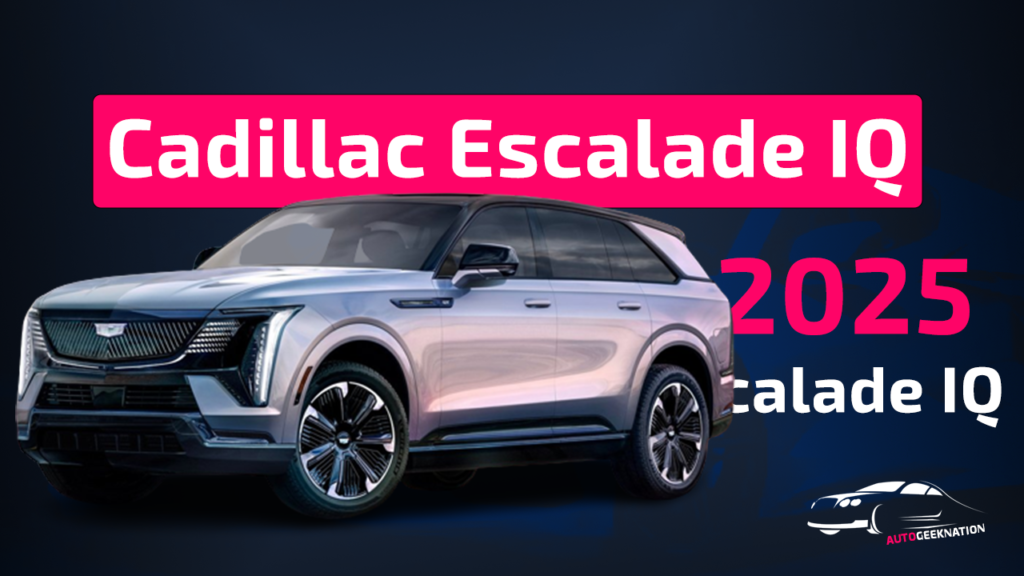
The 2025 Cadillac Escalade IQ is not simply an electric version of Cadillac’s traditional Escalade. It is a separate battery-electric SUV built around GM’s Ultium architecture, with a dedicated design, a very large battery, three rows of seating and technology aimed squarely at the premium end of the EV market.
Cadillac introduced the Escalade IQ as its first all-electric Escalade, combining a dual-motor all-wheel-drive system with a battery exceeding 200 kWh. Cadillac initially estimated up to 460 miles of range, while later Cadillac information has revised that estimate to 465 miles for newer model years. For the 2025 model, the commonly cited Cadillac estimate is 460 miles.
That headline range is only part of the story. The IQ is also an exceptionally large and heavy vehicle, and its enormous battery gives it capabilities that are unusual even among luxury electric SUVs.
What Is the Cadillac Escalade IQ?
The Escalade IQ is the first fully electric member of the Escalade family. Unlike the conventional Escalade, which is closely related to GM’s full-size body-on-frame SUVs, the IQ was developed as an EV using GM’s modular electric architecture.
Its proportions reflect that difference. The vehicle has a 136.2-inch wheelbase and a 224.3-inch overall length, making it considerably larger than many luxury electric SUVs. Cadillac also designed the body around aerodynamic efficiency rather than simply reproducing the upright shape of the gasoline-powered Escalade.
That approach gives the IQ a lower, smoother profile while retaining the visual presence expected from an Escalade.
Exterior Design: Familiar Name, Different Shape
The Escalade IQ carries Cadillac’s current electric design language, including vertical lighting elements, a distinctive illuminated front treatment and a relatively smooth body.
One of the most important changes is the roofline. Instead of the almost vertical rear profile associated with the traditional Escalade, the IQ uses a more tapered rear section. Cadillac says aerodynamic work contributed to an approximately 15 percent reduction in drag compared with previous generations of its full-size SUV.
That matters more on an EV than it might on a conventional SUV. At highway speeds, reducing aerodynamic resistance can have a direct effect on energy consumption and therefore driving range.
The downside is packaging. The sleek rear design contributes to the IQ’s distinctive appearance, but the third row is not as spacious as its enormous exterior dimensions might suggest. Independent testing by Car and Driver found the third row relatively cramped, particularly for adults.
Interior and Technology
The cabin is where the Escalade IQ makes perhaps its strongest statement.
The dashboard features a 55-inch curved pillar-to-pillar display, making the screen one of the defining elements of the interior rather than an accessory added to a conventional dashboard. Cadillac combines this large display with additional controls and screens for climate, vehicle functions and rear-seat features.
The technology is impressive, but there is an important distinction between having a large display and having an intuitive interface. With so many functions integrated into screens, buyers should consider whether they prefer Cadillac’s digital-first approach before assuming that more screen area automatically means a better experience.
The cabin can also be configured with Executive Second-Row Seating, adding a higher level of rear passenger comfort. Available equipment includes rear entertainment screens, massage functions and a 40-speaker AKG Studio Reference audio system.
For families, the IQ’s packaging also has a practical advantage that a conventional Escalade cannot replicate in exactly the same way: the absence of a traditional engine creates space for a 12.2-cubic-foot front trunk, or eTrunk. Cadillac lists up to 119.2 cubic feet of cargo capacity with the second and third rows folded.
Performance and Powertrain
The Escalade IQ uses two electric motors, one driving each axle, giving it all-wheel drive.
In normal operation, Cadillac quotes approximately 680 horsepower and 615 lb-ft of torque. Selecting Velocity Max raises output to as much as 750 horsepower and 785 lb-ft. Cadillac quotes a 0-to-60-mph time of less than five seconds.
Those numbers are remarkable for a vehicle of this size, but the IQ’s mass is equally important.
Independent testing has placed the vehicle at roughly 9,000 pounds, depending on configuration. Car and Driver recorded a 0-to-60-mph time of 4.5 seconds in testing, demonstrating that the electric powertrain can move this enormous SUV very quickly.
The weight also influences how the vehicle behaves. The Escalade IQ is designed primarily as a luxury cruiser rather than a sports SUV. Its acceleration is strong, but its size and mass can be felt when changing direction or dealing with uneven pavement. Car and Driver reported vague steering and unsettled body movements during its testing.
That is an important part of understanding the IQ: 750 horsepower does not turn a 9,000-pound luxury SUV into a lightweight performance vehicle.
Range and Charging
The Escalade IQ’s battery is one of its defining engineering features.
The vehicle uses a 205-kWh-class battery, with Cadillac originally specifying more than 200 kWh of usable energy. That enormous battery is the main reason the IQ can offer such a high claimed range while carrying a large body and three rows of seating.
Cadillac’s estimate for the 2025 model was up to 460 miles on a full charge. This is a manufacturer estimate rather than a guarantee of real-world range. Temperature, speed, terrain, passenger and cargo loads, tire selection and driving style can all change actual consumption.
Real-world testing illustrates the difference. In Car and Driver’s 75-mph highway range test, an Escalade IQ traveled 380 miles. That is still a substantial result for such a large SUV, but it is considerably below Cadillac’s maximum estimate.
The IQ uses an 800-volt electrical architecture and supports DC fast charging at rates up to 350 kW under appropriate conditions. Cadillac says the system can add up to 100 miles of estimated range in about 10 minutes, although actual charging speed varies with battery temperature, state of charge and charger capability.
For home charging, the vehicle can support up to 19.2 kW AC charging when properly equipped. That requires appropriate high-capacity electrical infrastructure, so buyers should not assume that every home charger can deliver the maximum rate.
Driver Assistance and Super Cruise
The Escalade IQ also highlights Cadillac’s Super Cruise technology.
Super Cruise is a hands-free driver-assistance system designed for compatible roads. It is important to describe it accurately: Super Cruise is not autonomous driving in the sense of a vehicle that can simply operate without driver responsibility.
Cadillac requires the driver to remain attentive and ready to take control. The system’s availability also depends on compatible roads and the vehicle’s active service plan or trial.
This distinction matters because the IQ’s technology can make long highway journeys less demanding, but the driver remains responsible for supervising the vehicle.
Towing and Everyday Practicality
Despite being an enormous luxury EV, the Escalade IQ is not purely about passenger comfort.
Cadillac estimates a maximum towing capacity of 8,000 pounds. That is substantial for an electric SUV, although towing introduces a major EV-specific consideration: additional weight and aerodynamic drag can significantly reduce driving range.
For buyers who regularly tow long distances, charging infrastructure and route planning therefore become much more important than the headline range figure suggests.
The eTrunk is another practical advantage. Instead of using the space under the hood for an internal-combustion engine, Cadillac turns it into additional luggage storage. This makes the IQ more versatile than its dramatic exterior might suggest.
Pricing and Availability
The original Cadillac announcement positioned the Escalade IQ at approximately $130,000 including destination charges. Later Cadillac communications listed a starting MSRP of $129,900 for the 2025 model.
That places the IQ firmly in the six-figure luxury SUV category.
It is also worth separating the 2025 Escalade IQ from later versions of the model. Cadillac subsequently introduced the longer-wheelbase 2026 Escalade IQL, which adds passenger and cargo space while retaining the basic electric Escalade formula.
Consequently, an article describing the 2025 IQ should not present the IQL’s additional space as though it were available on the original model.
What Makes the Escalade IQ Different?
The most interesting aspect of the Escalade IQ is not any individual specification. It is the way Cadillac combines several extreme characteristics in one vehicle.
It has:
- A battery of roughly 205 kWh
- Up to 750 horsepower
- A claimed range of up to 460 miles for the 2025 model
- Three rows of seating
- A 55-inch dashboard display
- Up to 8,000 pounds of towing capacity
- A front trunk
- Available Super Cruise
- A starting price around $130,000
Few electric SUVs attempt to combine this much size, luxury, range and towing capability.
But the same philosophy creates compromises. The enormous battery contributes to exceptional range but also contributes to the vehicle’s substantial weight. The dramatic exterior provides presence and aerodynamic benefits, but the third row is not as generous as its overall dimensions might suggest. And the huge digital interface is visually impressive but may not appeal to buyers who prefer simpler physical controls.
2025 Cadillac Escalade IQ: Pros and Cons
Pros
- Very long claimed driving range
- Extremely powerful dual-motor AWD system
- High-quality luxury interior
- Huge 55-inch curved display
- Available Executive Second-Row Seating
- Useful front trunk
- Strong towing capacity for an EV
- Advanced driver-assistance technology
- Quiet, comfortable long-distance character
Cons
- Extremely heavy
- Very large exterior dimensions
- Third-row space is less impressive than the vehicle’s size suggests
- Real-world highway range can fall well below the manufacturer’s estimate
- Six-figure starting price
- High-capacity home charging requires substantial electrical infrastructure
What We Know vs. What Should Be Treated Carefully
The original version of this article described the Escalade IQ as having a 450-mile range and suggested that several specifications were still unknown.
That information is now outdated.
Cadillac’s official specifications identify the 2025 model with a 460-mile Cadillac estimate, a dual-motor AWD system producing up to 750 horsepower, a battery exceeding 200 kWh, and a starting price around $130,000. The vehicle also reached retail production, so it is no longer simply a concept or future vehicle.
The range figure should nevertheless be treated as an estimate rather than a promise. Independent testing demonstrates why: Car and Driver achieved 380 miles during a 75-mph highway test.
That difference is not necessarily evidence that Cadillac’s estimate is misleading. Manufacturer range figures and independent highway tests use different conditions. The useful takeaway for buyers is that real-world EV range depends heavily on how and where the vehicle is driven.
Final Verdict
The 2025 Cadillac Escalade IQ succeeds by taking the traditional Escalade formula—size, luxury, technology and road presence—and rebuilding it around an electric powertrain.
Its strongest argument is not simply its 750 horsepower or its claimed 460-mile range. It is the combination of long-distance capability, premium passenger space, towing ability and advanced technology in a single electric SUV.
The compromises are equally clear. This is an exceptionally heavy and physically large vehicle, and its efficiency cannot be separated from that reality. Buyers should also look beyond the headline range and consider charging access, third-row requirements and whether they actually need this much vehicle.
For someone seeking a large, high-end electric SUV and willing to pay for it, the Escalade IQ is one of Cadillac’s most ambitious EVs. It is best understood not as an electric replacement for a conventional Escalade, but as Cadillac’s interpretation of what a full-size luxury SUV can become when the gasoline powertrain is removed from the equation.
FAQ
Is the 2025 Cadillac Escalade IQ fully electric?
Yes. The Escalade IQ is a battery-electric SUV and does not use a gasoline engine. It is the first all-electric member of the Escalade family.
How much range does the 2025 Escalade IQ have?
Cadillac estimated up to 460 miles of range for the 2025 model. Actual range varies according to speed, temperature, terrain, load and other conditions.
How much horsepower does the Escalade IQ have?
The dual-motor system produces up to 750 horsepower and 785 lb-ft of torque when Velocity Max is selected. Normal output is lower.
How fast can the Escalade IQ accelerate from 0 to 60 mph?
Cadillac quoted less than five seconds for 0–60 mph. Car and Driver recorded 4.5 seconds in independent testing.
Does the Escalade IQ have three rows?
Yes. It can seat up to seven people, although independent testing found the third row less spacious than the vehicle’s huge exterior dimensions might suggest.
How much does the 2025 Escalade IQ cost?
Cadillac listed a starting MSRP of $129,900 for the 2025 model in later official communications. Pricing can vary with equipment, destination charges, taxes and dealer fees.
Can the Escalade IQ tow?
Yes. Cadillac estimates a maximum towing capacity of 8,000 pounds. However, towing can substantially reduce EV driving range, especially at highway speeds.
Is Cadillac Super Cruise fully autonomous driving?
No. Super Cruise is a hands-free driver-assistance system for compatible roads. The driver must remain attentive and be prepared to take control.
Sources
- Cadillac — Introducing the all-electric 2025 Cadillac ESCALADE IQ
- Cadillac — First retail production 2025 Cadillac ESCALADE IQ EV raises $550,000 for Detroit Children’s Fund
- Cadillac — 2025 Escalade IQ official model information
- Car and Driver — 2025 Cadillac Escalade IQ Review, Pricing, and Specs
- Car and Driver — The 2025 Cadillac Escalade IQ Is One Massive EV
- Car and Driver — 2025 Cadillac Escalade IQ Tested: Big Kahuna