

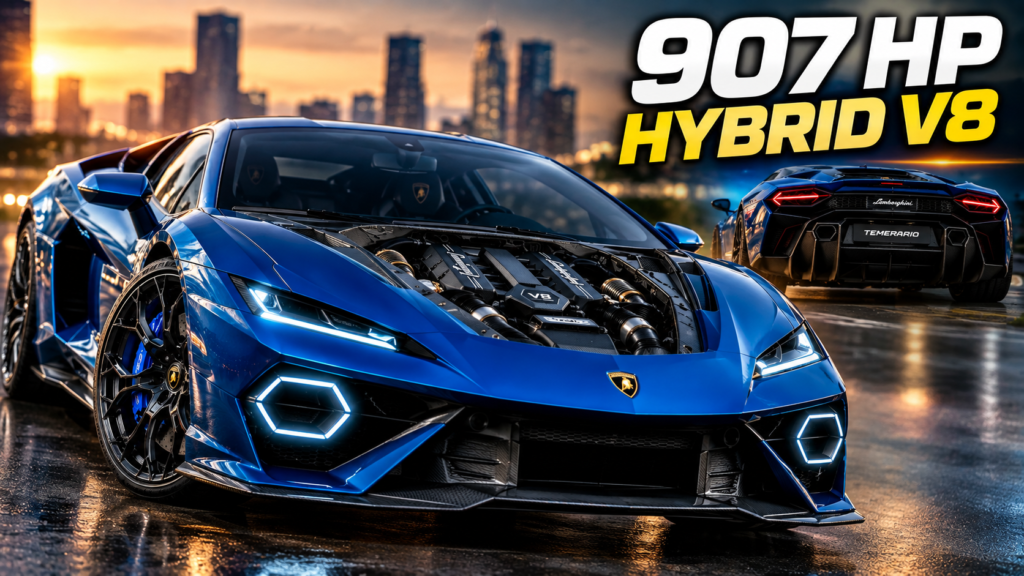
The 2026 Lamborghini Temerario: Hybrid Innovation Meets Supercar Performance – A Complete Guide
After more than a decade of production and over 14,000 units sold, Lamborghini officially retired the legendary Huracán in 2024. Its replacement is something that would have seemed unthinkable just five years ago: a hybrid supercar. The 2026 Lamborghini Temerario rewrites the playbook for what an entry-level supercar should be, combining cutting-edge electrification with brutal performance that actually exceeds its V10 predecessor.
A New Era Begins
The name “Temerario” roughly translates to “reckless” or “fearless” in Spanish—fitting for a car that challenges everything we thought we knew about supercars. The Temerario is the second model in Lamborghini’s High Performance Electrified Vehicle (HPEV) lineup, following the flagship V12 Revuelto. It marks Lamborghini’s official commitment to electrification across its entire portfolio, yet it proves that hybridization doesn’t mean compromised performance.
The numbers tell the story immediately: 907 horsepower combined output, 538 pound-feet of torque, 0-62 mph in 2.7 seconds, and a top speed of 213 mph. These figures don’t just match the old Huracán—they exceed it.
Design and Exterior
The Temerario’s exterior design represents a complete departure from the Huracán’s approach. Lead designer Mitja Borkert describes the front end as “shark-like,” and that description is accurate. The nose sits exceptionally low, with thin horizontal LED headlights positioned above hexagonal air intakes that aren’t merely aesthetic—they channel cooling air directly to the carbon-ceramic brakes, improving brake disc cooling by 20 percent and caliper cooling by 50 percent compared to its predecessor.
The side profile emphasizes aggressive functionality. Voluminous intakes flow air toward the rear of the car. The bodywork is sculpted with sharp edges and dramatic curves, conveying performance and precision. The most distinctive detail is the completely exposed V8 engine, sitting under a transparent panel with no protective cover—reminiscent of high-performance motorcycles. This design choice maximizes cooling and emphasizes the engineering underneath.
At the rear, a large integrated spoiler sits firmly in the body. The diffuser is 70 percent larger than the Huracán’s and angled 4 degrees steeper, working in conjunction with three pairs of vortex generators arranged like tree branches across the underbody. The result is a 103 percent increase in rear downforce compared to the Huracán EVO. When equipped with the optional Alleggerita package, downforce increases to 158 percent—a staggering improvement that keeps the car planted at extraordinary speeds.
The Temerario measures 185.3 inches long, 78.6 inches wide, and 47.3 inches tall, making it 14 centimeters longer than the Ferrari 296 GTB. Curb weight in dry form is 3,726 pounds. The car rides on forged or cast aluminum wheels, 20 inches up front and 21 inches at the rear, available in three designs and multiple finishes including carbon-composite options.
Lamborghini offers over 400 custom colors through its Ad Personam program, ensuring every Temerario can be uniquely configured. The two striking debut colors are Blu Marinus and Verde Mercurius, but the palette extends far beyond these options.
Engine and Powertrain
The headline specification is Lamborghini’s all-new 4.0-liter twin-turbocharged V8, internally designated the L411. What makes this engine remarkable isn’t just its performance—it’s its technical achievement: it revs to 10,000 rpm, the highest redline of any production V8 ever built.
This extreme rpm capability required exotic engineering that automotive enthusiasts would normally associate with racing programs. Lamborghini engineers employed a flat-plane crankshaft instead of a traditional cross-plane design. A flat-plane crank is lighter, reducing rotational mass and allowing the engine to sustain higher revolutions per minute. Titanium connecting rods attach to the crank, further minimizing rotating mass while maintaining structural integrity under the immense stresses of 10,000 rpm operation.
The two turbochargers employ a “hot-V” configuration, nestled directly within the V of the engine for a compact, integrated layout. These turbochargers generate 36 psi of boost, effectively pressurizing the incoming air charge. The engine itself is mounted low and central in the car’s chassis, maintaining ideal weight distribution.
In its purely gasoline operation, the V8 produces 789 horsepower between 9,000 and 9,750 rpm. Torque development is equally impressive, reaching 538 pound-feet from 4,000 rpm and holding that figure all the way to the redline. This torque curve is crucial for a turbocharged engine, as it ensures consistent power delivery throughout the rpm range.
Hybrid System and Electrification
The Temerario isn’t simply a turbocharged V8 with added complexity. It’s a genuine plug-in hybrid, and the hybrid system fundamentally changes how the car performs. Three electric motors are integrated into the drivetrain: two mounted in the front axle, one in the rear. These motors work in concert with the V8 to achieve 907 combined horsepower.
The hybrid system’s primary function isn’t fuel economy—although the battery does enable regenerative braking. Rather, the electric motors serve as a performance tool, filling the torque curve in the low-to-mid range where a high-revving turbocharged engine naturally exhibits gaps. At low speeds, the turbos are still spooling up; electric motors provide instantaneous torque. At higher speeds, the motors complement and enhance the V8’s power delivery, creating seamless acceleration without turbo lag.
The battery pack is a 3.8 kilowatt-hour lithium-ion unit—deliberately small. This isn’t intended to be an electric car; it’s a performance supplement. The Temerario can drive up to 6 miles on electric power alone in Città mode, enough for low-speed urban driving or silent parking lot maneuvering. The plug-in hybrid system allows the car to charge from a standard household outlet or DC fast charger when parked overnight.
Performance and Acceleration
The combined performance of the 4.0L twin-turbo V8 and three electric motors produces results that exceed modern supercar expectations. Zero to 62 mph is accomplished in 2.7 seconds—genuinely supercar territory. Zero to 100 mph takes less than five seconds. The car reaches 124 mph in under 7.3 seconds. The top speed is an electronically governed 213 mph.
These figures represent a performance upgrade over the final-generation Huracán, which made 631 horsepower. The Temerario is not just faster; it’s faster while carrying a transmission and hybrid system that would have been unthinkable in the previous generation.
The 8-speed dual-clutch transmission, sourced from Graziano, manages power delivery with lightning-quick shifts. When driving in the track-focused Corsa or Corsa Plus modes, manual paddle shifter operation is required—no automatic gear selection. This adds to the driver engagement while permitting full control over shift timing and engine braking.
All-wheel drive comes standard, channeling power to all four corners. Optional rear-axle steering improves cornering response and high-speed stability, a technology borrowed from the larger Revuelto.
Interior and Comfort
Lamborghini completely rethought the Temerario’s cabin around a philosophy called “Feel Like a Pilot”—the same concept applied to the Revuelto. This represents a significant departure from the cramped, unforgiving interiors that characterized previous Lamborghini supercars, particularly the Huracán.
The improvement is immediately apparent. The Temerario offers 1.8 inches more legroom and 1.3 inches more headroom than the Huracán. This may seem modest on paper, but for drivers wearing racing helmets or attempting to use the car for regular driving, the added space is meaningful and appreciated.
The seats represent another generational upgrade. The standard 18-way power-adjustable sport seats include heating and ventilation, remarkable features for a supercar focused on track performance. The seats are designed to cradle the driver and passenger during aggressive cornering while remaining comfortable during highway cruising. Optional racing buckets are available for maximum performance orientation—these are manually adjustable and engineered specifically for high-lateral-load driving with sufficient headroom to accommodate helmets.
The steering wheel is brand-new, featuring four control knobs designed to adjust driving modes and system behavior. These rotors control the suspension stiffness, powertrain response, hybrid behavior, and steering feel. Below the rotors are buttons for launch control, drift mode, and infotainment functions. This steering-wheel-centric control layout means the driver rarely needs to take both hands off the wheel to adjust car behavior.
The dashboard employs premium materials throughout: Alcantara headliner, leather surfaces, and Corsatex suede accents. The overall aesthetic is deliberately minimalist and dark, emphasizing a performance-focused interior. However, through Lamborghini’s Ad Personam customization program, buyers can select full-leather interiors in dramatically different color schemes, including jewel-tone greens, warm tans, and even striking turquoise.
The optional Alleggerita package adds extensive carbon-fiber components to the interior: door panels, instrument panel trim, air vents, and steering column covers. Each carbon application is functional, not merely decorative—the material choice contributes to overall weight reduction.
Front luggage capacity is 112 liters, substantially more than the Huracán’s limited storage space. This practical improvement makes the Temerario genuinely viable for weekend trips, not just quick drives to the track.
Technology and Driving Modes
The Temerario’s technology architecture is sophisticated and driver-focused. Behind the steering wheel sits a 12.3-inch digital instrument cluster displaying vehicle information in a modern, easily readable format. The center dashboard features an 8.4-inch touchscreen controlling the infotainment system, climate control, and driving mode selection. Both systems support Apple CarPlay and Android Auto, permitting seamless smartphone integration.
The defining technology feature is the suite of 13 driving modes, far exceeding the Huracán’s simpler Anima system. These modes are organized into three categories:
Road and Track Modes: Città mode emphasizes comfort and fuel efficiency, with active brake regeneration and electric-only driving capability. Strada mode balances performance with usability. Sport mode increases responsiveness. Corsa mode is the track-focused setting with maximum aggression. Corsa Plus is the ultimate track mode, requiring manual transmission operation via paddle shifters.
Hybrid-Specific Modes: Recharge mode uses regenerative braking to charge the battery during driving. Hybrid mode blends electric and gasoline power for balanced performance. Performance mode maximizes combined power output from both power sources simultaneously.
Each mode adjusts multiple vehicle systems simultaneously: power delivery from both engines, steering response, suspension stiffness (via magnetorheological dampers), aerodynamic flap positioning, and hybrid system strategy. The adaptability ensures the car feels responsive in sport driving and comfortable during regular driving—a remarkable achievement in a car designed for the track.
An optional Lamborghini Vision Unit represents the most advanced telemetry recording system in any production supercar. The system uses three integrated cameras to capture video of the driver’s experience. Importantly, it overlays telemetry data—brake pressure, throttle position, acceleration, braking distance, apex markers—directly on the video. The result is a personal racing analysis system that records every drive and permits detailed performance review. It also functions as a high-resolution dashcam for road driving.
Chassis, Suspension, and Braking
The entire chassis is constructed from aluminum alloy, balancing rigidity with weight reduction. Double-wishbone suspension at both ends provides a foundation for precise handling. The critical innovation is the application of magnetorheological dampers—electronically controlled shock absorbers that adjust their stiffness in real-time, essentially changing suspension behavior in milliseconds based on road input.
The practical result is remarkable compliance. In soft suspension modes, the Temerario can navigate rough roads without the jarring harshness typical of track-focused supercars. In firm modes, the suspension tightens to provide maximum cornering support and minimal body roll. This adaptability makes the Temerario genuinely usable as a daily car—not that any supercar is truly practical, but the Temerario comes closer than most.
Braking hardware is suitably extreme. Carbon-ceramic discs and calipers are specified at all four corners. Front rotors measure 16.1 inches, rear rotors 15.4 inches. These massive rotors, combined with optimized brake cooling, enable the car to shed speed from 213 mph to zero repeatedly without brake degradation.
Lamborghini engineered the cooling system specifically for the Temerario’s performance targets. The hexagonal air intakes in the front fenders channel cooling air directly to the brake calipers. Deflectors on the suspension arms further enhance brake cooling. The result is a 20 percent improvement in brake disc cooling and a 50 percent improvement in caliper cooling compared to the Huracán EVO. This engineering ensures the brakes remain effective even during extended track sessions.
Optional rear-axle steering is available, enhancing cornering response. This system adjusts rear wheel angle during high-speed cornering, reducing the turning radius and improving responsiveness.
The car rides on Bridgestone Potenza tires engineered specifically for the Temerario. Both road and track-focused compounds are available, matching the tires to the Temerario’s multi-mode personality.
Aerodynamic Development
Aerodynamics represent one of the Temerario’s most significant engineering achievements. The entire bodywork and underbody were developed specifically to manage the hybrid powertrain’s thermal output and maximize aerodynamic efficiency.
The front-end design, with its shark-nose profile and hexagonal intake design, isn’t merely aggressive styling—each element channels air for specific purposes. The wing mirrors work in unison with the front bumper to minimize drag while directing air toward the side radiators, increasing cooling capacity.
The roof features a central channel that directs air toward the integrated rear spoiler, effectively functioning as part of the aerodynamic system. The curved sides of the engine hood increase the portion of airflow reaching the rear spoiler, maximizing downforce generation.
Underneath the car, three pairs of vortex generators arranged in a tree-like pattern increase rear aerodynamic load. The rear diffuser contributes significantly: it’s 70 percent larger in surface area than the Huracán’s and angled 4 degrees steeper. This larger diffuser, combined with increased underbody engineering, maximizes vertical air extraction from beneath the car.
The result of this comprehensive aerodynamic development is a 103 percent increase in rear downforce compared to the Huracán EVO—meaning the Temerario generates twice the downforce of its predecessor. With the Alleggerita package, which adds a high-load rear spoiler with increased surface area and edge height, downforce improves to 158 percent over the baseline Huracán EVO.
This aerodynamic prowess serves three purposes: high-speed stability at 213 mph, enhanced cooling through improved air management, and maximum braking efficiency through aerodynamic load on the tires during emergency stops.
Pricing and Availability
The 2026 Lamborghini Temerario carries a starting price of $386,649, positioning it as the entry point into Lamborghini’s modern supercar lineup—below the V12 Revuelto but firmly in the elite performance segment.
The optional Alleggerita lightweight package adds $75,000 to the base price and includes a high-load rear spoiler, extensive carbon-fiber body components, polycarbonate windows, and a titanium exhaust. This package reduces total weight by 55 pounds and increases downforce to the maximum 158 percent specification.
Additional options permit extensive customization: carbon-fiber wheels, premium audio systems from Sonus Faber, interior material upgrades, special paint finishes through the Ad Personam program, and various carbon interior trim packages.
Production of the Temerario began in 2025 at Lamborghini’s factory in Sant’Agata Bolognese, Italy, where every Lamborghini has been manufactured since the company’s founding. The car is currently being delivered to customers worldwide, with lead times extending several months due to high demand and customization complexity.
Competitors and Context
The Temerario occupies a unique position in the supercar market. It doesn’t have a direct competitor—no other manufacturer has yet launched a similar hybrid supercar positioned at this price and performance level.
The closest comparison is the Ferrari 296 GTB, which also employs hybrid technology and Italian heritage. The 296 features a twin-turbocharged 3.0-liter V6 with a single electric motor, producing 830 horsepower combined. While slightly less powerful than the Temerario’s 907 horsepower, the 296 is lighter (1,540 kg vs. 1,690 kg) and employs a different design philosophy emphasizing elegance over aggression. The Ferrari commands similar pricing, making the two natural comparisons for wealthy supercar buyers evaluating Italian performance vehicles.
The Porsche 911 Turbo S offers formidable performance for approximately $230,000—a $156,000 price advantage. It produces 650 horsepower and can achieve remarkable acceleration, but it lacks the exclusivity, hybrid innovation, and raw power of the Temerario.
The McLaren Artura uses a hybrid twin-turbocharged V6 producing 680 horsepower, occupying similar price territory. However, the Artura emphasizes British engineering and carbon construction where the Temerario emphasizes Italian performance and design.
The Aston Martin Vantage provides magnificent styling and 665 naturally aspirated horsepower for less money, but lacks the technological sophistication and hybrid system of the Lamborghini.
The reality is that the Temerario creates its own category. It’s the hybrid performance supercar positioned for wealthy buyers seeking cutting-edge technology, exceptional performance, and Italian prestige without compromise.
Final Thoughts
The 2026 Lamborghini Temerario represents a pivotal moment in automotive history—the point at which Lamborghini officially committed to electrification across its entire lineup. Yet despite this commitment to modern technology, the Temerario proves that hybridization need not mean compromised performance or diluted driving experience.
The 907-horsepower twin-turbo V8 that revs to 10,000 rpm is historically significant engineering. The integration of three electric motors to enhance performance rather than replace it demonstrates sophisticated engineering thinking. The aerodynamic improvements that double downforce compared to the Huracán represent years of development focused on high-speed stability and thermal management.
Perhaps most importantly, the Temerario is usable. Its interior offers genuine comfort. Its driving modes adapt to any situation. Its electric range permits silent urban driving. Its advanced chassis provides capability across road, track, and everything between.
The Huracán is gone, replaced by something completely different. Whether the Temerario is “better” than its predecessor depends on what you value. It’s certainly faster, more advanced, and more capable. It’s also less analog, less naturally aspirated in character, and definitively a product of 2026 rather than 2014 engineering philosophy.
For buyers seeking the current pinnacle of Lamborghini performance and technology, the Temerario is the only choice. For those mourning the loss of the naturally aspirated V10 Huracán, the Temerario demonstrates that the future of performance need not abandon the visceral intensity that made Lamborghini famous.
– SOURCES
Official Lamborghini Sources:
- Lamborghini.com – “Sculpted by Speed” Campaign
- Provided: Official aerodynamic specifications, downforce figures (+103% standard, +158% Alleggerita), design philosophy, and engineering details about vortex generators and diffuser improvements.
- Lamborghini Official Specifications
- Provided: Engine specifications (L411 4.0L twin-turbo V8, 10,000 RPM redline, 789 HP gasoline output, 538 lb-ft torque), hybrid system details (3 electric motors, 3.8 kWh battery, 6-mile electric range), transmission (8-speed dual-clutch), dimensions, curb weight, and confirmed pricing ($386,649 base).
- Lamborghini Vision Unit Documentation
- Provided: Three-camera telemetry overlay system specifications and dashcam capabilities.