

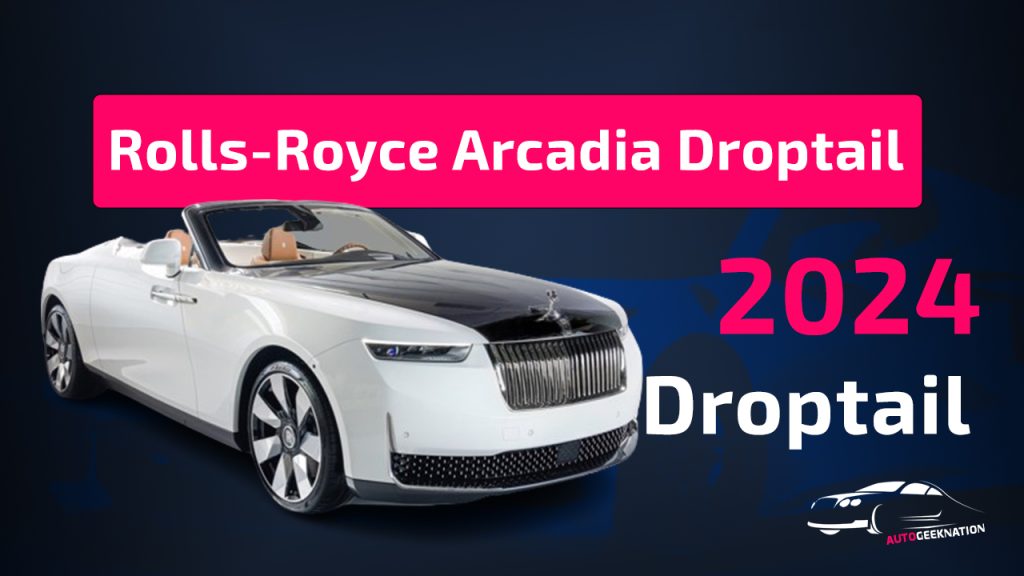
The Rolls-Royce Arcadia Droptail is not simply another ultra-expensive convertible. It is one of the rarest modern Rolls-Royce creations, built through the marque’s Coachbuild division as a deeply personalized commission for a single client.
Unveiled in February 2024, Arcadia is the third of four Droptail commissions planned by Rolls-Royce. Rather than focusing on outright performance or conventional luxury-car styling, this particular commission was designed around an idea that is surprisingly simple: creating a calm, private space away from the complexity of everyday life.
Its name comes from Arcadia, the mythical Greek realm often associated with an idealized natural paradise. That theme influenced almost every part of the car, from its restrained exterior colors to its extensive use of Santos Straight Grain wood.
A Rolls-Royce Created Around One Client
The most important thing to understand about the Arcadia Droptail is that it was not developed as a conventional production model.
Rolls-Royce Coachbuild worked directly with its commissioning client, allowing the customer’s preferences, architecture references and ideas about materials to shape the finished roadster.
The process lasted more than four years. Interestingly, the client wanted the finished car to remain faithful to the first hand-drawn design presented in 2019, particularly the roadster’s low stance and dramatic proportions.
The design references came from several parts of the world, including modernist tropical gardens and architectural forms associated with Singapore, Indonesia and Vietnam. British biomimetic architecture also influenced the design direction.
The result is deliberately restrained compared with some other Rolls-Royce Coachbuild creations. Arcadia does not rely on an extremely colorful exterior or an extravagant visual theme. Instead, it uses materials, proportions and craftsmanship to create its identity.
A White-and-Silver Exterior With Unusual Depth
At first glance, Arcadia’s exterior appears relatively simple.
The main body is finished in a bespoke white paint containing aluminum and glass particles. Under natural light, these particles create a subtle shimmering effect and give the paint greater visual depth.
The upper sections use a contrasting bespoke silver finish, creating the car’s understated two-tone appearance. Rolls-Royce also made an unusual decision with the carbon-fiber sections underneath the body: instead of leaving them exposed, they were painted silver.
That choice differentiates Arcadia from the other Droptail commissions and visually raises the lower body, emphasizing the roadster’s long, low proportions.
The exterior detailing is equally deliberate. The grille surround, selected exterior elements and 22-inch alloy wheels receive a mirror-polished finish inspired by the brightwork of historic Rolls-Royce automobiles.
Santos Straight Grain Wood Is the Star of the Interior
The most remarkable aspect of Arcadia may be its use of wood.
The client wanted a material with a distinctive texture and rich visual character, eventually leading Rolls-Royce to Santos Straight Grain.
The wood’s intricate interlocking grain made it particularly challenging to work with. Rolls-Royce had to develop specialized processes for shaping, drying, protecting and installing the material across the car.
According to Rolls-Royce, the wood components and their protective coating required more than 8,000 hours of development, followed by 1,000 hours of testing. The testing included simulations designed to ensure the material could withstand different global climates, including tropical conditions.
This is an important distinction between ordinary luxury trim and Coachbuild craftsmanship. The wood isn’t simply decorative veneer applied to a conventional interior. Engineers had to create a new underlying structure to support the material across complex curved surfaces.
Rolls-Royce says Formula 1-inspired carbon-fiber layering techniques were used to create a stiff foundation beneath the wood, helping it remain secure through the dynamic stresses experienced by the vehicle.
The 55-Degree Shawl Panel
One of Arcadia’s most interesting interior details is the large wooden shawl panel behind the occupants.
The panel uses the same Santos Straight Grain wood as the rear deck and is arranged at a 55-degree angle.
Although the finished surface can appear like a symmetrical mirrored piece, Rolls-Royce says the shawl panel is actually made from 40 individually shaped sections that were digitally mapped using CAD tools.
That is a good example of the philosophy behind the Arcadia: much of the work is hidden from view. The finished component looks simple precisely because an enormous amount of engineering and craftsmanship went into making it appear simple.
A Bespoke Cabin With Its Own Leather Colors
The interior continues the restrained white-and-tan theme of the exterior.
Rolls-Royce created two bespoke leather colors specifically for the client. The principal white tone echoes the exterior paint, while the contrasting tan shade was developed to complement the Santos Straight Grain wood.
The materials extend across the dashboard, doors and areas surrounding the occupants, creating a continuous visual relationship between the exterior bodywork and cabin.
Rather than filling the cabin with numerous contrasting materials, the designers concentrated on a relatively small palette and allowed the grain of the wood and the texture of the leather to provide most of the visual interest.
The Most Complex Rolls-Royce Clock Yet
Arcadia’s dashboard contains another remarkable Coachbuild feature: a bespoke mechanical-style clock.
Rolls-Royce describes it as the most complex clock face it had created at the time.
The clock took more than two years of development and approximately five months of assembly. Its face contains 119 facets, while the minute marker uses a ceramic coating rather than conventional anodizing, chosen for its long-term stability.
The detail extends to the finishing process. The clock’s small elements were developed and tested to Rolls-Royce standards rather than treated simply as decorative accessories.
It is another reminder that the Arcadia was conceived as a piece of craftsmanship as much as a vehicle.
What Engine Does the Arcadia Droptail Have?
Rolls-Royce’s official Arcadia material focuses overwhelmingly on the car’s design, materials and Coachbuild process rather than publishing a conventional specification sheet.
Independent automotive reporting identifies the Droptail’s powertrain as Rolls-Royce’s 6.6-liter twin-turbocharged V12, with the Arcadia reported at approximately 593 horsepower and 620 lb-ft of torque.
However, this is not the aspect Rolls-Royce chooses to emphasize.
That makes sense. A Droptail commission is fundamentally different from a conventional performance car. The purpose is not to establish a Nürburgring lap record or compete with a supercar. Its value comes from exclusivity, craftsmanship, personalization and the experience of owning something created specifically for one individual.
How Rare Is the Rolls-Royce Arcadia Droptail?
Extremely rare.
Rolls-Royce planned the Droptail program around just four individual commissions, with each car receiving its own identity and bespoke design. Arcadia followed the La Rose Noire Droptail and Amethyst Droptail.
This means Arcadia should not be thought of as a model that customers can simply order from a Rolls-Royce dealer.
It is a unique Coachbuild commission created around a specific client’s requirements.
Rolls-Royce has also confirmed that Arcadia was delivered to its commissioning client in Singapore.
How Much Does the Rolls-Royce Arcadia Droptail Cost?
This is where online articles often become misleading.
Rolls-Royce has not publicly confirmed an official price for the Arcadia Droptail.
Various media reports and estimates have placed Droptail commissions in the tens of millions of dollars or euros, but these figures should not be presented as an official Arcadia purchase price.
That distinction matters because Coachbuild commissions are individually specified. The final cost can depend heavily on the scope of engineering, materials, development and personalization involved.
For that reason, it is more accurate to describe Arcadia as a multi-million-dollar bespoke commission whose official price has not been disclosed rather than assigning it a precise price without confirmation.
Four Years of Development for One Finished Car
Perhaps the most revealing figure associated with Arcadia isn’t its horsepower or estimated value.
It is the amount of time invested in creating it.
Rolls-Royce says the complete project took more than four intensive years, while specific components required their own development programs.
The wooden components and protective coating required more than 8,000 hours of development, the wood underwent 1,000 hours of testing, and the dashboard clock alone required more than two years of development followed by five months of assembly.
This helps explain why the Arcadia Droptail occupies a different category from even other high-end Rolls-Royce models.
A production Rolls-Royce is already heavily customizable. Coachbuild goes several steps further, allowing engineering and design decisions to be developed around one client’s vision.
Arcadia Droptail vs. a Conventional Rolls-Royce
The Arcadia Droptail illustrates the difference between Bespoke and Coachbuild.
A conventional Rolls-Royce customer can personalize paint, leather, trim, embroidery and other elements through the company’s Bespoke program.
Coachbuild is fundamentally more exclusive. The car itself becomes the canvas.
With Arcadia, the design team did not simply select existing trim combinations. They developed new solutions for the wood structure, protective coatings and interior components while working toward the client’s original design vision.
That is why the car’s greatest achievement isn’t necessarily its engine.
It is the ability to turn a client’s aesthetic preferences into a functioning automobile without losing the engineering standards expected from Rolls-Royce.
Why the Arcadia Droptail Matters
The Arcadia Droptail represents an unusual direction in modern automotive luxury.
As many manufacturers increasingly focus on software, electrification, performance figures and digital technology, Rolls-Royce’s Coachbuild division is demonstrating a different definition of automotive value.
Here, rarity is measured in individual commissions, while craftsmanship can be measured in thousands of development hours.
The Arcadia also shows how modern luxury cars can borrow techniques from other disciplines. Its design references architecture, its woodwork requires advanced engineering, and its clock draws on traditional horological craftsmanship.
The result is not simply a car with expensive materials.
It is a vehicle designed around the idea that simplicity can require extraordinary complexity to achieve.
Final Verdict
The Rolls-Royce Arcadia Droptail is one of the clearest examples of what modern Coachbuild can achieve.
Its white-and-silver exterior is intentionally restrained, while the Santos Straight Grain wood, bespoke leather and intricate clock provide the visual drama inside. More importantly, the project demonstrates how far Rolls-Royce is prepared to go when a customer wants something genuinely personal.
There is no officially published price to point to, and Rolls-Royce does not present the Arcadia primarily through conventional performance statistics. Instead, its story is about four years of collaboration, thousands of hours of craftsmanship and a design that was created for one particular owner.
That makes Arcadia more than an exceptionally expensive roadster. It is a one-off expression of its client’s taste, translated into an automobile by Rolls-Royce Coachbuild.
Frequently Asked Questions
Is the Rolls-Royce Arcadia Droptail a production car?
No. It is a bespoke Coachbuild commission created for a specific client. It forms part of the extremely limited Droptail program.
How many Rolls-Royce Droptails will be built?
Rolls-Royce planned four individual Droptail commissions, each with its own bespoke identity. Arcadia is the third commission in that series.
When was the Arcadia Droptail revealed?
Rolls-Royce officially unveiled the Arcadia Droptail on February 29, 2024.
Where was the Arcadia Droptail delivered?
The completed car was delivered to its commissioning client in Singapore.
What wood is used in the Arcadia Droptail?
Rolls-Royce selected Santos Straight Grain, a high-density wood with an intricate interlocking grain pattern.
How long did the Arcadia Droptail take to develop?
The complete Coachbuild project took more than four years. Individual components, including the woodwork and clock, required additional development and testing.
How much does the Rolls-Royce Arcadia Droptail cost?
Rolls-Royce has not publicly confirmed an official price for the Arcadia Droptail. Media estimates have placed Droptail commissions in the tens of millions, but those figures should not be treated as an official MSRP.
What engine does the Arcadia Droptail use?
Independent automotive reporting identifies the Droptail as using a 6.6-liter twin-turbocharged V12, with the Arcadia reported at approximately 593 hp and 620 lb-ft. Rolls-Royce’s official Arcadia material does not emphasize a conventional performance specification sheet.
Sources
- Rolls-Royce Arcadia Droptail — Official Coachbuild page
- Rolls-Royce PressClub — Arcadia Droptail unveiling
- Rolls-Royce PressClub — Droptail program
- Car and Driver — Rolls-Royce Arcadia Droptail details
- Motor1 — Arcadia Droptail craftsmanship and powertrain reporting