

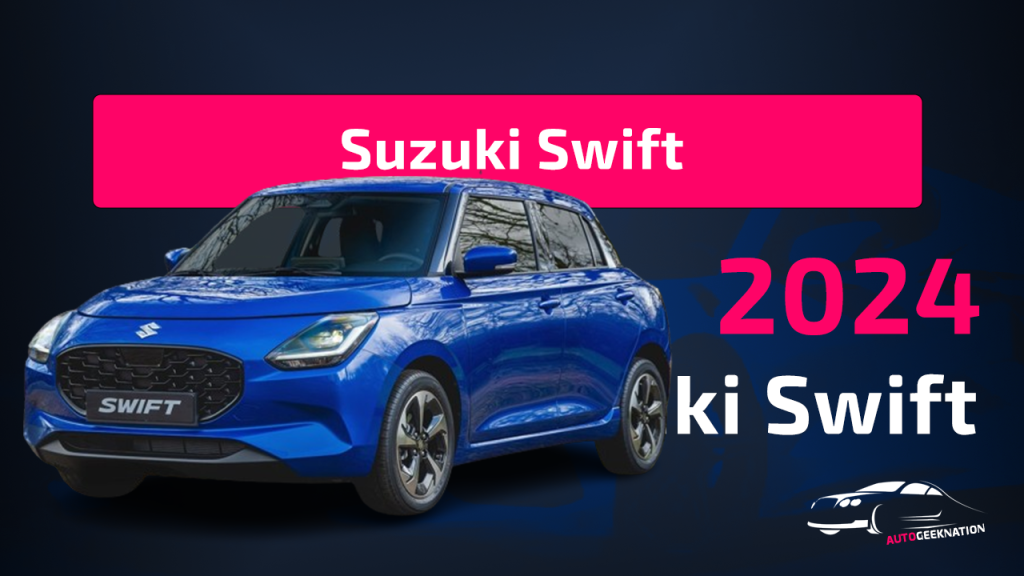
The Suzuki Swift has never tried to be the biggest car in its class. Its appeal has traditionally come from a different formula: compact dimensions, low weight, straightforward driving characteristics and relatively affordable running costs.
The fourth-generation Swift continues that approach while adding a newer three-cylinder engine, mild-hybrid assistance, updated driver-assistance technology and a more modern cabin.
Originally introduced in Japan in December 2023 and rolled out to international markets during 2024, the current Swift remains Suzuki’s answer to buyers who want a small hatchback without moving into a larger crossover. Suzuki says the fourth-generation model has continued the nameplate’s global success, with the Swift family reaching approximately 9.68 million units sold worldwide by the end of 2024.
But the current Swift is not simply an upgraded version of the previous generation. Suzuki made significant changes to the engine, hybrid system, safety technology and cabin.
A Familiar Shape With a More Modern Design
The fourth-generation Swift keeps the basic proportions that have made the nameplate recognizable, but its exterior is more rounded and contemporary.
The current model measures 3,860 mm long and 1,735 mm wide, with a 2,450-mm wheelbase in the UK specification. That keeps it firmly within the compact hatchback category and makes it relatively easy to maneuver in urban environments.
The front end features Suzuki’s updated grille treatment, LED lighting and a more pronounced shoulder line. Depending on market and trim, 16-inch alloy wheels and different exterior finishes are available.
Suzuki’s global site also makes an important point for international buyers: the specifications and equipment shown can vary between markets. That means a Swift sold in Europe, Japan, India or another market should not automatically be assumed to have identical equipment.
A Simple Formula for the Interior
Inside, Suzuki has concentrated on making the Swift easy to use rather than turning it into a technology showcase.
The dashboard incorporates a 9-inch display audio system in many European specifications, with the screen positioned in a floating center section angled slightly toward the driver. It can display navigation, vehicle information, camera images and other functions depending on specification.
The layout also retains physical controls for important functions, which can make everyday operation more straightforward than a cabin that places every function inside a touchscreen.
The overall interior design is modern but intentionally compact. The Swift remains a small hatchback, so buyers should not expect the passenger or cargo space of a small SUV.
The New 1.2-Liter Three-Cylinder Engine
One of the most significant changes is underneath the bonnet.
The current Swift uses Suzuki’s Z12E 1.2-liter three-cylinder petrol engine in markets such as Europe and Japan.
In UK specification, the engine produces 82 PS and 112 Nm, while Suzuki’s Japanese specification lists 82 PS and 108 Nm. The small difference illustrates why specifications should always be checked for the market in which the car is being sold.
Suzuki developed the Z12E around efficiency and low-speed drivability rather than outright performance.
The engine uses a relatively long stroke and a high-efficiency combustion strategy. Suzuki says the engine can achieve thermal efficiency of up to 40 percent under its specified conditions.
Compared with the previous four-cylinder 1.2-liter engine, the new unit is designed to deliver more torque at lower engine speeds while improving fuel consumption and emissions.
Mild-Hybrid Technology Instead of a Plug-In System
The Swift’s hybrid system is a mild hybrid, not a plug-in hybrid or a full-size battery-electric system.
Suzuki uses its SHVS system, incorporating an integrated starter generator and a lithium-ion battery.
During deceleration, energy is recovered and stored in the battery. During acceleration, the system can provide electrical assistance to the engine.
The advantage is relatively simple: the Swift can reduce the amount of fuel required during everyday driving without carrying the weight and cost associated with a large traction battery.
This approach fits Suzuki’s broader strategy of developing relatively lightweight electrification rather than immediately moving every model toward a large battery-electric powertrain.
Fuel Economy Depends on the Market
Fuel economy is one of the Swift’s strongest arguments, but the exact figure depends on the engine, transmission, drivetrain and testing system used in a particular market.
For example, Suzuki’s Japanese specification lists 24.5 km/L WLTC for the HYBRID MZ/MX 2WD CVT versions, while the non-hybrid XG specification is listed at 23.4 km/L WLTC.
European specifications differ.
For example, Suzuki UK’s technical documentation lists the 1.2 Mild Hybrid with a five-speed manual transmission and also offers an automatic CVT depending on trim. An ALLGRIP four-wheel-drive version is available in the UK range as well.
Therefore, claims such as “the Swift gets X mpg” should always be accompanied by the relevant market and test cycle.
Manual, CVT and ALLGRIP Options
The Swift is unusual in the modern small-car market because Suzuki continues to offer different transmission and drivetrain configurations depending on the market.
In the UK, the 1.2 Mild Hybrid is available with a five-speed manual or CVT, while the Ultra version can also be equipped with ALLGRIP four-wheel drive.
ALLGRIP AUTO is designed primarily to provide additional traction when the front wheels begin to lose grip. It uses a viscous coupling to transfer drive to the rear wheels.
This is not intended to transform the Swift into a serious off-road vehicle. Its value is mainly in conditions such as snow, wet roads and loose surfaces.
HEARTECT Keeps the Swift Lightweight
The current Swift continues to use Suzuki’s HEARTECT platform.
The structure is designed to combine low weight with sufficient rigidity while distributing crash forces through the body structure.
Suzuki also increased the use of high-tensile steel and structural adhesives during development of the fourth-generation car. The company says these changes contribute to handling, ride comfort and body rigidity.
Keeping the vehicle relatively light is particularly important for a small car.
A lighter vehicle requires less energy to accelerate and can potentially maintain efficiency without needing a large engine or large battery.
Safety Technology Has Taken a Big Step Forward
The fourth-generation Swift has a considerably more sophisticated safety package than older versions of the model.
Depending on market and specification, Suzuki Safety Support includes systems such as:
- Dual Sensor Brake Support II
- Adaptive Cruise Control
- Lane Keep Assist
- Lane Departure Prevention
- Traffic Sign Recognition
- Blind Spot Monitoring
- Rear Cross Traffic Alert
- Adaptive High Beam
- Driver Monitoring System
- eCall
Suzuki introduced the Driver Monitoring System to the Swift for the first time with this generation. A camera monitors the driver’s face and eyes and can issue warnings when it detects signs of drowsiness or inattention.
These systems make the current Swift considerably more technologically advanced than the simple small hatchbacks of previous generations.
But the Swift’s Euro NCAP Result Needs Context
One area where the current Swift deserves a more careful discussion is crash-test performance.
The fourth-generation Swift received a three-star Euro NCAP rating in 2024.
Its individual scores were 67% for adult occupant protection, 65% for child occupant protection, 76% for vulnerable road users and 62% for safety assistance.
Euro NCAP’s assessment found good performance in several areas, including side-pole protection and whiplash protection, but identified weaker results in some frontal and child-occupant tests. The organization also noted limitations in some of the Swift’s post-crash and far-side protection systems.
This does not mean the Swift is an unsafe car.
It does mean that the current Swift should not be described as a class-leading safety performer simply because it offers a long list of driver-assistance technologies.
That distinction is important: having many electronic safety systems and achieving a high crash-test score are not the same thing.
Connectivity and Everyday Technology
The Swift’s technology is mostly focused on useful everyday functions rather than extravagant digital features.
The 9-inch display can provide navigation, multimedia and vehicle information, while Suzuki’s connected services vary depending on market.
The system can also display information related to the mild-hybrid system, fuel consumption and driving range in supported specifications.
The result is a cabin that feels more modern than the previous-generation Swift without abandoning the relatively simple character that has traditionally defined the model.
Is the Suzuki Swift Actually Fun to Drive?
Performance numbers alone do not tell the whole story of a small hatchback.
The Swift’s relatively compact dimensions, low weight and modest engine are designed around easy everyday driving rather than outright acceleration.
Suzuki’s objective with the fourth generation was to improve steering response, handling and ride comfort while maintaining the lightweight character of the car.
The 1.2-liter engine is not intended to make the Swift a hot hatch. Instead, its appeal is strongest in urban and suburban driving, where the car’s compact dimensions and relatively low running costs matter more than high horsepower.
For drivers who want a genuinely sporty Swift, the current standard model should not be confused with the more performance-oriented Swift Sport offered in some previous markets.
The Swift Has Already Earned Recognition
The fourth-generation Swift has received recognition beyond Suzuki’s own marketing.
In November 2024, Suzuki announced that the Swift had won the 2025 RJC Car of the Year award in Japan. Suzuki also reported that the model had been selected as a finalist for the 2025 World Car Awards.
These awards do not prove that the Swift is the best small car for every buyer, but they reinforce the fact that the fourth-generation model has been well received by parts of the automotive industry.
What Makes the Swift Different From a Small SUV?
The biggest question for many buyers is whether a compact hatchback like the Swift still makes sense when small crossovers dominate the market.
The answer depends on priorities.
The Swift’s advantages are its relatively small footprint, low weight and efficient petrol-hybrid powertrain.
A small SUV may provide a higher driving position and sometimes more perceived interior space, but it can also be heavier and less efficient.
The Swift therefore remains relevant for buyers who prioritize easy parking, maneuverability and low fuel consumption over SUV styling.
Suzuki Swift: Strengths and Weaknesses
What the Swift Does Well
- Compact dimensions make it easy to drive and park.
- Efficient 1.2-liter three-cylinder engine.
- Mild-hybrid assistance is standard in many markets.
- Manual and CVT options are available depending on market.
- ALLGRIP four-wheel drive remains available in selected markets.
- Modern driver-assistance technology.
- Relatively simple and practical cabin.
- Lightweight HEARTECT architecture.
- Strong global track record for the Swift nameplate.
Where It Falls Short
- Performance is modest rather than genuinely sporty.
- Rear and luggage space remain limited compared with small SUVs.
- Equipment varies significantly by market.
- The three-star Euro NCAP rating is weaker than some modern competitors.
- The infotainment system is functional rather than class-leading.
- The mild-hybrid system cannot provide the electric-only capability of a full hybrid or plug-in hybrid.
Is the 2026 Suzuki Swift Worth Considering?
For the right buyer, yes.
The current Swift does not attempt to compete with expensive electric cars or high-performance hatchbacks. Instead, it continues a formula that is becoming increasingly unusual: a small, lightweight petrol hatchback with modest hybrid assistance and modern safety technology.
Its biggest strength is arguably its lack of unnecessary complexity.
The Z12E engine is small, the SHVS hybrid system is compact, the body remains relatively light and the dimensions are genuinely city-friendly.
However, prospective buyers should look beyond the marketing claims. The three-star Euro NCAP result is important, and equipment, engine output, transmission choices and fuel-economy figures differ by market.
That makes the Swift less of a “technological marvel” and more of something arguably more useful: a carefully engineered small car designed to make everyday driving inexpensive and uncomplicated.
Final Verdict
The fourth-generation Suzuki Swift is an evolution rather than a revolution.
Its exterior is sharper and more contemporary, its cabin is better equipped, and the new Z12E three-cylinder engine gives Suzuki a more efficient foundation for the model. The SHVS mild-hybrid system adds electrical assistance without turning the Swift into a heavy or complicated hybrid.
The car’s compact dimensions and lightweight construction remain central to its character.
At the same time, the Swift deserves a realistic assessment. Its three-star Euro NCAP result means its safety performance should not be exaggerated, and international buyers need to check local specifications before assuming that a feature or powertrain is available in their market.
Ultimately, the Swift’s appeal is simple.
It is small, efficient, easy to maneuver and still designed around the idea that a compact car can be enjoyable without being expensive or unnecessarily complicated.
That formula may be less spectacular than the latest electric SUV, but it remains highly relevant in 2026.
Frequently Asked Questions
What engine does the 2026 Suzuki Swift have?
The current fourth-generation Swift uses Suzuki’s 1.2-liter Z12E three-cylinder petrol engine in markets including Europe and Japan. In the UK specification, it produces 82 PS and 112 Nm.
Is the Suzuki Swift a hybrid?
Yes. Many current Swift versions use Suzuki’s SHVS mild-hybrid system, which combines an integrated starter generator with a lithium-ion battery to recover energy during deceleration and assist the engine during acceleration.
Does the Suzuki Swift have four-wheel drive?
Selected versions are available with ALLGRIP AUTO four-wheel drive, depending on market and trim. The system is primarily designed to improve traction on slippery surfaces rather than provide serious off-road capability.
Is the 2026 Suzuki Swift safe?
The current Swift includes a substantial suite of driver-assistance technologies, but its 2024 Euro NCAP rating was three stars. It scored 67% for adult occupant protection, 65% for child occupant protection, 76% for vulnerable road users and 62% for safety assist.
How fuel-efficient is the Suzuki Swift?
Fuel economy depends on the market, engine, transmission and test cycle. For example, Suzuki’s Japanese HYBRID MZ/MX 2WD CVT is rated at 24.5 km/L under Japan’s WLTC test procedure. European figures differ.
How big is the Suzuki Swift?
The UK-specification Swift measures approximately 3,860 mm long, 1,735 mm wide and 1,495 mm high, with a 2,450-mm wheelbase for the two-wheel-drive version.
Is the Suzuki Swift good for city driving?
Yes. Its compact dimensions, relatively small turning circle, light construction and mild-hybrid powertrain make it particularly well suited to urban and suburban driving.
When was the current Suzuki Swift introduced?
Suzuki launched the fourth-generation Swift in Japan in December 2023, with overseas-market introductions following during 2024.
Sources
- Suzuki Global — All-New Swift
- Global Suzuki — Swift model information
- Suzuki UK — Swift specifications
- Euro NCAP — Suzuki Swift safety assessment
- Suzuki — Fourth-generation Swift in India
- Suzuki — Swift wins 2025 RJC Car of the Year