

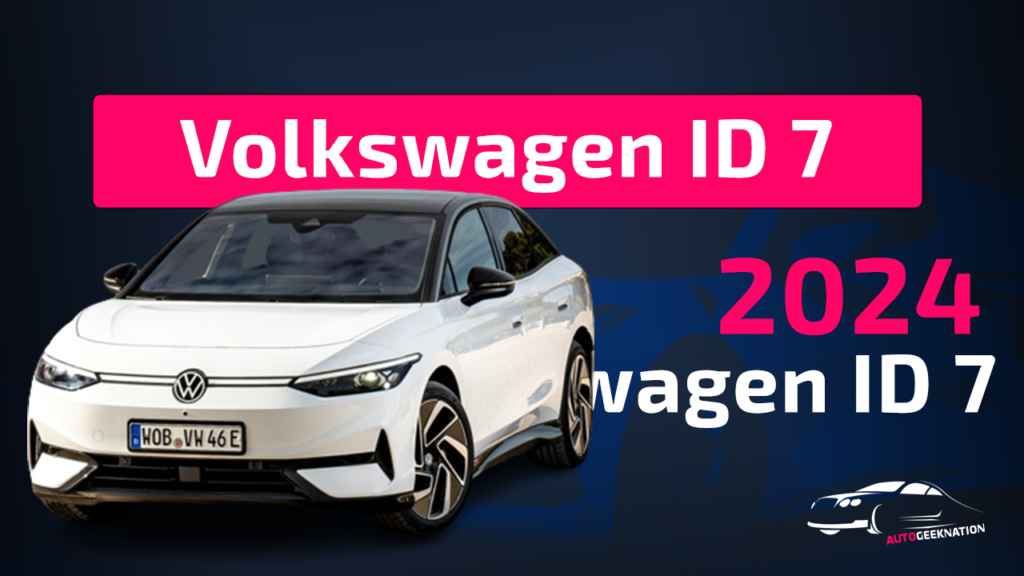
The Volkswagen ID.7 has evolved from an ambitious new electric fastback into one of Volkswagen’s most capable long-distance EVs. Instead of focusing purely on acceleration or futuristic styling, the ID.7 is designed around a different idea: making electric travel comfortable, efficient and practical over long distances.
Since its original launch, Volkswagen has expanded the range considerably. The lineup now includes the rear-wheel-drive ID.7 Pro, the longer-range ID.7 Pro S, the performance-focused ID.7 GTX, and the practical ID.7 Tourer estate. Depending on version and market, battery capacity ranges from 77 kWh to 86 kWh, while the most efficient Pro S can achieve a WLTP range of up to 709 km.
Here is what makes the Volkswagen ID.7 different from the electric cars that came before it.
A fastback designed for efficiency
The ID.7 is a large electric fastback measuring around 4.96 metres long, with a 2,971-mm wheelbase. Its proportions are designed not only to give passengers more room but also to reduce aerodynamic resistance.
One of the most important numbers is its drag coefficient of approximately 0.23, depending on specification. That aerodynamic efficiency matters because reducing air resistance at higher speeds can have a significant effect on an EV’s energy consumption.
The long roofline, smooth front end, flush surfaces and carefully shaped rear section are therefore more than styling exercises. They are part of Volkswagen’s attempt to make the ID.7 an efficient motorway and long-distance car.
The result is a design that sits somewhere between a conventional executive saloon and a five-door fastback. The shape also gives the ID.7 a large rear opening and useful luggage space without turning it into an SUV.
The ID.7 range has grown significantly
The biggest change since the original launch is the expansion of the ID.7 lineup.
The initial ID.7 Pro used a 77-kWh net battery, while Volkswagen subsequently introduced the Pro S with a larger 86-kWh net battery. The Pro S uses a 210-kW (286 PS) electric drive system and is designed primarily around efficiency rather than outright performance.
Volkswagen quotes a maximum WLTP range of up to 709 km for the ID.7 Pro S. That figure is considerably higher than the original ID.7 Pro’s maximum range and makes the Pro S particularly interesting for drivers who regularly cover long distances.
The important point is that 709 km is a WLTP laboratory figure, not a guarantee of how far the car will travel in every situation. Real-world range depends on speed, temperature, weather, traffic, terrain, wheel and tyre configuration, cabin heating or cooling and driving style.
Current ID.7 versions
Volkswagen’s expanded ID.7 family can broadly be understood like this:
- ID.7 Pro – 77-kWh battery and rear-wheel drive, prioritising value and efficiency.
- ID.7 Pro S – 86-kWh battery, 210 kW/286 PS and rear-wheel drive, designed for maximum range.
- ID.7 GTX – 86-kWh battery, 250 kW/340 PS and dual-motor all-wheel drive for stronger performance.
- ID.7 Tourer – the estate version, offering substantially more luggage flexibility.
- ID.7 GTX Tourer – the high-performance estate with 4MOTION all-wheel drive.
Exact availability varies by market.
86-kWh battery and faster charging
The 86-kWh battery is one of the most important developments in the ID.7 range.
Volkswagen specifies the Pro S battery at 86 kWh net, compared with 77 kWh for the regular Pro. The larger battery is combined with the highly efficient rear-mounted electric drive system to deliver the Pro S’s long WLTP range.
Charging performance has also improved. The Pro S can accept up to 200 kW of DC charging, compared with up to 175 kW for the 77-kWh Pro versions. Volkswagen quotes approximately 26 minutes for a 10–80% DC charge under suitable conditions.
That makes the ID.7 better suited to long journeys than an EV that combines a large battery with relatively slow charging.
Of course, maximum charging power is not maintained throughout an entire charging session. Actual charging time depends on battery temperature, state of charge, charger capability and other conditions.
A surprisingly efficient long-distance EV
The ID.7’s strongest argument is arguably not its acceleration. It is efficiency.
Volkswagen’s Pro S combines its 86-kWh battery with aerodynamic bodywork and a highly efficient electric motor. In January 2025, Volkswagen reported an efficiency test in which a standard ID.7 Pro S covered 941 km on a single charge, consuming an average of 9.2 kWh/100 km.
That test took place on a controlled circuit in Nardò, Italy, and Volkswagen itself presents it as an efficiency exercise rather than a normal real-world driving range figure. The official WLTP maximum remains 709 km.
A separate real-traffic test in Switzerland saw an ID.7 Pro S travel 794 km on one charge, again exceeding its official WLTP figure.
These results shouldn’t be interpreted as promises of 800–900 km of everyday range. They do, however, demonstrate why aerodynamic efficiency and powertrain efficiency are so important in a large electric car.
340 PS and all-wheel drive: the ID.7 GTX
Drivers who want more performance can move to the ID.7 GTX.
The GTX combines an 86-kWh battery with dual electric motors and Volkswagen’s 4MOTION all-wheel-drive system. Total system output is 250 kW, or 340 PS, and Volkswagen quotes 0–100 km/h in 5.4 seconds for the fastback GTX.
This changes the character of the ID.7 considerably.
The Pro S is essentially the range-focused version: rear-wheel drive, strong efficiency and long-distance comfort.
The GTX takes the opposite approach. It adds another electric motor and significantly more power, making it the performance-oriented member of the family.
The trade-off is range. Volkswagen quotes up to 584 km WLTP for the ID.7 GTX Tourer, while the exact fastback range depends on specification and market.
The ID.7 Tourer adds practicality
Volkswagen has also turned the ID.7 into an estate.
The ID.7 Tourer retains the same basic wheelbase and overall length as the fastback but replaces the rear bodywork with a more practical estate configuration.
The luggage compartment can hold up to 605 litres with the rear seats in place and up to 1,714 litres with them folded, according to Volkswagen.
This gives the Tourer a clear advantage for families, luggage-heavy trips and owners who regularly transport larger objects.
In the UK, for example, the current ID.7 Tourer range includes Pro Match Plus, Pro S Match Plus and GTX Plus versions, with official WLTP combined ranges of approximately 360 miles, 420 miles and 364 miles respectively. Those figures correspond to roughly 579 km, 676 km and 586 km.
Again, specifications and available versions differ between markets.
A more mature Volkswagen interior
The ID.7’s cabin was designed around space and reduced visual clutter.
The long wheelbase creates generous passenger accommodation, while the dashboard uses a relatively clean layout dominated by the central infotainment display.
One of the most distinctive features is the 15-inch infotainment touchscreen. Volkswagen redesigned the software and interface compared with earlier ID models, including permanently accessible controls for important vehicle functions.
The ID.7 also uses a smaller driver display while placing additional information into the standard augmented-reality head-up display.
Augmented-reality head-up display
The original ID.7 article highlighted the AR head-up display as one of its headline innovations. That remains an important part of the car.
Instead of requiring the driver to look down at the central screen for every navigation instruction, the AR system can position navigation guidance within the driver’s field of view.
Volkswagen says the system can display lane-level navigation information, helping the driver understand which lane or direction to follow. In newer model-year configurations, navigation from compatible Apple CarPlay or Android Auto applications can also be integrated into the AR route display.
The benefit is less about creating a futuristic visual effect and more about reducing the amount of time the driver needs to look away from the road.
IDA voice assistant and ChatGPT integration
The infotainment system also includes Volkswagen’s IDA voice assistant.
The system can control various vehicle functions and access online information. Volkswagen has also introduced ChatGPT integration into IDA, allowing the assistant to handle certain general questions beyond conventional vehicle commands.
This does not mean ChatGPT controls every function of the vehicle. The capabilities remain subject to the vehicle’s software and system limitations.
Comfort is central to the ID.7’s mission
Volkswagen positions the ID.7 as a long-distance touring EV rather than simply a fast electric car.
Depending on specification, the car can be equipped with features such as:
- Adaptive chassis control
- ergoActive or premium comfort seats
- Massage functions
- Multi-zone climate control
- Heat pump technology
- Ambient lighting
- Heated and ventilated seats
- Premium audio systems
- Wellness-oriented cabin functions
The availability of these features varies significantly by trim and market.
The Tourer GTX, for example, is available with adaptive chassis control, ventilated massage front seats and heated front and rear seats in the UK market.
Driving technology and chassis
The ID.7 uses Volkswagen’s electric vehicle architecture and places the battery low in the floor, helping produce a low centre of gravity.
The chassis can be equipped with Volkswagen’s adaptive damping technology, while the vehicle’s dynamics management system coordinates various chassis functions.
This gives the ID.7 a different driving objective from a compact performance EV. The emphasis is on stability, refinement and predictable handling while still offering strong acceleration when needed.
The GTX versions naturally push the balance further toward performance, particularly with their dual-motor 4MOTION system.
Driver assistance and parking technology
The ID.7 can be equipped with a wide range of driver-assistance and parking technologies.
Depending on market and specification, these include systems such as:
- Travel Assist
- Park Assist
- Area View cameras
- Rear-view camera
- Exit warning assistance
- Adaptive cruise-related functions
- Lane-related assistance
- IQ.LIGHT LED matrix headlights
Volkswagen also offers Park Assist Pro on certain versions, which can allow parking manoeuvres to be controlled using a smartphone.
As with all driver-assistance systems, these technologies are designed to support the driver rather than replace attention and responsibility behind the wheel.
Is the Volkswagen ID.7 a good long-distance EV?
The ID.7 makes the most sense when viewed as an electric alternative to a conventional large touring saloon.
Its advantages are clear:
Long range: the Pro S can reach up to 709 km WLTP.
Fast charging: the 86-kWh versions can accept up to 200 kW DC under suitable conditions.
Efficiency: aerodynamic design and an efficient rear-mounted motor help reduce energy consumption.
Space: the long wheelbase provides generous passenger accommodation, while the Tourer adds substantial cargo capacity.
Technology: the 15-inch infotainment system, AR head-up display and IDA voice assistant give the cabin a high level of digital functionality.
Performance: the GTX provides 340 PS and all-wheel drive without requiring a separate performance-focused vehicle architecture.
Its main limitation is that specifications, equipment and pricing vary considerably between markets. A European Pro S, a UK-specification ID.7 and an ID.7 sold in another region should not automatically be assumed to have identical equipment.
Volkswagen ID.7: a more complete EV than the original launch model
The original ID.7 arrived as Volkswagen’s answer to the question of how a large electric touring car should work. Since then, the model has become considerably more versatile.
The Pro S makes the strongest case for long-distance efficiency, with its 86-kWh battery and up to 709 km WLTP range. The GTX demonstrates that the same basic concept can deliver 340 PS and all-wheel-drive performance. Meanwhile, the Tourer adds the practicality that many families expect from a large estate.
That broader lineup is what makes the ID.7 more interesting today than it was when it first appeared.
Rather than being simply another large electric car, the ID.7 has developed into Volkswagen’s dedicated long-distance EV: aerodynamic, spacious, technologically advanced and available in configurations that prioritise either efficiency, practicality or performance.
Frequently Asked Questions
How far can the Volkswagen ID.7 travel on a charge?
The ID.7 Pro S has a maximum official WLTP range of up to 709 km, depending on specification. Real-world range will vary according to temperature, speed, weather, driving style and other conditions.
How big is the ID.7 battery?
The current ID.7 family uses either a 77-kWh or 86-kWh net battery, depending on version. The Pro S and GTX versions use the larger 86-kWh battery.
How quickly can the ID.7 charge?
The 86-kWh ID.7 versions can accept up to 200 kW DC, with Volkswagen quoting around 26 minutes for a 10–80% charge under suitable conditions. The 77-kWh versions have lower maximum charging capability, depending on specification and market.
Is the Volkswagen ID.7 available with all-wheel drive?
Yes. The ID.7 GTX uses dual electric motors and Volkswagen’s 4MOTION all-wheel-drive system. The GTX produces 250 kW, equivalent to 340 PS.
What is the fastest ID.7?
The ID.7 GTX is the performance-focused fastback. Volkswagen quotes 0–100 km/h in 5.4 seconds and 340 PS.
Does the ID.7 come as an estate?
Yes. The ID.7 Tourer is the estate version. It offers up to 605 litres of luggage capacity with the rear seats in use and up to 1,714 litres with them folded.
Does the ID.7 have an augmented-reality head-up display?
Yes. The AR head-up display is a key feature of the ID.7 and can display navigation information, including lane-level guidance, within the driver’s field of vision.
Is the 709-km range realistic in everyday driving?
It is an official WLTP maximum for the ID.7 Pro S, not a guaranteed real-world figure. Volkswagen has also demonstrated higher distances in specific efficiency and real-traffic tests, but those should not be treated as normal everyday range expectations.
Sources
- Volkswagen Newsroom – ID.7 Pro S and GTX
- Volkswagen Newsroom – ID.7 Pro S international media drive
- Volkswagen Newsroom – ID.7 interior and technology
- Volkswagen Newsroom – 941-km ID.7 Pro S efficiency test
- Volkswagen UK – ID.7 Tourer technical data