

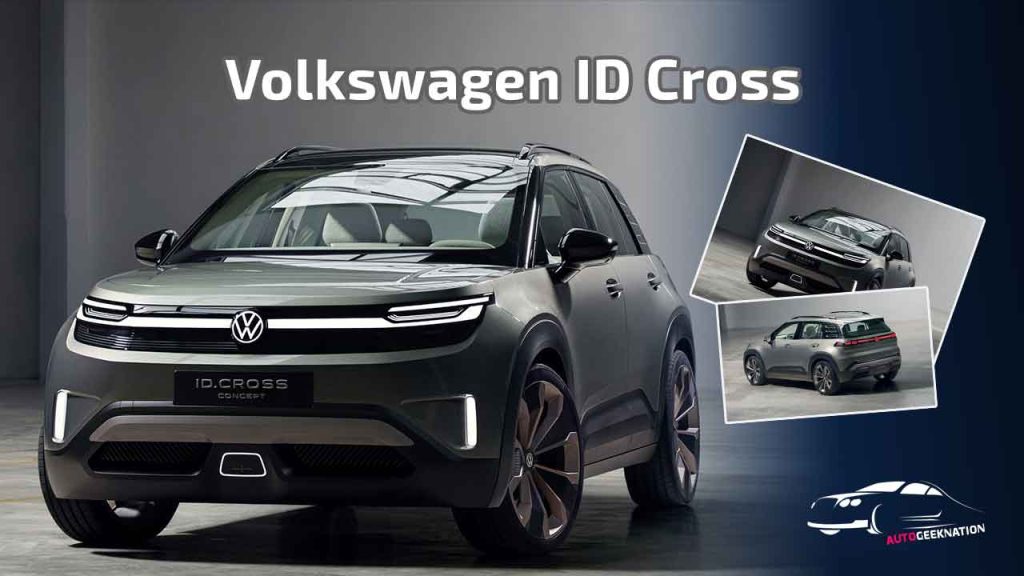
The Volkswagen ID. Cross has officially moved beyond the concept stage.
Originally presented as the ID. CROSS Concept at IAA Mobility 2025 in Munich, Volkswagen’s compact electric SUV has now been revealed in production form. The new ID. Cross is designed to bring Volkswagen’s electric lineup into a more affordable segment while combining compact dimensions with a practical five-seat interior, modern technology and a starting price below €28,000 in Germany.
Volkswagen plans to launch the ID. Cross across European markets from autumn 2026.
That makes it one of the most important additions to Volkswagen’s new generation of more affordable electric vehicles.
From Concept to Production
The story of the ID. Cross began at IAA Mobility 2025, where Volkswagen showed a near-production concept designed to preview a new compact electric SUV.
At the time, Volkswagen described the vehicle as an electric alternative in the T-Cross class and indicated that production would follow from 2026.
The production version has now arrived.
While the final ID. Cross remains visually close to the concept, Volkswagen has developed the vehicle around its new “Pure Positive” design language, which is intended to combine clean proportions, a confident stance and a more approachable appearance.
The result is an electric SUV that looks recognizably Volkswagen without simply copying the existing ID. models.
Exterior Design and Dimensions
The ID. Cross is designed as a compact SUV for both urban driving and longer journeys.
The production model measures:
- Length: 4,153 mm
- Width: 1,794 mm
- Height: 1,581 mm
- Wheelbase: 2,601 mm
- Ground clearance: 140 mm
These dimensions place the ID. Cross firmly in the compact-SUV category.
Interestingly, the production vehicle is slightly smaller than the original 2025 concept specification, which measured 4,161 mm long and 1,839 mm wide.
Volkswagen has maintained the short-overhang proportions that help create useful interior space without making the vehicle unnecessarily large.
The exterior follows the company’s new Pure Positive design philosophy, with clean surfaces, strong horizontal elements and a deliberately confident front end.
Rather than making the ID. Cross look aggressively futuristic, Volkswagen appears to be moving toward a more familiar and timeless design for its new generation of EVs.
A Compact SUV With a Practical Interior
The ID. Cross is a five-seat electric SUV.
Volkswagen has placed particular emphasis on space efficiency, aiming to provide a cabin that feels larger and more comfortable than its compact exterior dimensions might suggest.
The interior follows the same Pure Positive philosophy as the exterior.
Volkswagen describes the cabin as a calm, high-quality environment with fabric-covered surfaces, comfortable seating and intuitive controls.
One notable change from some earlier ID. models is Volkswagen’s renewed emphasis on physical controls and buttons.
The company says the interior has been designed to make important functions easier to operate without forcing the driver to navigate through multiple touchscreen menus.
That could be an important improvement for buyers who found some earlier Volkswagen ID interiors overly dependent on touch controls.
Innovision Infotainment
The ID. Cross introduces Volkswagen’s new Innovision infotainment system.
Large-format displays provide the main digital interface, while the system is designed around simpler operation and connected functions.
Depending on equipment, the ID. Cross can also be equipped with higher-level technology such as a premium sound system and massage seats.
Volkswagen is positioning these features as technologies that traditionally appeared in more expensive vehicles.
The goal is not simply to make the ID. Cross an affordable electric SUV, but to make it feel more sophisticated than its entry-level price might suggest.
Electric Powertrain Options
Unlike the original article, which described the ID. Cross as having a single front-wheel-drive motor, the production model will be offered with three power levels.
The lineup includes:
- 85 kW / 116 PS
- 99 kW / 135 PS
- 155 kW / 211 PS
All versions use front-wheel drive.
This is an interesting decision because many Volkswagen ID models use rear-wheel drive or all-wheel drive.
For the ID. Cross, Volkswagen has returned to a front-mounted electric drive configuration to help control costs, packaging and weight.
The electric motor belongs to Volkswagen’s APP290 drive family and is paired with a single-speed transmission.
The 155 kW version produces up to 290 Nm of torque and has a top speed of 160 km/h.
The lower-power versions are limited to 150 km/h.
Two Battery Sizes
Volkswagen will offer the ID. Cross with two battery capacities:
- 37 kWh net
- 52 kWh net
The smaller 37-kWh battery uses LFP chemistry, while the larger 52-kWh battery uses NMC chemistry.
This gives Volkswagen the ability to offer different versions for different types of drivers.
The smaller battery is particularly suited to urban use, where lower purchase price and daily efficiency can be more important than maximum range.
The larger battery is aimed at customers who regularly travel outside cities.
Volkswagen ID. Cross Range
The original ID. CROSS Concept was presented with a projected range of around 450 km, but the production model has more specific official figures.
Volkswagen currently quotes a maximum WLTP range of up to 427 km for the ID. Cross.
The range varies depending on battery, powertrain and equipment.
The smaller 37-kWh battery is expected to offer up to approximately 316 km WLTP, while the larger 52-kWh battery can reach up to approximately 427 km WLTP depending on configuration.
These figures are based on the WLTP testing procedure and should not be interpreted as guaranteed real-world driving distances.
Weather, speed, temperature, wheel choice, traffic and driving style can all affect actual range.
Charging the ID. Cross
Charging is another area where Volkswagen has focused on making the ID. Cross practical without adding excessive cost.
The maximum AC charging rate is 11 kW.
For DC fast charging, the maximum depends on the battery:
- 37-kWh battery: up to 90 kW
- 52-kWh battery: up to 105 kW
Volkswagen says the 37-kWh battery can charge from 10 to 80 percent in approximately 23 minutes under the specified conditions.
The 52-kWh version requires approximately 24 minutes for a 10–80 percent DC charge.
Those are respectable charging times for a compact EV positioned toward the affordable end of the market.
However, the ID. Cross does not attempt to compete with more expensive EVs offering 150, 200 or 300-kW charging systems.
Volkswagen has instead prioritized a balance between charging capability and vehicle cost.
Vehicle-to-Load Adds More Flexibility
One particularly useful feature is Vehicle-to-Load (V2L).
The ID. Cross can provide up to 3.6 kW of electrical power to external devices.
That could be useful for charging an electric bicycle, powering camping equipment or operating other compatible electrical devices away from a conventional power outlet.
Volkswagen has even highlighted the possibility of using the system with e-bikes carried on the vehicle.
For buyers who use their electric SUV for weekend trips and outdoor activities, this could be more useful than it initially sounds.
Towing Capacity
The ID. Cross is also more practical than its compact dimensions might suggest.
When equipped with the 52-kWh battery, Volkswagen says the vehicle can tow a trailer with a gross weight of up to 1,200 kg, under the specified conditions.
The vehicle can also be equipped with a detachable tow hitch with a 75-kg vertical load rating.
That means the ID. Cross could potentially carry equipment such as bicycles while still retaining its usefulness as a family vehicle.
Towing, of course, will affect energy consumption and therefore reduce the vehicle’s real-world driving range.
Driver Assistance Technology
Volkswagen is also using the ID. Cross to bring more advanced driver-assistance technology into the compact segment.
Available technology includes Connected Travel Assist, which combines assisted longitudinal and lateral control.
One of the more interesting features is its ability to use online traffic-light information.
Within the system’s operating limits, Connected Travel Assist can recognize traffic lights and respond to them.
Volkswagen says this technology can automatically slow the vehicle and bring it to a stop when a red traffic light is detected.
The ID. Cross can also be equipped with additional parking assistance functions.
These features demonstrate Volkswagen’s strategy of bringing technology previously associated with larger and more expensive vehicles into a smaller and more affordable SUV.
Adaptive DCC Suspension
The ID. Cross can also be equipped with adaptive DCC suspension.
This is significant because adaptive damping is not normally associated with entry-level electric SUVs.
The system allows the suspension characteristics to be adjusted according to driving conditions and driver preferences.
Volkswagen has also developed a new chassis for the ID. Cross using a MacPherson front axle and a compact torsion-beam rear axle.
The company says the suspension has been engineered to provide a balance between comfort, stability and precise handling.
Energy Efficiency
Volkswagen quotes combined electricity consumption of approximately 14.3–16.9 kWh/100 km, depending on version and equipment.
As with the range figures, these are WLTP values.
The compact dimensions and relatively small battery options are important here.
Instead of simply installing a huge battery, Volkswagen is trying to achieve useful range through a combination of vehicle efficiency, aerodynamic design and battery sizing.
That approach can help reduce both vehicle weight and purchase price.
Price: The €25,000 Estimate Is Now Outdated
This is one of the biggest changes from the original article.
When the ID. CROSS Concept was introduced in 2025, Volkswagen’s affordable-electric-car strategy generated expectations of a vehicle priced around €25,000.
The production ID. Cross is now officially priced from €27,995 in Germany.
That is the starting price for the basic version with the 85-kW motor and 37-kWh battery.
Higher-powered versions with the larger 52-kWh battery cost significantly more.
At launch, Volkswagen announced advance sales for the 155-kW/211-PS version with the 52-kWh battery in Life and Style specifications, with prices starting at €36,525 in Germany.
Other versions and equipment combinations are scheduled to follow.
Prices will also vary between European markets because of local taxes, equipment, incentives and registration costs.
When Will the Volkswagen ID. Cross Go on Sale?
Volkswagen plans to launch the ID. Cross across Europe from autumn 2026.
Advance sales have already begun in Germany for selected configurations.
This means the original description of the ID. Cross as a future 2026 concept is no longer accurate.
It has now entered the production phase and is moving toward customer deliveries.
Exact availability and launch timing will vary between individual European markets.
How Does It Compare With the T-Cross?
Volkswagen is positioning the ID. Cross in roughly the same compact-SUV space as the T-Cross, but the two vehicles serve different purposes.
The T-Cross uses an internal-combustion powertrain, while the ID. Cross is fully electric.
The ID. Cross also benefits from an electric platform designed specifically around battery-powered propulsion.
For buyers who mainly drive in cities and have access to home or workplace charging, the ID. Cross could provide a quieter and simpler alternative.
For drivers who regularly travel long distances without reliable charging access, the T-Cross may still be more convenient.
That distinction will remain important even as electric vehicles become more affordable.
Is the ID. Cross Really an Affordable EV?
The answer depends on which version you choose.
The €27,995 starting price makes the ID. Cross one of Volkswagen’s more accessible electric SUVs in Europe.
But the most powerful 155-kW version with the 52-kWh battery starts much higher, at €36,525 in Germany for the announced Life configuration.
That creates a significant gap between the entry-level model and the higher-spec version.
Still, this is arguably the point of offering multiple battery and powertrain options.
A city driver doesn’t necessarily need 211 PS and the larger battery.
Someone who frequently travels longer distances may consider the additional cost worthwhile.
What Makes the ID. Cross Important for Volkswagen?
The ID. Cross is more than another electric SUV.
It forms part of Volkswagen’s broader strategy to make electric cars more accessible in Europe.
The company is introducing several new compact EVs around the same period, including the electric ID. Polo.
These vehicles are intended to bring Volkswagen’s traditional strengths—space efficiency, recognizable design, technology and practicality—into a lower-priced electric segment.
The ID. Cross could therefore become an important volume model if Volkswagen succeeds in keeping production costs under control.
Final Verdict
The 2026 Volkswagen ID. Cross has evolved considerably from the concept shown at IAA Mobility 2025.
What began as a near-production concept is now a production electric SUV scheduled for European launch from autumn 2026.
Its formula is straightforward:
compact dimensions + five seats + front-wheel drive + two battery sizes + multiple power levels + a starting price below €28,000.
The maximum WLTP range of 427 km with the 52-kWh battery is competitive for its class, while 105-kW DC charging, V2L capability, available adaptive suspension and advanced driver-assistance technology give the vehicle more versatility than its affordable positioning might suggest.
The biggest question will be how the different versions are priced in individual European markets and how well the smaller battery performs in real-world driving.
But Volkswagen has clearly moved beyond the early concept stage.
The ID. Cross is now one of the company’s most important attempts to make electric SUV ownership more accessible.
For buyers looking for a compact electric crossover with a familiar Volkswagen identity, practical five-seat packaging and a relatively accessible entry price, the ID. Cross is a model worth watching as it reaches European roads in 2026.
Frequently Asked Questions
Is the Volkswagen ID. Cross still a concept?
No. Volkswagen has now unveiled the production ID. Cross. The original ID. CROSS Concept was shown at IAA Mobility 2025, while the production model made its world premiere in July 2026.
When will the Volkswagen ID. Cross be available?
Volkswagen plans to launch the ID. Cross in European markets from autumn 2026. Advance sales have already started in Germany for selected versions.
How much does the Volkswagen ID. Cross cost?
The German-market starting price is €27,995 for the entry-level version. Higher-spec versions cost more. Volkswagen announced a starting price of €36,525 for the 155-kW/211-PS version with the 52-kWh battery in Life specification.
What is the range of the ID. Cross?
The maximum official WLTP range is up to 427 km with the 52-kWh battery. The 37-kWh version is expected to offer up to approximately 316 km WLTP, depending on configuration.
What battery sizes are available?
Volkswagen offers 37-kWh and 52-kWh net batteries. The smaller battery uses LFP chemistry, while the larger battery uses NMC chemistry.
How powerful is the Volkswagen ID. Cross?
The ID. Cross is available with 85 kW (116 PS), 99 kW (135 PS) and 155 kW (211 PS) power outputs.
Does the ID. Cross have all-wheel drive?
No. The production ID. Cross uses front-wheel drive.
How fast can the ID. Cross charge?
The 37-kWh battery supports DC charging at up to 90 kW, while the 52-kWh battery supports up to 105 kW. Volkswagen quotes approximately 23–24 minutes for a 10–80 percent DC charge, depending on battery version.
Can the ID. Cross tow a trailer?
Yes. With the 52-kWh battery, Volkswagen says the ID. Cross can tow a trailer weighing up to 1,200 kg under the specified conditions.
Does the ID. Cross have Vehicle-to-Load?
Yes. V2L is available with a maximum output of 3.6 kW, allowing the vehicle to power compatible external devices.
Is the ID. Cross cheaper than the Volkswagen ID.4?
The ID. Cross is positioned below larger Volkswagen electric SUVs and has a German starting price of €27,995. However, actual comparisons depend on market, trim, incentives and equipment.
Sources & Links
Official Volkswagen Sources
Volkswagen Newsroom — ID. Cross Official Model Page
Official Volkswagen information covering the production ID. Cross, European launch and model positioning.
Volkswagen — World Premiere of the All-New ID. Cross
Primary source for the July 2026 production model, pricing, battery sizes, power outputs, range and charging information.
Volkswagen — ID. Cross World Premiere: Technical Overview
Official technical overview covering the ID. Cross powertr